
What Is Thread Pitch?
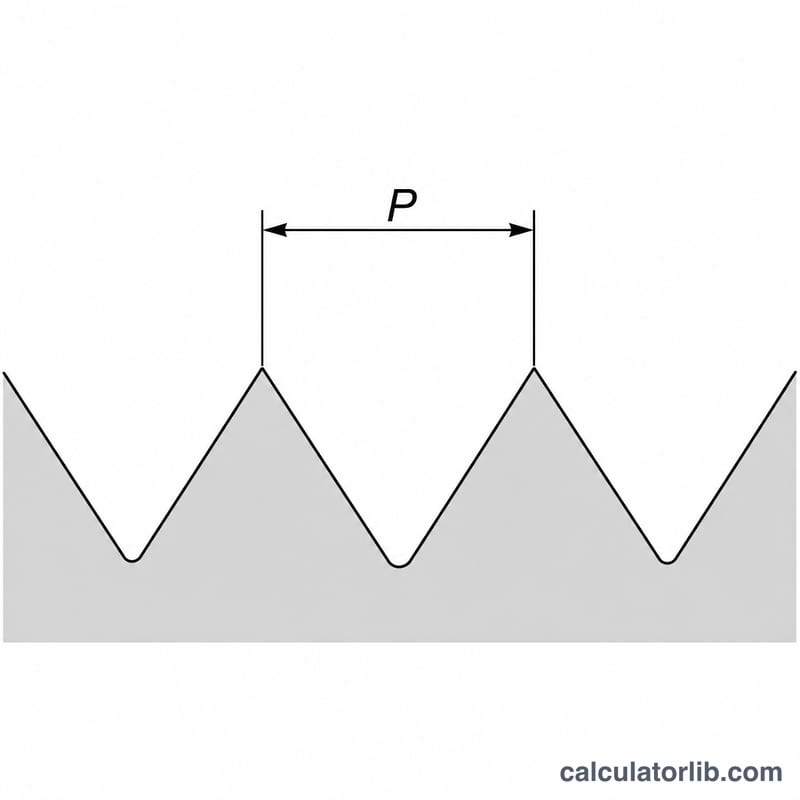
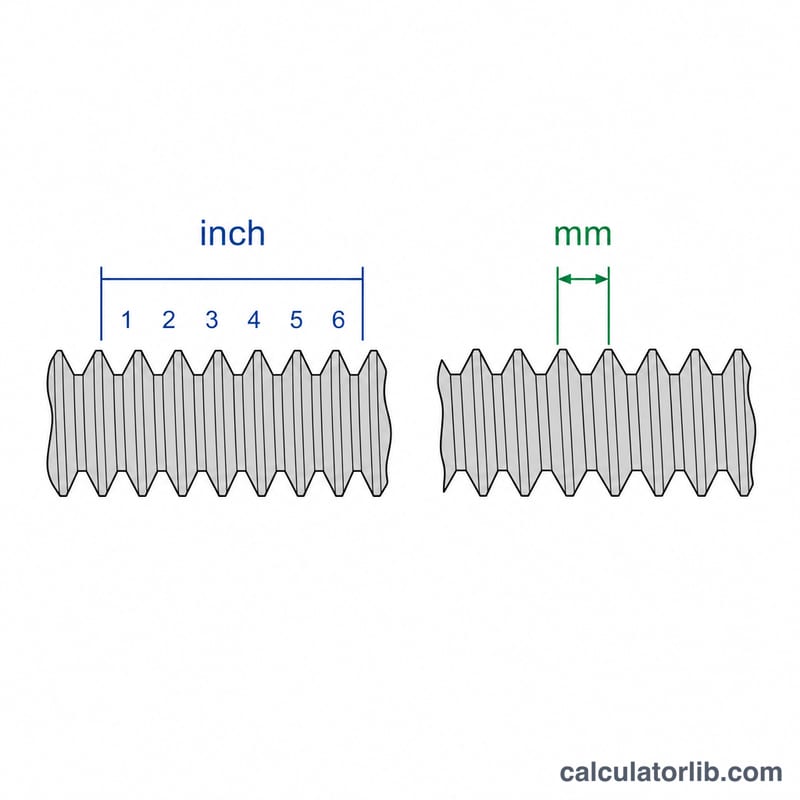
Thread pitch is the distance from one thread crest to the next, measured along the axis of a screw or bolt. Metric fasteners specify this distance directly in millimetres (e.g. M8×1.25 has a 1.25 mm pitch). Imperial fasteners instead state how many threads fit into one inch — the threads per inch (TPI). This calculator converts freely between the two systems so you can identify a fastener, machine a thread, or pick the correct tap and die.
How to Use It
Choose your standard. For an imperial bolt, select Imperial (TPI) and enter the threads-per-inch count (for example 20 for a 1/4-20 bolt). For a metric bolt, select Metric (threads/mm) and enter how many threads occur per millimetre. The tool returns the pitch in both millimetres and inches plus the equivalent TPI, making cross-standard comparison easy.
The Formula Explained
Pitch is simply the reciprocal of thread density. In metric terms, $$\text{Pitch (mm)} = \frac{1}{\text{threads-per-mm}}$$ In imperial terms, $$\text{Pitch (in)} = \frac{1}{\text{TPI}}$$ Because one inch equals 25.4 mm, the metric pitch of an imperial thread is $$\text{Pitch (mm)} = \frac{1}{\text{TPI}} \times 25.4$$
Worked Example
A 1/4-20 UNC bolt has 20 threads per inch. Pitch in inches $$= \frac{1}{20} = 0.05 \text{ in}$$ Converting to metric: $$0.05 \times 25.4 = 1.27 \text{ mm}$$ So each thread crest sits \(1.27\) mm from the next.
FAQ
Is pitch the same as lead? For a single-start thread, yes. For multi-start threads, \(\text{lead} = \text{pitch} \times \text{number of starts}\).
What is a coarse vs fine thread? Coarse threads have a larger pitch (fewer threads per unit length); fine threads have a smaller pitch and more threads.
Can I measure pitch with a ruler? Count the threads over a known length and divide; a thread pitch gauge is more accurate for small fasteners.