What It Is
A battery bank is a group of individual cells combined to store electrical energy for solar, RV, marine, or off-grid systems. This calculator estimates how much energy you can actually use from that bank based on how many cells you have, each cell voltage and capacity, and the depth of discharge (DoD) you allow. Because draining a battery to zero shortens its life, the usable capacity is always less than the nameplate total.
The Formula Explained
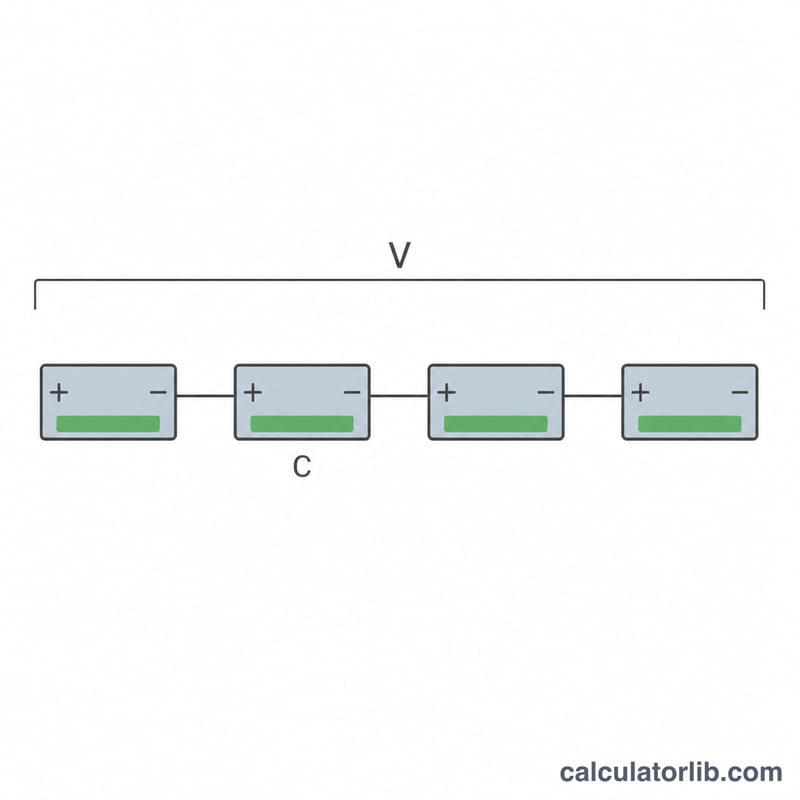
The total nominal stored energy is the number of cells \(N\) times cell voltage \(V\) times cell capacity \(C\). Multiplying by the DoD fraction gives the usable energy:
$$\text{Usable Wh} = N \times V \times C \times \frac{\text{DoD}}{100}$$Dividing the usable energy by the reference cell voltage yields usable charge in amp-hours:
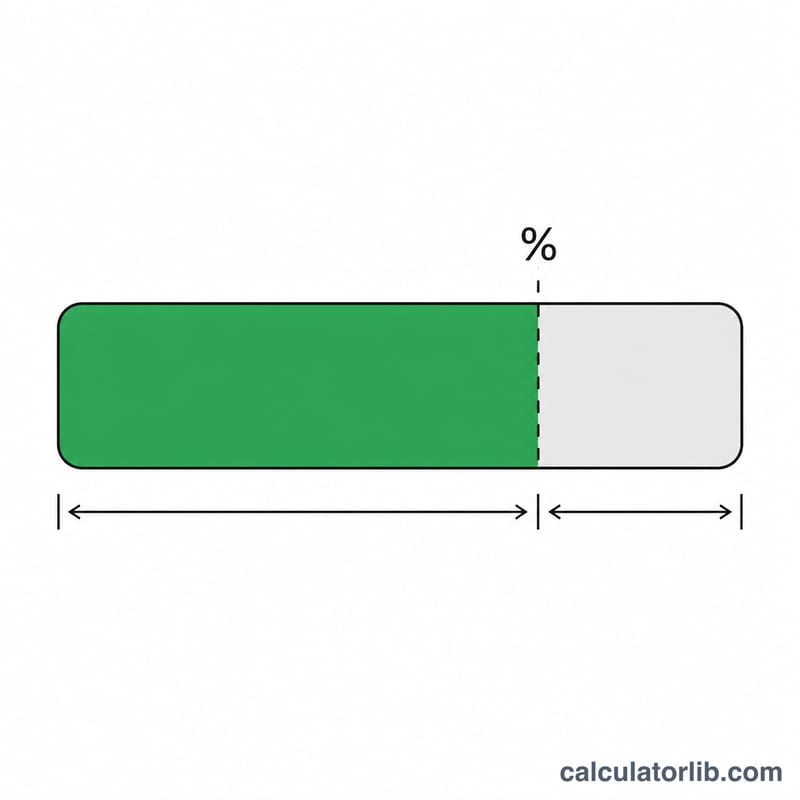
$$\text{Usable Ah} = N \times C \times \frac{\text{DoD}}{100}$$Here \(N\) = number of cells, \(V\) = volts per cell, \(C\) = amp-hours per cell, and \(\text{DoD}\) = depth of discharge in percent.
How To Use It
Enter the number of cells in your pack, the nominal voltage of each cell (for example 3.2 V for LiFePO4 or 2.0 V for lead-acid), the rated capacity of each cell in amp-hours, and the depth of discharge you plan to use. The calculator instantly returns usable watt-hours and amp-hours plus the total nominal energy.
Worked Example
Consider 16 LiFePO4 cells rated at 3.2 V and 100 Ah each, used to 80% DoD:
$$\text{Total} = 16 \times 3.2 \times 100 = 5120\,\text{Wh}$$$$\text{Usable Wh} = 5120 \times \frac{80}{100} = 4096\,\text{Wh}$$$$\text{Usable Ah} = 16 \times 100 \times \frac{80}{100} = 1280\,\text{Ah}$$So this bank delivers about 4096 Wh of usable energy.
FAQ
Why not use 100% DoD? Deep discharges accelerate wear. Lithium banks often allow 80-90%, while lead-acid is usually limited to 50%.
Does arrangement matter? Series and parallel wiring change the bank voltage and current split, but the total stored energy in watt-hours stays the same for the same cells.
What about efficiency losses? Real inverters and wiring lose a few percent, so treat the usable figure as an ideal upper bound.