What this calculator does
The Yarn Yardage by Weight Calculator estimates how many yards of yarn are left on a partial ball or skein. Instead of unwinding and measuring, you weigh the leftover yarn on a kitchen scale and compare it to the yardage and weight printed on the original ball band. Because yarn of the same type has a consistent length-per-weight ratio, this gives a reliable estimate of what remains for your next project.
The formula explained
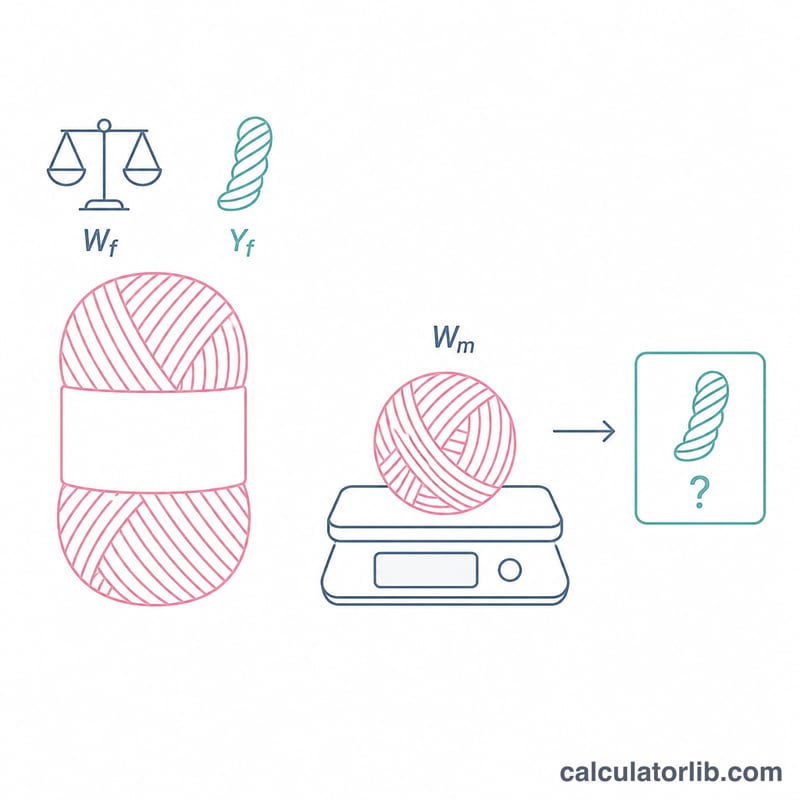
The estimate assumes the yarn density is uniform, so the remaining length scales directly with weight:
$$\text{Yardage} = W_m \times \frac{Y_f}{W_f}$$where \(W_m\) = measured weight of your leftover ball (g), \(Y_f\) = full skein yardage from the label (yd), and \(W_f\) = full skein weight from the label (g). The ratio \(\rho = \frac{Y_f}{W_f}\) is the yarn density in yards per gram.
How to use it
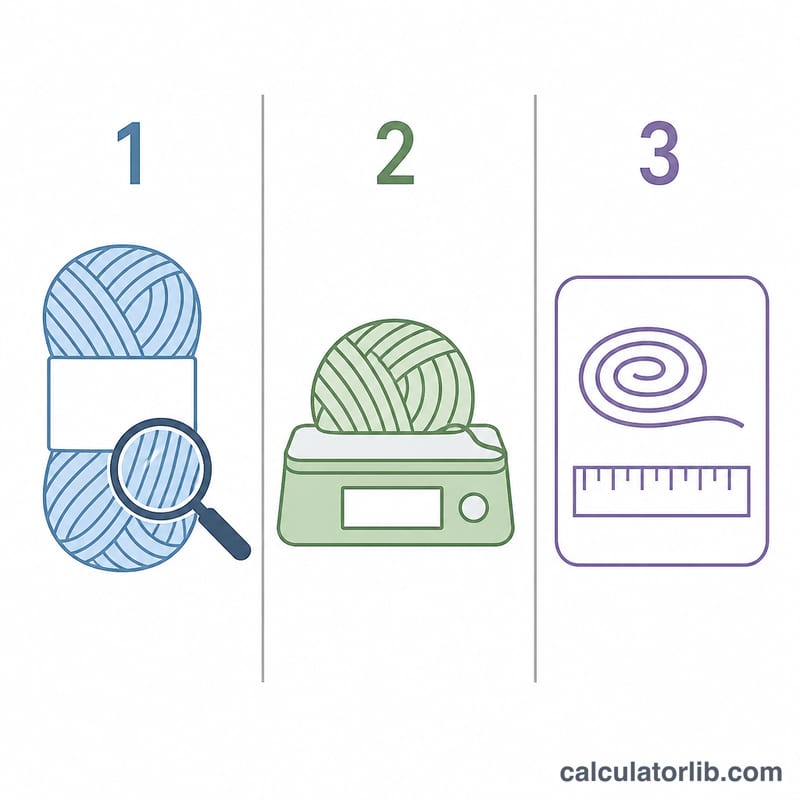
Find the ball band for your yarn and read off the total yardage and total weight. Weigh your remaining yarn in grams, enter all three numbers, and read the estimated yards. Keep the units consistent: if the label lists meters, either convert to yards first or treat the output as meters.
Worked example
Suppose a full skein lists \(220\) yd at \(100\) g, and your leftover ball weighs \(50\) g. The density is \(\rho = \frac{220}{100} = 2.2\) yd/g, so:
$$\text{Yardage} = 50 \times \frac{220}{100} = 110 \ \text{yd}$$You have roughly 110 yards left \(-\) enough to check against a pattern's requirements.
Typical Yardage per Weight by Yarn Weight Category
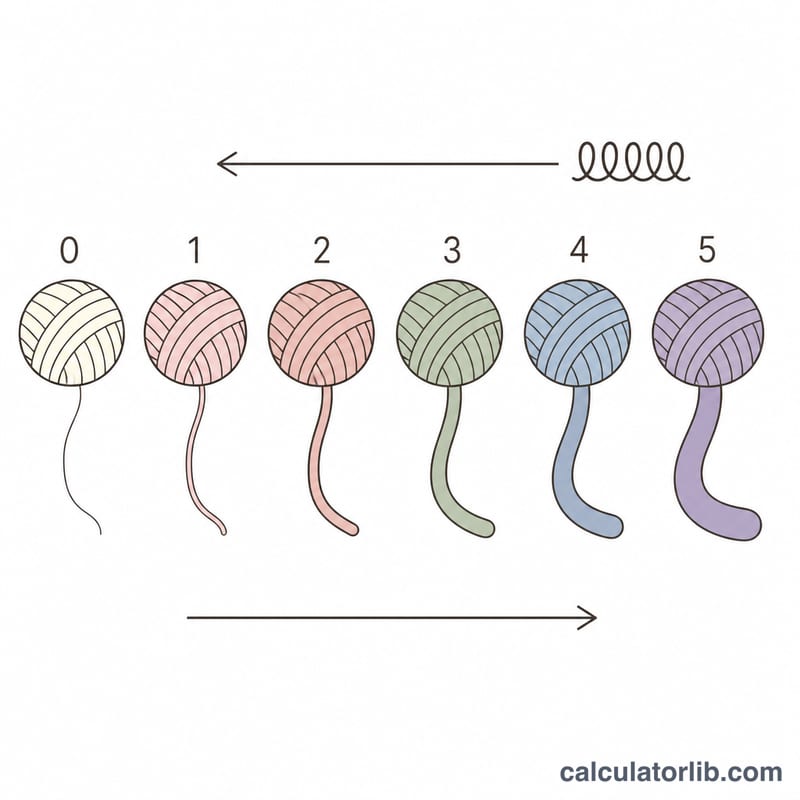
The table below lists the standard yarn weight categories defined by the Craft Yarn Council (a US-based industry group whose Standard Yarn Weight System is widely used on English-language labels). The yards-per-100 g figures are typical approximate ranges only — actual length per weight varies considerably with fiber content (wool, cotton, acrylic, silk, blends), ply, and how tightly the yarn is spun, so always prefer your own skein's printed yardage and weight when using the calculator.
| CYC category | Common names | Typical yards per 100 g | Approx. yards per gram |
|---|---|---|---|
| 0 — Lace | Lace, cobweb, light fingering | ~600–1000+ | ~6–10 |
| 1 — Super Fine | Fingering, sock, baby | ~380–460 | ~3.8–4.6 |
| 2 — Fine | Sport | ~300–350 | ~3.0–3.5 |
| 3 — Light | DK (double knitting) | ~230–260 | ~2.3–2.6 |
| 4 — Medium | Worsted | ~190–220 | ~1.9–2.2 |
| 4 — Medium | Aran | ~150–180 | ~1.5–1.8 |
| 5 — Bulky | Bulky, chunky | ~100–130 | ~1.0–1.3 |
| 6 — Super Bulky | Super bulky, roving | ~50–100 | ~0.5–1.0 |
Note that the Craft Yarn Council places both Worsted and Aran in category 4 (Medium); they are shown separately here because Aran runs noticeably thicker and therefore shorter per 100 g. Use the yards-per-gram column as a sanity check: after weighing a partial ball, multiply its weight in grams by the appropriate figure to get a rough expected yardage, then compare it with the calculator's result based on your skein's actual label data.
FAQ
Is the estimate exact? No. It assumes even density and ignores dye, moisture, and any attached labels or ties, but it is accurate to within a few percent for most yarns.
Should I subtract packaging? Yes \(-\) remove paper bands, tags, and ties before weighing for the best result.
Can I use grams and meters? Yes. Enter the label's length value; the output uses the same length unit you provide.