What this calculator does
The Cushion Fabric Yardage Calculator estimates how much fabric you must buy to cover one or many cushions. Enter the finished cushion size, thickness, quantity, seam allowance, usable fabric width and a waste percentage, and it lays out the top and bottom panels (plus a boxing strip for box cushions) across the width of the bolt and returns the length of fabric required in yards and metres.
How to use it
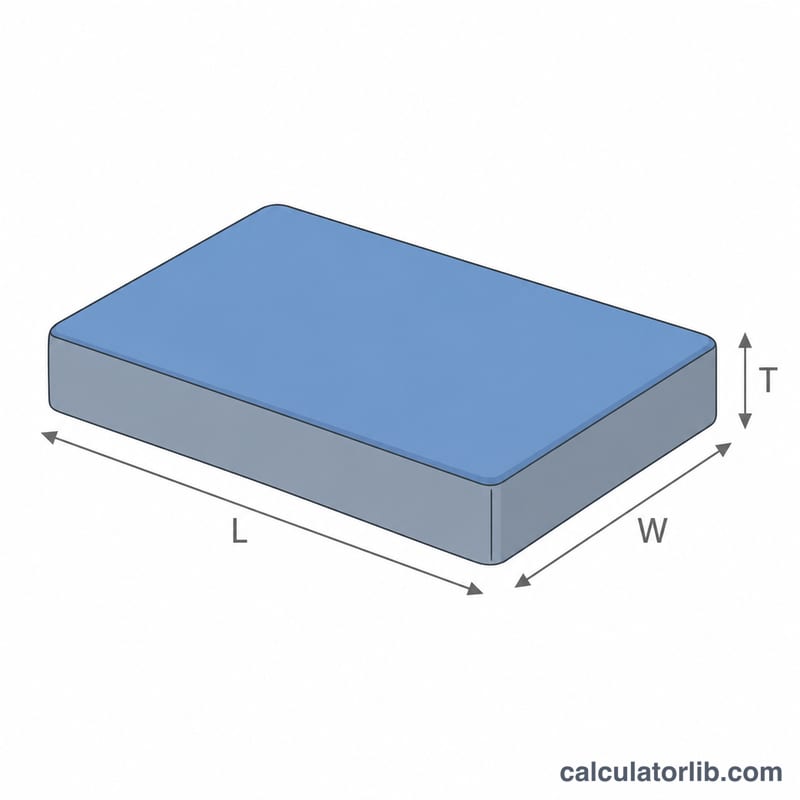
Choose box cushion if your cushion has a boxing strip around the sides, or knife-edge pillow if it is just a front and a back. Measure the insert length, width and thickness in inches. Add your seam allowance per side (0.5 inch is common), the fabric width (54 inches for most upholstery fabric, 44-45 inches for quilting cotton) and a waste allowance of 5-15% for pattern matching or directional prints.
The formula explained
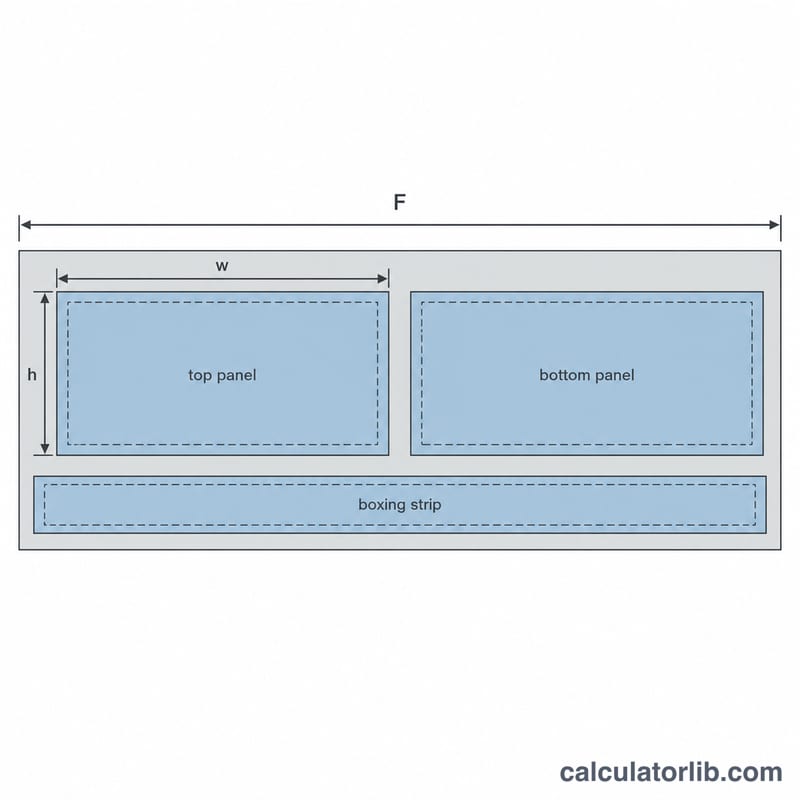
Each panel is cut at \(L + 2a\) by \(W + 2a\), where \(a\) is the seam allowance. The number of panels that fit across the fabric width \(F\) is \(\lfloor F/(L+2a) \rfloor\), and \(n\) cushions need \(2n\) panels.
$$R_p = \left\lceil \frac{2n}{\lfloor F/(L+2a) \rfloor} \right\rceil$$The boxing strip has a length of \(2(L+W)+2a\) per cushion and a height of \(T+2a\). Strips are joined end to end, so the rows needed are \(R_b = \lceil n(2(L+W)+2a)/F \rceil\). The total length is converted to yards by dividing by 36, and rounded up to the next eighth of a yard.
Worked example
Four 18 by 18 inch cushions, 4 inches thick, with 0.5 inch seams on 54 inch fabric and 10% waste. Panels are 19 by 19 inches, so two fit across, giving \(R_p = 4\) rows and 76 inches. The boxing strip is 73 inches long per cushion, so \(R_b = \lceil 292/54 \rceil = 6\) rows of 5 inches, or 30 inches.
$$\frac{(76 + 30) \times 1.10}{36} = 3.24\,\text{yd} \rightarrow 3.25\,\text{yd}$$Typical Seam Allowances, Fabric Widths and Waste Percentages
These are common starting values for home-sewn cushions and pillows. Always check your pattern, fabric bolt and sewing method, because individual projects vary.
| Input | Typical value | Notes |
|---|---|---|
| Seam allowance (home sewing) | 0.5 in (1.27 cm) | Standard for pillow covers and simple box cushions |
| Seam allowance (upholstery) | 0.625–1 in (1.6–2.5 cm) | Gives stronger seams on heavy fabric and high-wear seats |
| Fabric width: quilting cotton | 44–45 in | Usable width is slightly less after trimming selvedges |
| Fabric width: upholstery | 54 in | A common bolt width for upholstery-weight fabric |
| Fabric width: decor / linen | 58–60 in | Wider widths often fit more panels per row |
| Waste: solid fabric | 5% | No pattern matching needed |
| Waste: small repeat pattern | 10–15% | Allows for matching the repeat |
| Waste: large or directional pattern | 15–25% | Motifs must be aligned and face the same way |
| Box cushion thickness | 2–5 in | Thin seat pads to thick sofa or bench cushions |
The calculator adds the seam allowance to every side of each panel. A finished edge of length \(L\) therefore becomes \(L + 2S\) in the cut piece.
Yardage Comparison for Common Cushion Setups
The table uses the article's formula with a 0.5 in seam allowance and 5% waste. Results are rounded up to the next 1/8 yard. Knife-edge pillows use two panels each and no boxing strip. Box cushions use a top and bottom panel plus a boxing strip around the perimeter.
| Setup | 44 in fabric | 54 in fabric |
|---|---|---|
| 1 knife-edge pillow, 16×16 in | 0.5 yd | 0.5 yd |
| 2 knife-edge pillows, 20×20 in | 1.25 yd | 1.25 yd |
| 4 box cushions, 18×18×4 in | 3.25 yd | 3.125 yd |
| 3 box cushions, 22×22×5 in | 5.25 yd | 3 yd |
How the 4 box cushions on 44 in fabric work out
Panel size: \(w_p = h_p = 18 + 2(0.5) = 19\) in. Two panels fit across 44 in, since \(\lfloor 44/19 \rfloor = 2\). Panel rows: \(R_p = \lceil 8/2 \rceil = 4\).
Boxing strip: \(L_b = 2(18+18) + 2(0.5) = 73\) in and \(h_b = 4 + 1 = 5\) in. Strip rows: \(R_b = \lceil 4 \cdot 73 / 44 \rceil = \lceil 6.64 \rceil = 7\).
$$Y = \frac{4 \cdot 19 + 7 \cdot 5}{36}\left(1 + \frac{5}{100}\right) = \frac{111}{36} \cdot 1.05 \approx 3.24 \text{ yd}$$
Rounded up to the next 1/8 yard, this is 3.25 yd.
Why the 3 large cushions change so much
For 22×22×5 in cushions the panels are 23 in wide. Only one fits across 44 in, but two fit across 54 in. That halves the number of panel rows, so the wider fabric saves a lot of yardage. Check this fit whenever you compare fabrics.
Buying and Cutting Tips
- Round up. Buy to the next 1/8 or 1/4 yard. Cutting counters usually sell in those increments, and a small surplus covers cutting errors.
- Add for patterns and dye lots. Use a higher waste percentage for pattern repeats or directional prints. Buy all the fabric for a project at once, because a later purchase may come from a different dye lot and not match.
- Pre-wash if the cushion cover will be laundered. Many fabrics shrink, especially cotton and linen. Wash and dry them the way you will care for the finished cover, and allow extra yardage if the fabric shrinks noticeably.
- Check the usable width. Selvedges and printed text along the edges are often unusable, so the true width can be an inch or two less than the bolt label. If it is, enter the smaller width in the calculator, as it can change how many panels fit across.
- Cut the largest panels first. Lay out the top and bottom panels, then fit boxing strips and smaller pieces around them. For directional or patterned fabric, keep every piece facing the same way.
- Plan the zipper or closure. Boxing strips for zippered covers may need extra length or a separate piece, so allow a little more fabric if your design needs it.
These are general guidelines. Your pattern and fabric supplier's advice take priority.
FAQ
Does this include piping or ties?
No. Add extra yardage for piping, welting, ties or skirts separately.
What if my fabric has a directional pattern?
Increase the waste percentage to 15-25% so every panel can face the same way and patterns can be matched.
Why is the result larger than simple area math?
Fabric is bought in full-width lengths, so leftover space beside the panels cannot always be used. This layout-based method reflects what you actually have to buy.