What This Calculator Does
The Curtain Fabric Yardage Calculator estimates how much fabric you need to sew curtains for a given window. It accounts for the extra width that gives curtains their gathered, full look, and the extra length needed for headers and hems. The result is expressed in yards so you can buy the right amount at the fabric store without over- or under-purchasing.
How To Use It
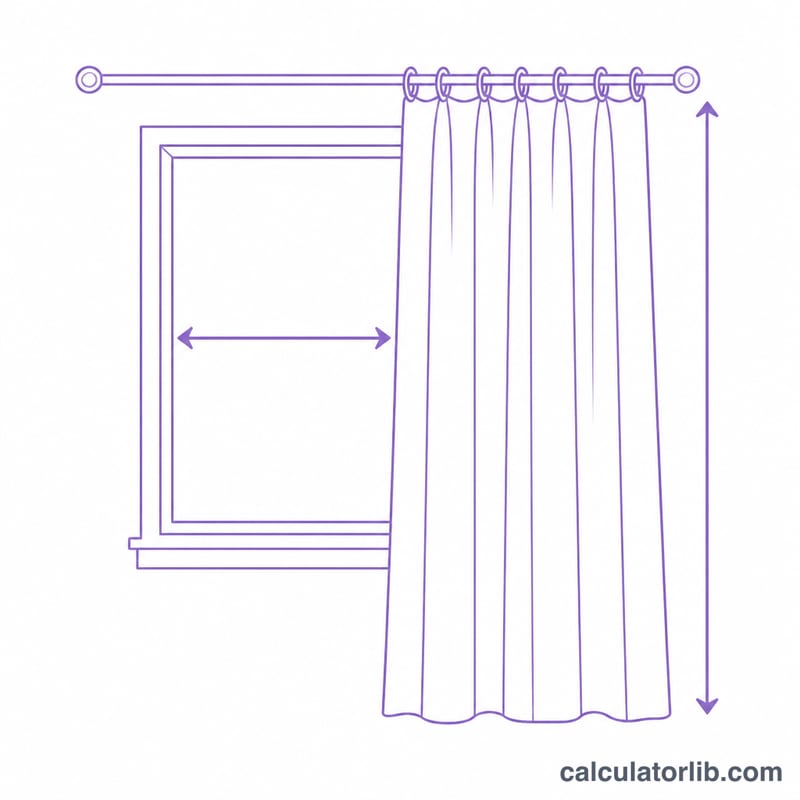
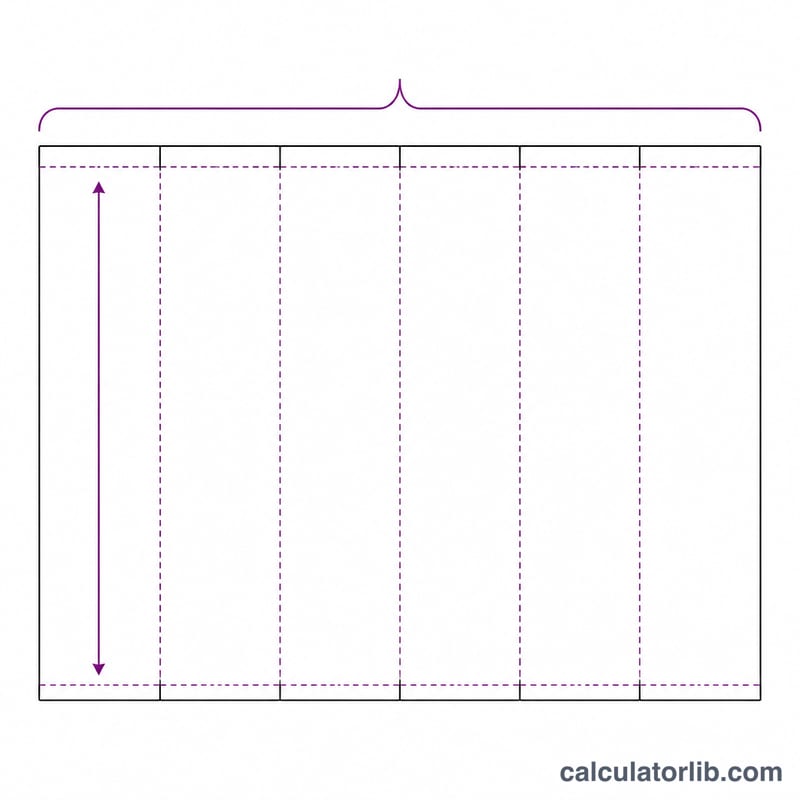
Enter the window width \(W\) and the finished curtain length \(L\) in inches. Choose a fullness ratio \(F\) (about 2 for standard gathered panels, 2.5–3 for a luxurious look). Enter the fabric width \(B\) from the bolt (often 54 in) and the total header plus hem allowance \(H\) you add to each cut. The calculator returns the number of fabric widths to cut and the total yardage.
The Formula
First find the flat gathered width, divide by the bolt width and round up to whole cuts, then multiply by the cut length and convert inches to yards:
$$\text{Yardage} = \frac{ \lceil (W \times F)/B \rceil \times (L + H)}{36}$$Here \(W\) = window width, \(F\) = fullness ratio, \(B\) = fabric width, \(L\) = finished length, and \(H\) = header and hem allowance, all in inches.
Worked Example
Suppose \(W = 72\) in, \(F = 2\), \(B = 54\) in, \(L = 84\) in, and \(H = 16\) in.
$$W \times F = 72 \times 2 = 144\,\text{in}$$$$\left\lceil \frac{144}{54} \right\rceil = \lceil 2.67 \rceil = 3\ \text{cuts}$$$$\text{Yardage} = \frac{3 \times (84 + 16)}{36} = \frac{300}{36} \approx 8.33\,\text{yd}$$You would buy about 8.5 yards to be safe.
Typical Fullness and Allowances by Heading Style
Fullness (F) is the finished curtain width divided by the window or track width. The total allowance H is the header allowance plus the bottom hem allowance. You add H to the finished length to get the cut length of each width of fabric: \(L_{cut} = L + H\).
| Heading style | Typical fullness F | Header allowance | Bottom hem allowance | Typical total H |
|---|---|---|---|---|
| Flat panel (no gathering) | 1–1.5 | 3–4 in | 8 in (4 in double-turned) | 11–12 in |
| Ripplefold / wave (track system) | about 1.6–2 (set by carrier spacing) | 3–4 in (heading tape) | 8 in (4 in double-turned) | 11–12 in |
| Tab top | 1.5–2 | 3–4 in (facing) | 8 in (4 in double-turned) | 11–12 in |
| Grommet / eyelet | 1.5–2 | 6–8 in (doubled, interfaced header) | 8 in (4 in double-turned) | 14–16 in |
| Rod pocket | 2–2.5 | 6–8 in (pocket plus ruffle heading) | 8 in (4 in double-turned) | 14–16 in |
| Pinch pleat | 2–2.5 | 8 in (4 in buckram, double-turned) | 8 in (4 in double-turned) | 16 in |
| Pencil pleat | 2.5–3 | 3–6 in (depends on tape depth) | 8 in (4 in double-turned) | 11–14 in |
These are common workroom ranges, not fixed standards. Pattern instructions, heading tape makers and track systems often give their own figures, and when they do, use theirs. For sheers, people often use a higher fullness (around 2.5–3), and some sewists use a smaller 3 in double hem (6 in total) on lightweight fabric.
Yardage for Common Window Sizes
Every row uses $$\text{Yardage} = \frac{\lceil W \times F / B \rceil \times (L + H)}{36}$$ with H = 16 in. W is the window width, F is the fullness, B is the fabric (bolt) width and L is the finished length, all in inches. You round the number of cuts up to a whole width because you can't buy part of a width.
| Window W | Length L | Fullness F | Fabric B | W × F ÷ B | Cuts N | Cut length L + H | Total inches | Yards |
|---|---|---|---|---|---|---|---|---|
| 36 in | 63 in | 2 | 54 in | 72 ÷ 54 = 1.33 | 2 | 79 in | 158 in | 4.39 yd |
| 48 in | 84 in | 2 | 54 in | 96 ÷ 54 = 1.78 | 2 | 100 in | 200 in | 5.56 yd |
| 72 in | 84 in | 2.5 | 54 in | 180 ÷ 54 = 3.33 | 4 | 100 in | 400 in | 11.11 yd |
| 96 in | 95 in | 2 | 54 in | 192 ÷ 54 = 3.56 | 4 | 111 in | 444 in | 12.33 yd |
| 72 in | 84 in | 2 | 118 in (wide sheer) | 144 ÷ 118 = 1.22 | 2 | 100 in | 200 in | 5.56 yd |
Here is how the third row works out: \(\lceil 72 \times 2.5 / 54 \rceil = \lceil 3.33 \rceil = 4\) cuts, then \(4 \times (84 + 16) = 400\) in, and \(400 / 36 = 11.11\) yd. The 48 in window and the 72 in window on 118 in sheer both need 200 in of fabric. The wide sheer covers 1.5 times the window width with the same two cuts.
Practical Buying Tips
- Adjust the cut length for pattern repeats. On patterned fabric, every cut has to start at the same point in the pattern. Round \(L + H\) up to the next whole multiple of the vertical repeat, then multiply by the number of cuts. Take the 72 in window from the table: 84 in length, F = 2.5, so 4 cuts. With a 27 in repeat, \(100 / 27 = 3.70\), which rounds up to 4 repeats. Each cut is then \(4 \times 27 = 108\) in, and the total is \(4 \times 108 / 36 = 12\) yd instead of 11.11 yd. Many sewists also buy one extra repeat so they can choose where the pattern starts.
- Allow for shrinkage. Cotton, linen and other natural fibres can shrink. Either prewash the fabric before cutting, or add about 5–10% to the yardage if you plan to wash the curtains later.
- Buy everything from one dye lot. The colour can change slightly from one production batch to the next. Buy the full yardage at once, from the same bolt or dye lot, so the panels match when they hang side by side.
- Round up to the store's cutting increment. Many shops cut in 1/4 or 1/8 yd steps, so round your result up. For example, 4.39 yd becomes 4.5 yd, and 5.56 yd becomes 5.75 yd at a 1/4 yd increment.
- Work out lining separately. Use the same formula with the lining's own bolt width. Lining is often a different width from the face fabric, and it usually needs no pattern-repeat adjustment. Lining is often cut slightly narrower and shorter than the face fabric, so follow your pattern's lining allowances.
- Measure twice. Measure the width of the rod or track, including any overlap and returns, not just the window glass. Check the finished length from the top of the heading to the floor or sill, at several points along the window.
FAQ
What fullness ratio should I use? Use 2 for a standard gathered curtain, 1.5 for a flatter look, and 2.5–3 for very full drapes.
Does this include pattern repeat? No. For patterned fabric add one pattern repeat per cut so motifs line up across panels.
Should I round up when buying? Yes. Fabric is sold in fixed increments, so round the yardage up and add a little extra for shrinkage and mistakes.