What is the Aircraft Fuel Burn Calculator?
The Aircraft Fuel Burn Calculator estimates how much fuel an aircraft consumes on a given flight. Pilots, dispatchers, and aviation students use fuel burn figures to plan payload, compute reserves, and estimate operating cost. By combining the fuel flow of a single engine with the number of engines and the flight time, you get both an instantaneous consumption rate and the total fuel required.
The formula explained
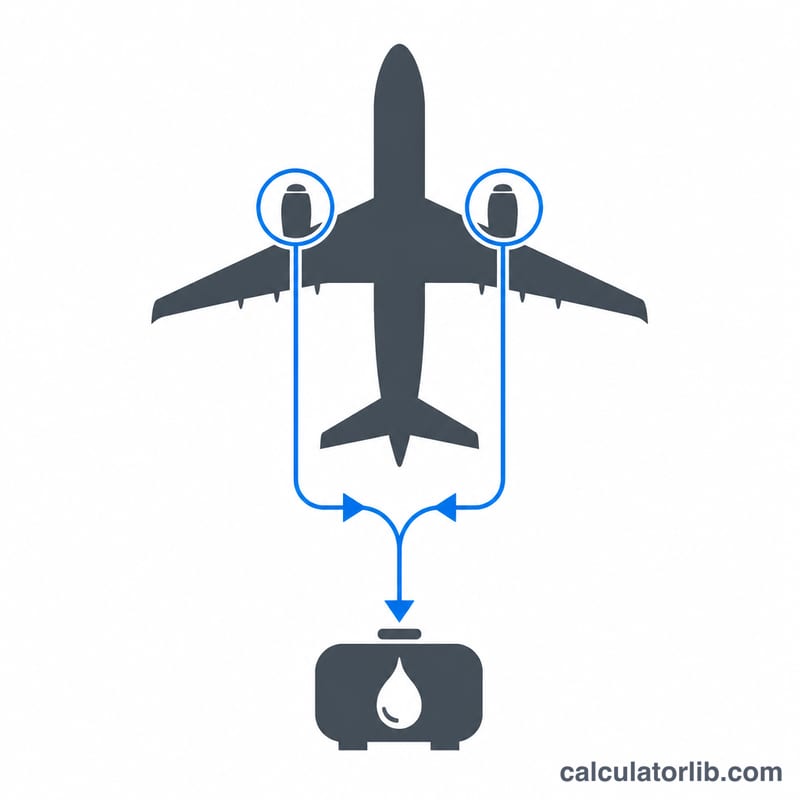
The total consumption rate is the per-engine fuel flow scaled by how many engines the aircraft has, and the total burn is that rate multiplied by flight time:
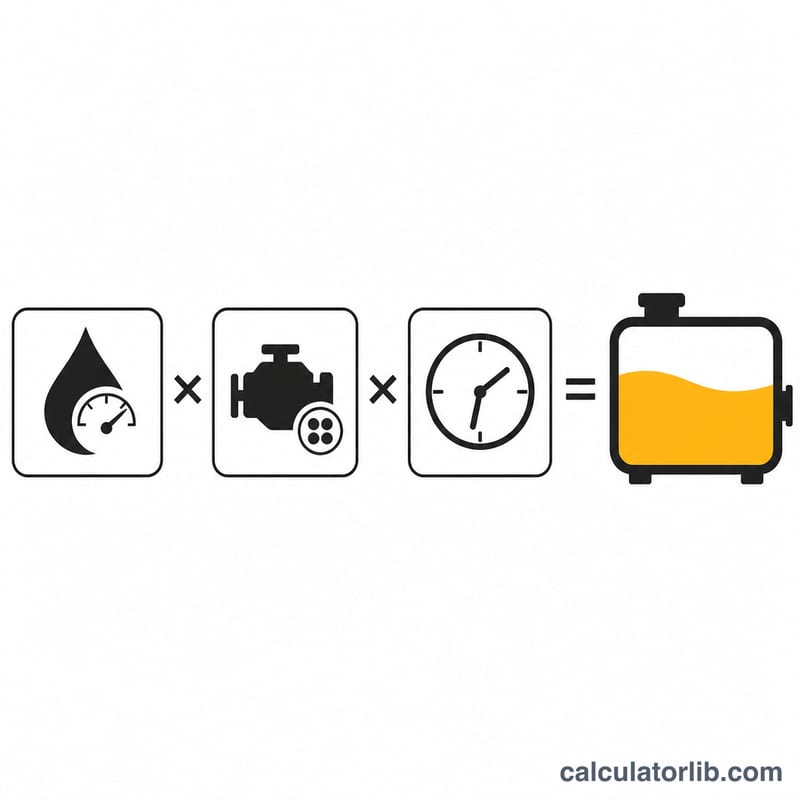
$$\text{Burn} = \text{Flow}_{\text{eng}} \times N_{\text{eng}} \times t$$where \(\text{Flow}_{\text{eng}}\) = fuel flow per engine in kg/hr, \(N_{\text{eng}}\) = number of engines, and \(t\) = flight time in hours. The intermediate total flow rate is \(\dot{m}_{\text{total}} = \text{Flow}_{\text{eng}} \times N_{\text{eng}}\).
How to use it
Enter the fuel flow for one engine, the number of engines, and the planned flight time. The calculator returns the total flow rate in kg/hr and the total fuel burn in kilograms. Use cruise fuel flow for a quick block estimate, and remember to add taxi, climb, and reserve fuel for a real flight plan.
Worked example
A twin-engine jet burns \(600\) kg/hr per engine on a \(5\)-hour flight:
$$\dot{m}_{\text{total}} = 600 \times 2 = 1200\,\text{kg/hr}$$$$\text{Burn} = 1200 \times 5 = 6000\,\text{kg}$$The aircraft needs roughly \(6000\) kg of trip fuel before reserves.
Typical Per-Engine Fuel Flow by Aircraft
The values below are approximate cruise fuel flows per engine, expressed in kilograms per hour (kg/hr), along with the typical engine count. They are intended as planning ballparks only: actual fuel flow varies significantly with aircraft weight, altitude, temperature, speed, and phase of flight (takeoff and climb burn far more per hour than cruise, while descent burns less). Always use manufacturer performance data or your flight management system for real planning.
| Aircraft | Class | Typical cruise flow (kg/hr per engine) | Engines |
|---|---|---|---|
| Cessna 172 | Light piston single | ~30 | 1 |
| Beechcraft King Air (B200) | Twin turboprop | ~150 | 2 |
| Airbus A320 | Narrowbody jet | ~1,150 | 2 |
| Boeing 737-800 | Narrowbody jet | ~1,200 | 2 |
| Boeing 777-300ER | Widebody twin | ~3,400 | 2 |
| Airbus A380 | Widebody quad | ~2,700 | 4 |
To turn a per-engine flow into a total burn, multiply by the engine count and the flight time using the core relationship \(\text{Burn} = \text{Flow}_{\text{eng}} \times N_{\text{eng}} \times t\). For example, an A320 cruising at about 1,150 kg/hr per engine with 2 engines for 2 hours burns \(1150 \times 2 \times 2 = 4600\) kg, or 4,600 kg of fuel for the cruise segment.
Fuel Mass and Volume Conversions
Flight planning is normally done in mass (kilograms or pounds) because an aircraft's performance depends on weight, not volume. Fuel is often loaded and priced in volume (litres or US gallons), so converting between the two requires the fuel's density. The figures below assume a nominal Jet A / Jet A-1 density of about \(0.80\ \text{kg/L}\).
| From | Approximate equivalent |
|---|---|
| 1 kilogram (kg) | 2.20462 pounds (lb) |
| 1 pound (lb) | 0.453592 kg |
| 1 kg of fuel (@ 0.80 kg/L) | ≈ 1.25 litres ≈ 0.33 US gallons |
| 1 litre of fuel (@ 0.80 kg/L) | ≈ 0.80 kg ≈ 1.76 lb |
| 1 US gallon of fuel (@ 0.80 kg/L) | ≈ 3.03 kg ≈ 6.68 lb ≈ 3.785 litres |
The mass-to-volume figures follow directly from density. At \(0.80\ \text{kg/L}\):
$$1\ \text{kg} \times \frac{1\ \text{L}}{0.80\ \text{kg}} = 1.25\ \text{L}, \qquad 1.25\ \text{L} \times \frac{1\ \text{US gal}}{3.785\ \text{L}} \approx 0.33\ \text{US gal}$$
Important: jet fuel density is not constant. It typically ranges from about \(0.775\) to \(0.840\ \text{kg/L}\) depending mainly on temperature (fuel expands when warm and contracts when cold) and the specific batch. This can shift a volume-to-mass conversion by several percent, which matters for accurate loading. When precision is required, use the actual measured density for the fuel being uplifted rather than the 0.80 kg/L nominal value used here.
FAQ
Does this include reserve fuel? No. It computes trip burn only; add taxi, contingency, alternate, and final reserves separately.
Can I use pounds instead of kilograms? Yes. The math is unit-agnostic, so if you enter fuel flow in lbs/hr the result is in pounds.
Why per-engine flow? Engine gauges usually display per-engine fuel flow, so multiplying by engine count matches cockpit readings.