What Is the Crop Yield Calculator?
The Crop Yield Calculator estimates the total harvest you can expect from a field by combining how much land you have planted with the productivity of that land. It is a fast planning tool for farmers, agronomists, and agricultural students who need a quick production forecast without spreadsheets. The result is expressed in tonnes, using hectares for area and tonnes per hectare for the yield rate.
The Formula Explained
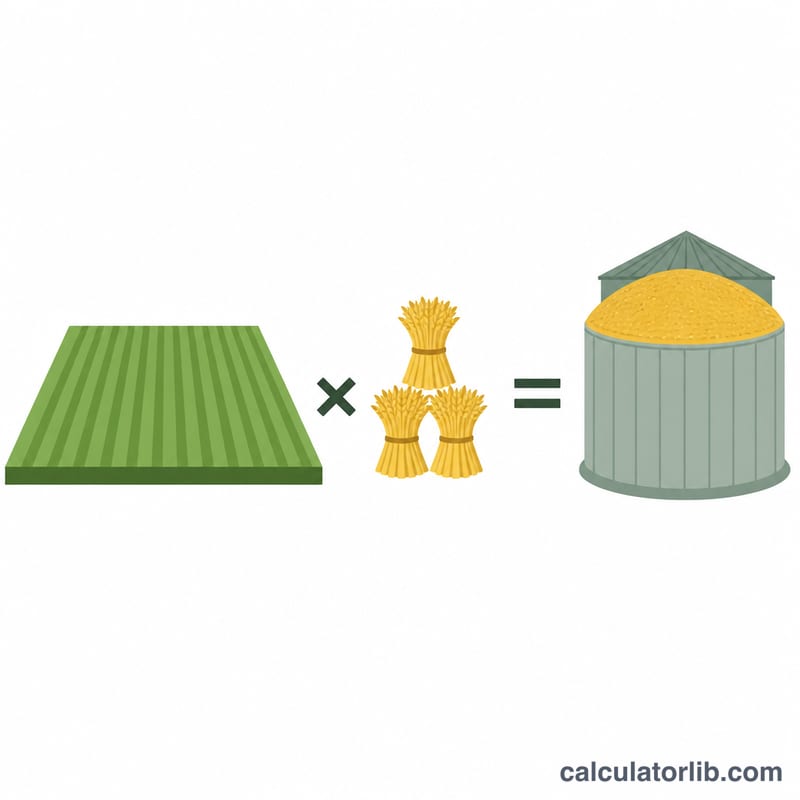
The calculation is a simple product of area and yield rate:
$$Y = A \times R$$where \(Y\) = total yield in tonnes, \(A\) = planted area in hectares, and \(R\) = expected yield rate in tonnes per hectare. Because the relationship is linear, doubling either the area or the yield rate doubles the total output. If you instead know your total production and want the productivity, rearrange to \(R = \tfrac{Y}{A}\).
How to Use It
Enter the planted area of your field in hectares and the expected yield per hectare for your crop and variety. The yield rate usually comes from historical farm records, seed supplier guidance, or regional agronomy data. Press calculate to see the projected total harvest, which you can then use to plan storage, transport, and sales.
Worked Example
Suppose you plant \(100\) hectares of wheat and expect \(6\) tonnes per hectare. The total yield is:
$$Y = 100 \times 6 = 600\,\text{tonnes}$$If your market price were $250 per tonne, that harvest would be worth $150,000 before costs.

Typical Yield Rates by Crop
The table below lists indicative yield rates for common field crops, expressed in tonnes per hectare (t/ha). These are broad global/regional averages drawn from international agricultural statistics such as FAOSTAT (Food and Agriculture Organization of the United Nations); actual yields vary widely with climate, soil, variety, irrigation and management. Use them only as a starting estimate for the Yield (t/ha) field, and replace them with your own local farm records or national agricultural statistics whenever possible.
| Crop | Typical yield range (t/ha) | Notes |
|---|---|---|
| Wheat | 2 – 8 | Global average roughly 3–4 t/ha; higher under irrigation. |
| Maize / Corn (grain) | 3 – 11 | High-input irrigated systems reach the upper range. |
| Rice (paddy) | 3 – 7 | Reported as rough/paddy rice, not milled. |
| Soybeans | 2 – 4 | Global average close to 2.5–3 t/ha. |
| Barley | 2 – 6 | Feed and malting varieties differ. |
| Potatoes | 15 – 45 | Fresh tuber weight; very high in intensive systems. |
| Sugarcane | 50 – 100 | Fresh cane weight; strongly climate-dependent. |
Important: These figures are indicative averages, not guarantees for any specific field. Crop statistics also differ by moisture basis and whether they report grain, fresh, or dry weight, so always confirm the basis of any local figure before using it.
Unit Conversions for Area and Yield
The calculator multiplies Planted Area (ha) by Yield (t/ha), so both inputs must be in hectares and tonnes per hectare. Use the conversions below to bring other units into that consistent form.
Area
| 1 hectare (ha) | Equivalent |
|---|---|
| Square metres | 10,000 m² |
| Acres | 2.4711 acres |
So 1 acre = 0.4047 ha, and 1 m² = 0.0001 ha.
Mass and yield
| Quantity | Equivalent |
|---|---|
| 1 tonne (metric) | 1,000 kg |
| 1 bushel of wheat or soybeans | ≈ 27.2 kg (60 lb) |
| 1 bushel of maize/corn or sorghum | ≈ 25.4 kg (56 lb) |
| 1 bushel of barley | ≈ 21.8 kg (48 lb) |
The bushel is a US customary volume-based unit; the kilogram-per-bushel figures above are the standard US crop weights used by the USDA, and they differ from historical Imperial bushels used elsewhere. Report your own data in tonnes and hectares to avoid ambiguity.
Converting a yield rate: t/ha ↔ bushels/acre
Because 1 ha = 2.4711 acres and 1 t = 1,000 kg, a yield in tonnes per hectare converts to US bushels per acre with:
$$\text{bu/acre} = \frac{\text{t/ha} \times 1000}{2.4711 \times (\text{kg per bushel})}$$
Worked example for wheat (27.2 kg/bushel) at 3 t/ha:
$$\frac{3 \times 1000}{2.4711 \times 27.2} = \frac{3000}{67.21} \approx 44.6\ \text{bu/acre}$$
To go the other way, rearrange to \( \text{t/ha} = \dfrac{\text{bu/acre} \times 2.4711 \times (\text{kg per bushel})}{1000} \). Common quick factors: for wheat/soybeans 1 t/ha ≈ 14.87 bu/acre, and for maize/corn 1 t/ha ≈ 15.93 bu/acre.
Frequently Asked Questions
Can I use different units? Yes, as long as they are consistent. If you enter area in acres and yield in tonnes per acre, the result is still tonnes.
Does this account for losses? No. It gives gross expected yield. To estimate net yield, reduce the yield rate by your expected loss percentage before entering it.
Where do I get the yield rate? Use your own past field data when possible, or published averages for your crop and region as a starting point.