What is the compost C:N ratio?
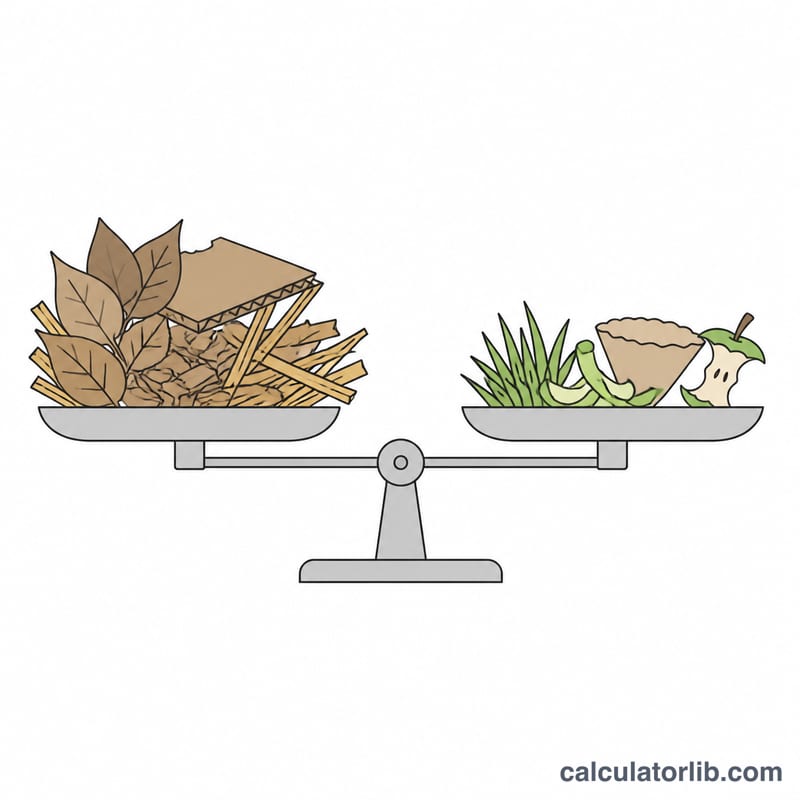
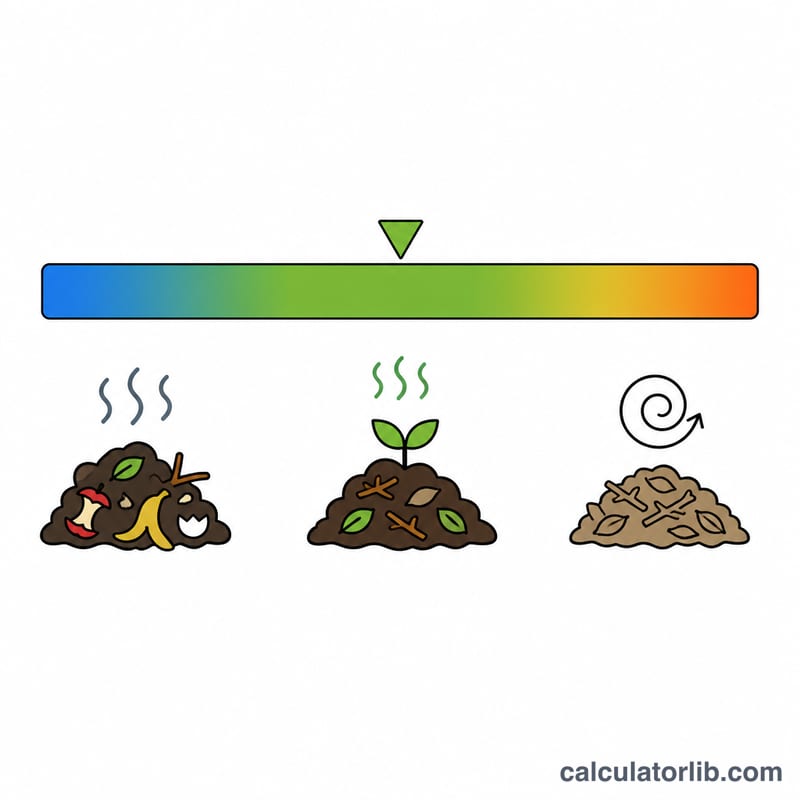
The carbon-to-nitrogen (C:N) ratio compares how much carbon your compost pile contains relative to nitrogen. Microbes use carbon for energy and nitrogen to build proteins, so the balance between the two controls how quickly and cleanly organic matter breaks down. A ratio near \(30:1\) is widely regarded as ideal: enough carbon to fuel decomposition without an excess that slows the pile, and enough nitrogen to keep microbes active without producing ammonia odors.
The formula
The overall ratio is the total carbon mass divided by the total nitrogen mass, summed over every ingredient \(i\):
$$\text{C:N} = \frac{\sum (m_i \times C_i)}{\sum (m_i \times N_i)}$$Here \(m_i\) = mass of ingredient \(i\) in kg, \(C_i\) = its carbon fraction, and \(N_i\) = its nitrogen fraction. Because the calculator takes carbon and nitrogen as percentages, each is divided by 100 before use, e.g. \(C_i = \tfrac{\text{carbon \%}}{100}\).
How to use it
Enter the mass of each ingredient and its carbon and nitrogen content as a percentage of that mass. "Browns" such as dry leaves, straw, and cardboard are carbon-rich; "greens" such as grass clippings, food scraps, and manure are nitrogen-rich. Leave the second ingredient at zero if you only want to check one material.
Worked example
Mix \(10\,\text{kg}\) of dry leaves (50% carbon, 1% nitrogen) with \(5\,\text{kg}\) of grass clippings (45% carbon, 3% nitrogen). The carbon and nitrogen masses are:
$$\text{C} = 10 \times 0.50 + 5 \times 0.45 = 7.25\,\text{kg}$$$$\text{N} = 10 \times 0.01 + 5 \times 0.03 = 0.25\,\text{kg}$$So the ratio is:
$$\text{C:N} = \frac{7.25}{0.25} = 29:1$$That sits right inside the ideal window.
C:N Ratios of Common Compost Materials
Every ingredient you add to a compost pile carries its own carbon-to-nitrogen (C:N) ratio. "Browns" are dry, woody, carbon-rich materials with a high ratio, while "greens" are moist, fresh, nitrogen-rich materials with a low ratio. Blending the two toward an overall pile ratio of about 25–30:1 gives microbes the balance they need to decompose efficiently. Use the table below to look up a typical ratio for each feedstock and enter it — or the underlying carbon and nitrogen percentages — into the calculator fields.
The figures are approximate, dry-basis values compiled from widely published composting references (for example, university extension and the Cornell Waste Management Institute). They are general guidance, not tied to any single country or standard, and real values vary with the material's age, moisture, and source, so treat them as starting estimates. Note that the C:N ratio equals the carbon % divided by the nitrogen %, so the three columns are internally consistent for each row.
| Material | Type | Typical C:N ratio | Approx. carbon % (dry) | Approx. nitrogen % (dry) |
|---|---|---|---|---|
| Dry (fallen) leaves | Brown | ~60:1 | ~50% | ~0.8% |
| Straw | Brown | ~80:1 | ~48% | ~0.6% |
| Paper / newspaper | Brown | ~175:1 | ~45% | ~0.25% |
| Cardboard (corrugated) | Brown | ~350:1 | ~45% | ~0.13% |
| Sawdust | Brown | ~325:1 | ~50% | ~0.15% |
| Wood chips | Brown | ~400:1 | ~50% | ~0.12% |
| Grass clippings (fresh) | Green | ~20:1 | ~45% | ~2.4% |
| Vegetable / food scraps | Green | ~15:1 | ~45% | ~3.0% |
| Coffee grounds | Green | ~20:1 | ~50% | ~2.5% |
| Alfalfa (hay / meal) | Green | ~12:1 | ~40% | ~3.0% |
| Fresh manure (varies by animal) | Green | ~15–20:1 | ~40% | ~2.0–2.5% |
Fresh manure is especially variable: poultry manure can be as low as roughly 10:1, cow manure around 20:1, and horse manure (often mixed with bedding) closer to 25–30:1, so confirm the source before entering a value. When a material sits well above the 25–30:1 target it needs a nitrogen-rich green partner, and vice versa — the calculator combines the mass, carbon %, and nitrogen % of each ingredient using \(\text{C:N} = \frac{C_{\text{total}}}{N_{\text{total}}}\) to show your blended result.
FAQ
What if my ratio is too high? A high C:N (say \(50:1\)) means too much carbon; add more greens like grass or food scraps to speed things up.
What if it is too low? A low ratio (below \(20:1\)) can smell of ammonia; add browns such as shredded cardboard or dry leaves.
Do I need dry or wet mass? For best accuracy use dry mass and dry-basis carbon and nitrogen percentages, since moisture dilutes both elements equally.