What the compost C:N ratio is
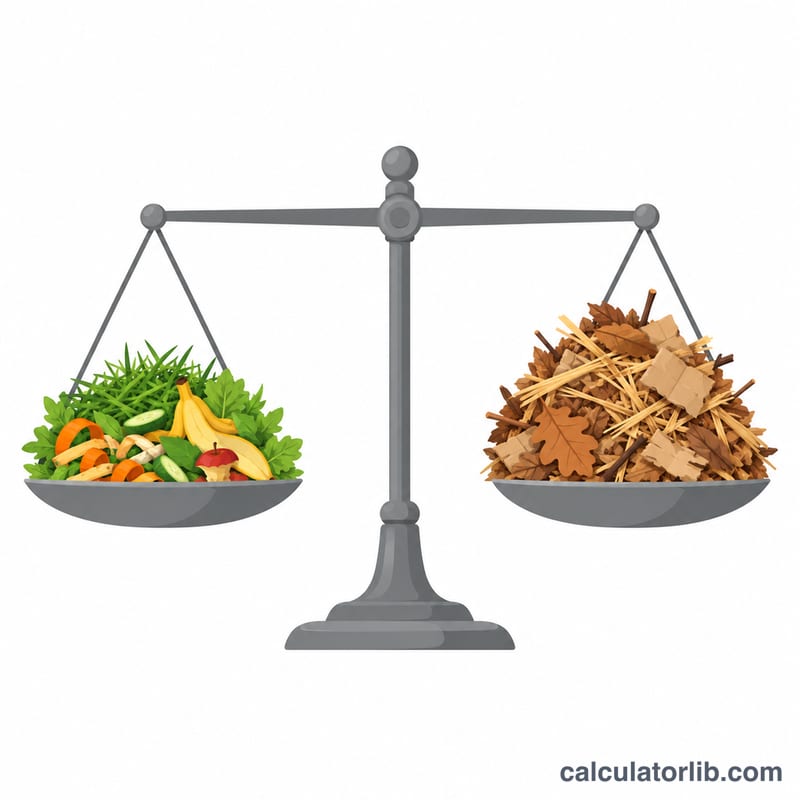
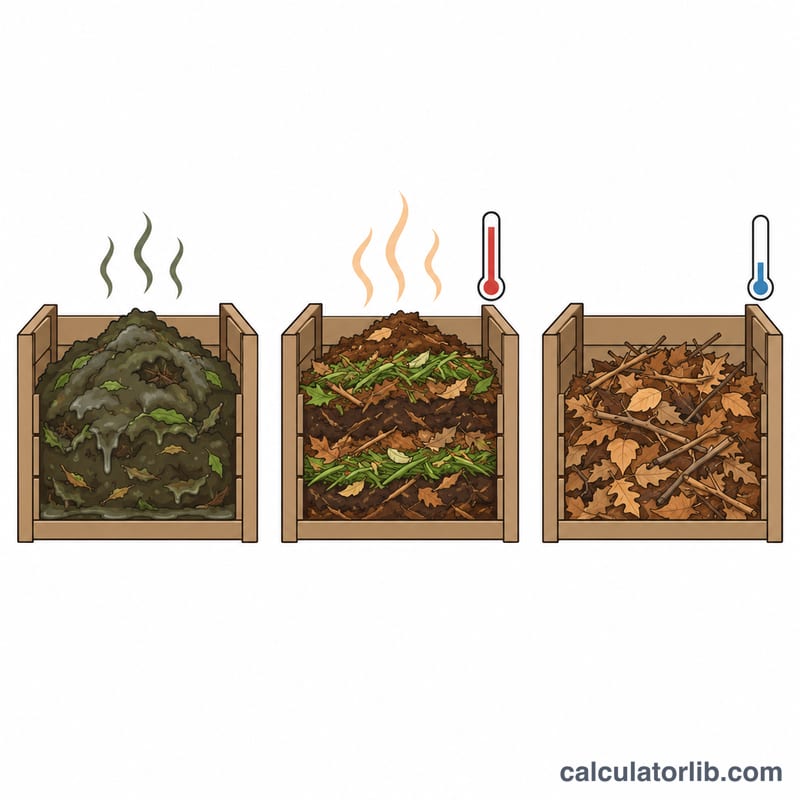
Every compost ingredient carries carbon and nitrogen in a fixed proportion called its C:N ratio. Microbes that break down a pile need roughly 30 parts carbon for every 1 part nitrogen. Hit that window and the heap heats to 55-65 °C and finishes in weeks. Miss it low and the pile goes slimy and smells of ammonia; miss it high and it sits cold and inert for a year. This calculator mixes two piles of material — greens and browns — and tells you the resulting ratio plus the correction needed.
How to use it
Weigh (or estimate) your green, nitrogen-rich material and your brown, carbon-rich material, then enter each one together with its published C:N ratio. Grass clippings are about 17, food scraps 15, fresh manure 15, coffee grounds 20; dry leaves are about 60, straw 80, shredded cardboard 350 and sawdust 400. Leave the target at 30 unless you have a reason to run hotter or slower.
The formula explained
Carbon and nitrogen add as masses, not as ratios, so you cannot simply average the two C:N numbers. With \(M_g\) = green weight, \(R_g\) = green C:N, \(M_b\) = brown weight and \(R_b\) = brown C:N:
$$\left( \text{C:N} \right)_{mix} = \frac{M_g + M_b}{ {\frac{M_g}{R_g}} + {\frac{M_b}{R_b}}}$$Each material is assumed to be about 50% carbon by dry weight; that factor appears in both the numerator and the denominator and cancels, so the answer depends only on weights and ratios.
Carbon and nitrogen masses assume all dry organic matter is roughly 50% carbon by weight; the carbon fraction cancels out of the ratio itself, so the C:N result does not depend on that assumption.
Worked example
You have 20 kg of grass-and-scraps at \(R_g = 15\) and 40 kg of dry leaves at \(R_b = 60\):
$$\left( \text{C:N} \right)_{mix} = \frac{20 + 40}{ {\frac{20}{15}} + {\frac{40}{60}}} = \frac{60}{1.333 + 0.667} = \frac{60}{2.0} = 30$$Exactly on target, so no adjustment is required. Had you only had 10 kg of leaves, the mix would read about 19:1 and the calculator would tell you to add 30 kg more.
C:N Ratios of Common Compost Materials
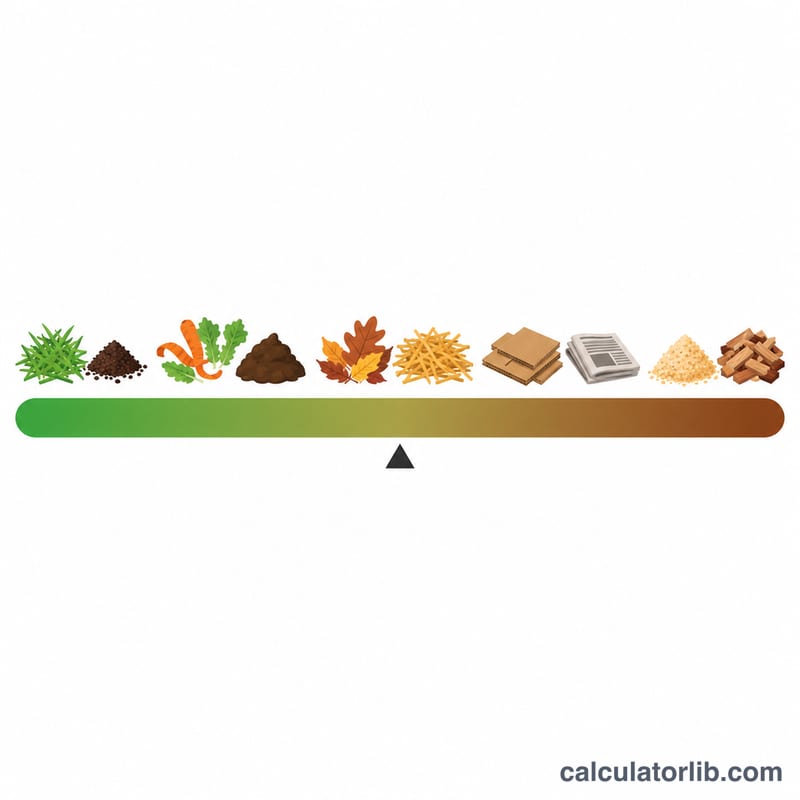
Every compost ingredient carries its own carbon-to-nitrogen ratio, measured on a dry-matter basis. Nitrogen-rich "greens" sit low on the scale; carbon-rich "browns" sit high. The values below are the typical ranges published in standard composting references — notably the Cornell Waste Management Institute tables and the USDA Natural Resources Conservation Service composting guidance, both United States sources that are nevertheless widely used internationally. Because real materials vary with species, age, dryness and how they were stored, ranges are given rather than single points; pick a mid-range figure unless you have a laboratory analysis of your own feedstock.
| Material | Group | Typical C:N (dry matter) |
|---|---|---|
| Poultry manure | Green | ~10:1 |
| Alfalfa / legume hay | Green | ~12:1 |
| Vegetable and food scraps | Green | ~15:1 |
| Fresh cow or horse manure | Green | ~15–20:1 |
| Fresh grass clippings | Green | ~17:1 |
| Seaweed | Green | ~19:1 |
| Coffee grounds | Green | ~20:1 |
| Green weeds (before seed set) | Green | ~20:1 |
| Fruit waste | Green (weak) | ~35:1 |
| Hay, dry | Brown | ~25–40:1 |
| Dry leaves | Brown | ~40–80:1 (oak and beech at the high end, maple and ash lower) |
| Corn stalks | Brown | ~75:1 |
| Straw | Brown | ~80:1 |
| Pine needles | Brown | ~80:1 |
| Bark | Brown | ~100–130:1 |
| Mixed paper | Brown | ~170:1 |
| Shredded newspaper | Brown | ~175:1 |
| Corrugated cardboard | Brown | ~350:1 |
| Wood chips | Brown | ~400:1 |
| Sawdust | Brown | ~400–500:1 |
Two practical cautions. First, "fruit waste" looks like a green because it is wet and soft, but its sugars make it carbon-heavy relative to its nitrogen — it behaves more like a mild brown. Second, the weights you enter should be consistent: the ratios above are dry-matter figures, so if you weigh very wet material (fresh grass, kitchen scraps) you are over-counting water on both sides of the fraction, which largely cancels out but still makes the result approximate. Treat the calculated number as a planning figure, not a measurement.
What Your C:N Result Means
Standard composting guidance reads the starting ratio in bands. Find yours below.
| C:N of mix | Interpretation |
|---|---|
| Below ~20:1 | Nitrogen excess. Surplus nitrogen leaves as ammonia, so the pile smells sharp and you lose the very nutrient you wanted to keep. Wet low-ratio material also compacts and can turn anaerobic, producing sulphurous odours. Add browns. |
| ~20–25:1 | Fast and hot, but some nitrogen is still volatilised. Acceptable if you turn frequently and have good structure; a little more brown material will reduce the loss. |
| ~25–35:1 | The accepted working window. Microbial demand for carbon and nitrogen is roughly matched, and a pile of adequate volume (around 1 m³ or more) and moisture will typically climb to 55–65 °C within a few days. |
| ~35–40:1 | Slower and cooler, but it will finish. Nitrogen is the limiting nutrient, so expect weeks rather than days at peak temperature. |
| Above ~40:1 | Carbon excess. Microbes scavenge nitrogen from their surroundings — if you spread this material on a bed it will immobilise soil nitrogen and visibly starve your plants. A very high-ratio heap can sit cold for many months. |
On the temperature figure: 55 °C maintained for three consecutive days is the commonly cited pathogen- and weed-seed-reduction benchmark, drawn from United States regulation and practice — the US EPA's biosolids rules (40 CFR Part 503) and the US Composting Council's guidance for aerated static piles and in-vessel systems. Other countries set their own time-and-temperature requirements, so check your national standard if you are composting commercially rather than at home.
Expect the ratio to fall as the pile works. Microbes respire most of the carbon away as CO₂ while retaining nitrogen in their biomass, so a heap that started near 30:1 typically finishes somewhere around 10–15:1. That means a mature compost reads much lower than the mix you built, and a low reading on finished material is a sign of maturity rather than a fault.
Finally, read the number for what it is. The C:N ratio describes the chemistry of the feedstock mix — it says nothing about compost quality, contamination, salinity or maturity, and it cannot tell you whether the pile will actually work. Moisture around 50–60 % by weight (damp like a wrung-out sponge) and free air movement through the heap matter just as much: a perfectly balanced 30:1 pile that is bone dry, waterlogged or airless will stall completely. Use the ratio to choose your recipe, then manage water, particle size and turning to deliver it.
This section is general composting information, not a prescription for a specific site or regulated operation.
FAQ
Should I measure by weight or by volume? The formula is a mass balance, so weight is correct. Gardeners often quote volume rules such as 2-3 parts browns to 1 part greens; those are rough proxies because dry leaves are far less dense than wet scraps.
Does moisture change the ratio? Published C:N values are dry-matter figures, so water does not alter the ratio. It still matters for the pile — aim for 50-60% moisture, damp like a wrung-out sponge.
Why is my target unreachable? You cannot reach 30:1 if your brown material has a C:N below 30, or if the greens are already above the target. Add a higher-carbon brown such as cardboard or sawdust.