What Is Kerf Bending?
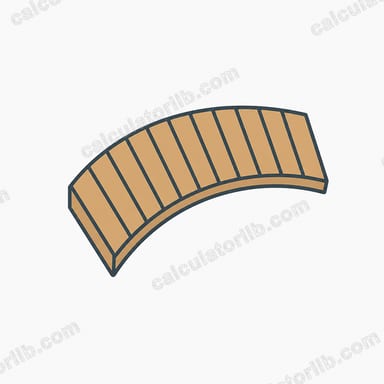
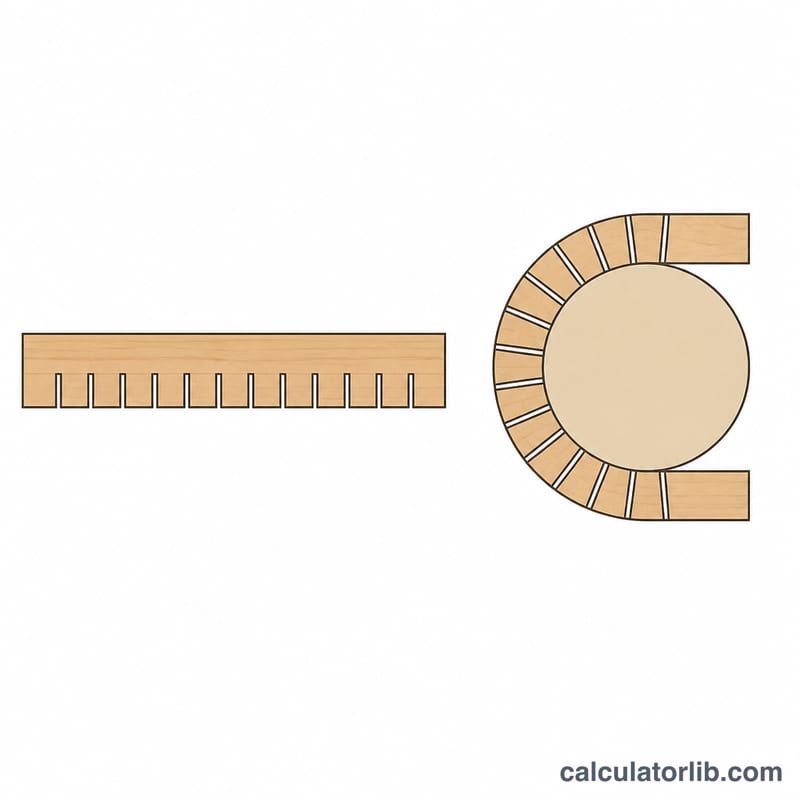
Kerf bending lets a flat, rigid board curve around a form by cutting a series of closely spaced grooves, called kerfs, across its width. Each groove removes most of the thickness and leaves a thin hinge of material on the back face. When the board is flexed, every kerf closes up and the board bends smoothly to the target radius without steaming or laminating.
How to Use the Calculator
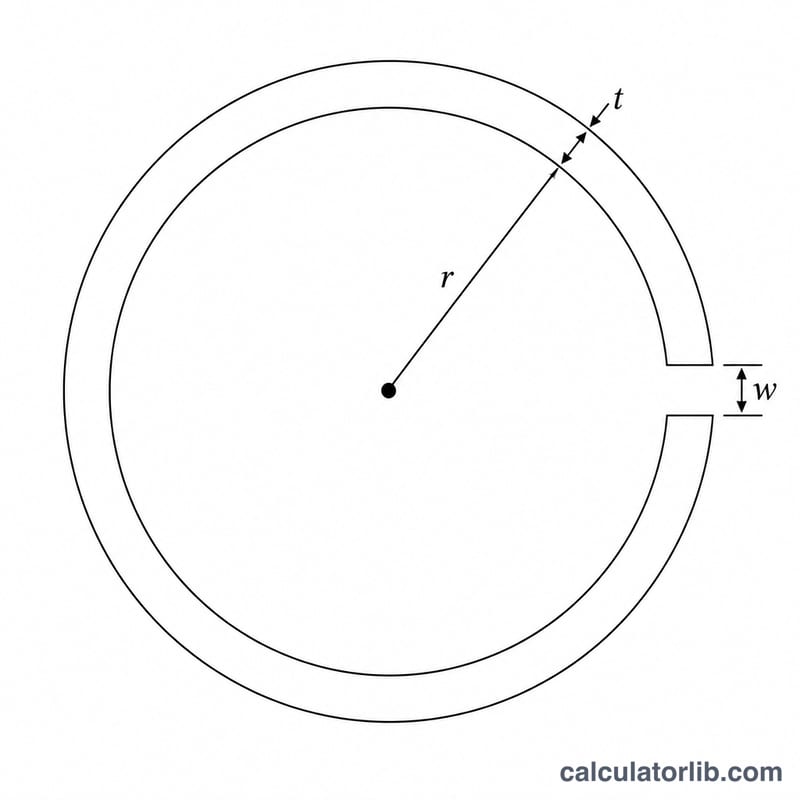
Enter the bend radius \(R\), the total bend angle \(\theta\) in degrees, the board thickness \(t\), and the width of your saw blade cut \(w\). The tool returns the spacing between cuts, the number of cuts required, and the arc length of the bend. Use the same length unit (inches or millimetres) for every field.
The Formula Explained
When a kerf closes, the board pivots about the hinge on its back face. The angle each cut can close is \(\theta_k = w/t\) radians, so the spacing measured along the back face is:
$$s = R \times \frac{w}{t}$$The number of cuts needed to sweep the full angle is:
$$N = \frac{\theta\, t}{w}$$where \(\theta\) is expressed in radians. Rounding \(N\) up guarantees the board reaches or slightly exceeds the target angle.
Worked Example
For a \(6\) inch radius, a \(90^\circ\) bend, \(t = 0.75\) in, and a \(w = 0.125\) in blade:
$$s = 6 \times \frac{0.125}{0.75} = 1\,\text{in}$$and the number of cuts:
$$N = \frac{1.5708 \times 0.75}{0.125} \approx 9.42 \rightarrow 10$$So cut ten kerfs spaced one inch apart.
FAQ
Do I cut on the inside or outside of the curve? Cut on the concave (inside) face so the grooves close as you bend.
How deep should each kerf be? Leave a thin, consistent skin on the back face, typically about 1/8 in, so the hinge stays strong but flexible.
Why round the number of cuts up? A fractional cut cannot be made, and extra spacing would leave the board short of the target radius.