What This Calculator Does
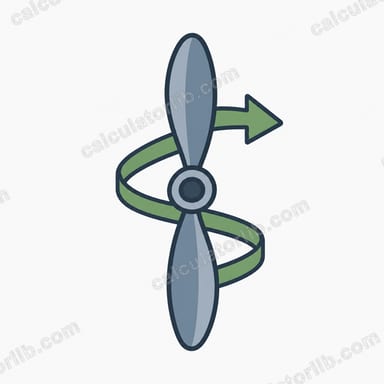
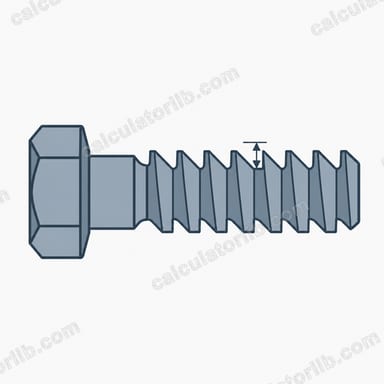
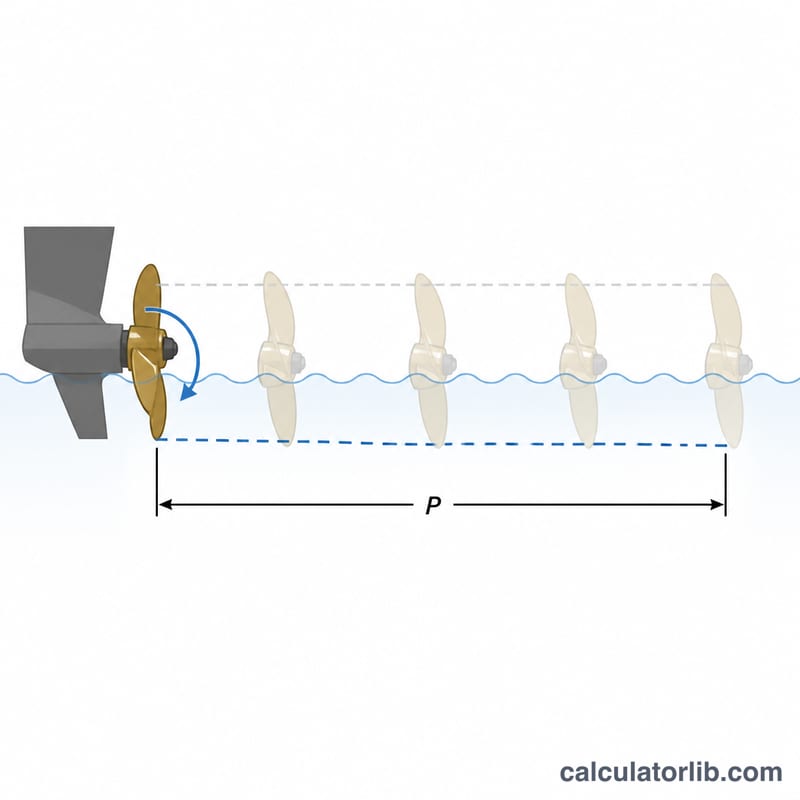
The Boat Propeller Pitch Calculator estimates the propeller pitch (in inches) your boat needs to reach a chosen top-end speed. Pitch is the theoretical distance a propeller moves forward in one full revolution. By combining your target speed with engine RPM, gear (lower unit) ratio and expected slip, it points you toward a prop that lets the engine spin in its ideal operating range.
The Formula Explained
Speed depends on how fast the prop shaft turns and how far each turn should carry the boat. The core relationship is:
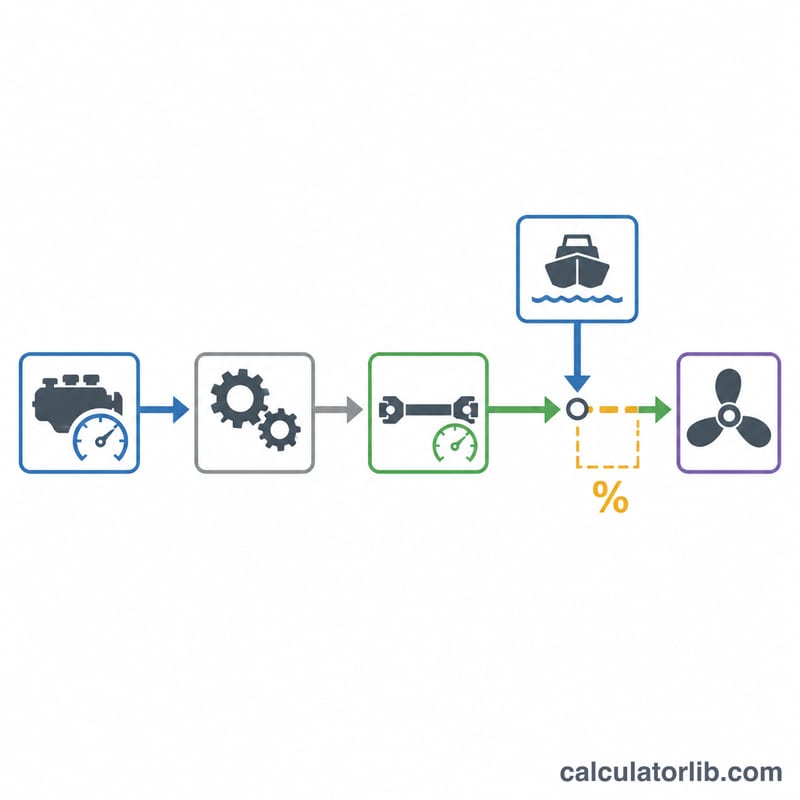
$$P = \frac{S \times 63360}{R_p \times 60 \times (1 - s)}$$where \(P\) = pitch in inches, \(S\) = target speed in mph, \(R_p\) = propeller shaft RPM, and \(s\) = slip as a decimal. The constant \(63360\) converts miles to inches (\(5280 \times 12\)), and \(60\) converts hours to minutes. The shaft RPM comes from the engine RPM \(N\) and gear ratio \(G\):
$$R_p = \frac{N}{G}$$Slip accounts for the fact that a prop never advances its full geometric pitch through water; typical values range from 8% to 15%.
How To Use It
Enter the speed you want to achieve, the engine RPM you expect at that speed, your lower unit gear ratio, and an estimated slip percentage. The calculator returns the ideal pitch and the resulting prop shaft RPM. Round to the nearest available pitch when shopping for a propeller.
Worked Example
Suppose you want \(30\) mph at \(5000\) engine RPM with a \(2.0{:}1\) gear ratio and \(10\%\) slip. First the shaft RPM:
$$R_p = \frac{5000}{2.0} = 2500$$Then the pitch:
$$P = \frac{30 \times 63360}{2500 \times 60 \times 0.90} = \frac{1900800}{135000} = 14.08\,\text{in}$$So a 14-inch pitch prop is a strong starting point.
Pitch Across Common Setups
Each row applies this calculator's formula, \(\text{Pitch (in)} = \dfrac{\text{Speed} \times 63360}{\left(\frac{\text{Engine RPM}}{\text{Gear Ratio}}\right) \times 60 \times \left(1 - \frac{\text{Slip}}{100}\right)}\), where 63360 is the number of inches in one statute mile (so the target speed is in mph and pitch in inches — US customary units). Shaft RPM is the engine RPM divided by the gear ratio. Values are rounded to two decimals.
| Target speed (mph) | Engine RPM | Gear ratio | Slip (%) | Shaft RPM | Pitch (in) |
|---|---|---|---|---|---|
| 25 | 5000 | 2.0 | 10 | 2500 | 11.73 |
| 30 | 5000 | 2.0 | 10 | 2500 | 14.08 |
| 30 | 5000 | 2.0 | 12 | 2500 | 14.40 |
| 30 | 5800 | 1.8 | 12 | 3222 | 11.17 |
| 40 | 5800 | 1.8 | 10 | 3222 | 14.57 |
| 25 | 4500 | 2.3 | 12 | 1957 | 15.33 |
Worked example (row 1), with full substitution: \(\dfrac{25 \times 63360}{\left(\frac{5000}{2.0}\right) \times 60 \times \left(1 - \frac{10}{100}\right)} = \dfrac{1584000}{2500 \times 60 \times 0.90} = \dfrac{1584000}{135000} = 11.73\text{ in}\).
Notice that a lower shaft RPM (from a numerically higher gear ratio or lower engine RPM) demands more pitch to reach the same speed, while higher slip also pushes the required pitch down slightly. These are theoretical estimates; hull design, weight and prop diameter also affect real-world results.
Choosing Your Propeller
The calculated pitch is a starting estimate, not an exact part number. Propellers are typically sold in whole 1- or 2-inch pitch increments, so you will pick the nearest available size rather than a decimal value.
- Round to the nearest stocked pitch. If the formula returns 14.57 in, you will realistically choose a 15-inch prop (or compare a 14 vs. 16 if that is what your line offers).
- Use pitch to tune RPM. As a widely used rule of thumb, dropping about 1 inch of pitch typically raises wide-open-throttle RPM by roughly 150–200 RPM, and adding about 1 inch lowers it by a similar amount. Use this to nudge the engine toward the RPM you want.
- Stay inside the wide-open-throttle (WOT) range. Verify the chosen prop keeps the engine within the RPM band specified by your engine manufacturer. Running below the range lugs the engine; running above it risks over-revving. Always defer to your specific engine's manual.
- Test on the water, then adjust. Load the boat as you normally run it, record actual WOT RPM and GPS speed, and step pitch up or down one increment if you are outside the target band.
This is general guidance for estimation and tuning. For engine-specific limits, warranty and safe operation, follow your engine and propeller manufacturer's documentation.
FAQ
Does higher pitch mean more speed? More pitch increases potential top speed but reduces acceleration and can lug the engine below its RPM range.
What slip should I use? Efficient hulls run 8–10%; heavier or less efficient setups run 12–15%.
Is this exact? It is a solid estimate; hull load, trim and prop design still affect real results.