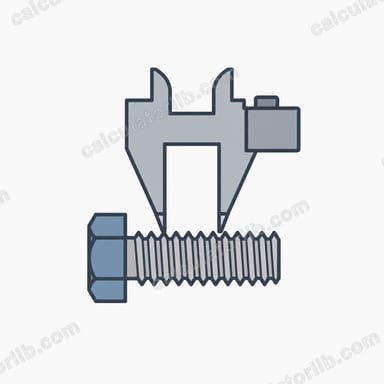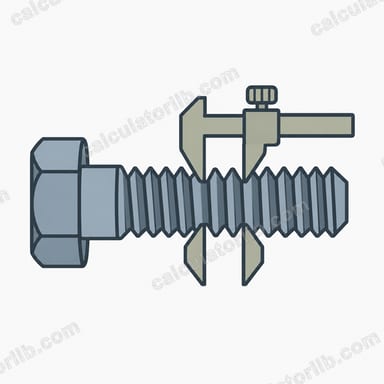
What is the BSW Thread Pitch Diameter Calculator?
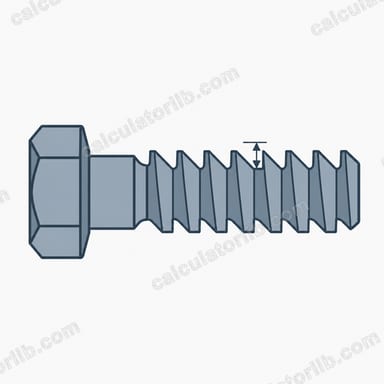
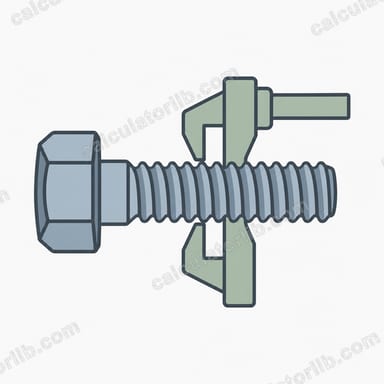
The British Standard Whitworth (BSW) system defines a 55-degree symmetrical thread with rounded crests and roots. This calculator finds the pitch (effective) diameter together with the matching thread depth and core diameter from just the major diameter and the number of threads per inch, so you can set up gauges, lathes or inspection reports quickly.
The formula explained
The pitch of the thread is the reciprocal of the threads per inch, \(p = \tfrac{1}{n}\). The Whitworth single depth of thread removes one sixth of the fundamental triangle at both crest and root, giving the constant 0.640327:
$$h = 0.640327 \times p$$The effective diameter lies halfway down the flanks, so it is the major diameter \(D\) minus one thread depth, while the minor (core) diameter removes two depths:
$$\text{PD} = D - h, \qquad \text{MD} = D - 2h$$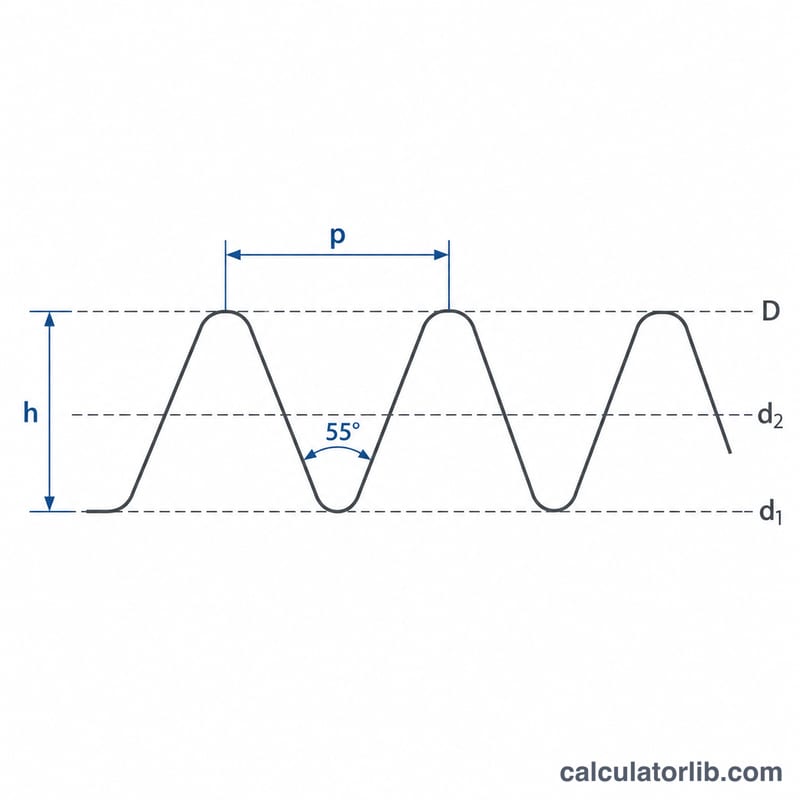
How to use it
Enter the nominal major diameter in inches and the threads per inch (for example 0.5 and 12 for a 1/2 inch BSW bolt). The calculator returns the pitch, the single thread depth, the pitch diameter and the core diameter, all in inches.
Worked example
For a 1/2 inch BSW thread with \(D = 0.5\) in and \(n = 12\):
$$p = \tfrac{1}{12} = 0.08333\,\text{in}$$ $$h = 0.640327 \times 0.08333 = 0.05336\,\text{in}$$ $$\text{PD} = 0.5 - 0.05336 = 0.44664\,\text{in}$$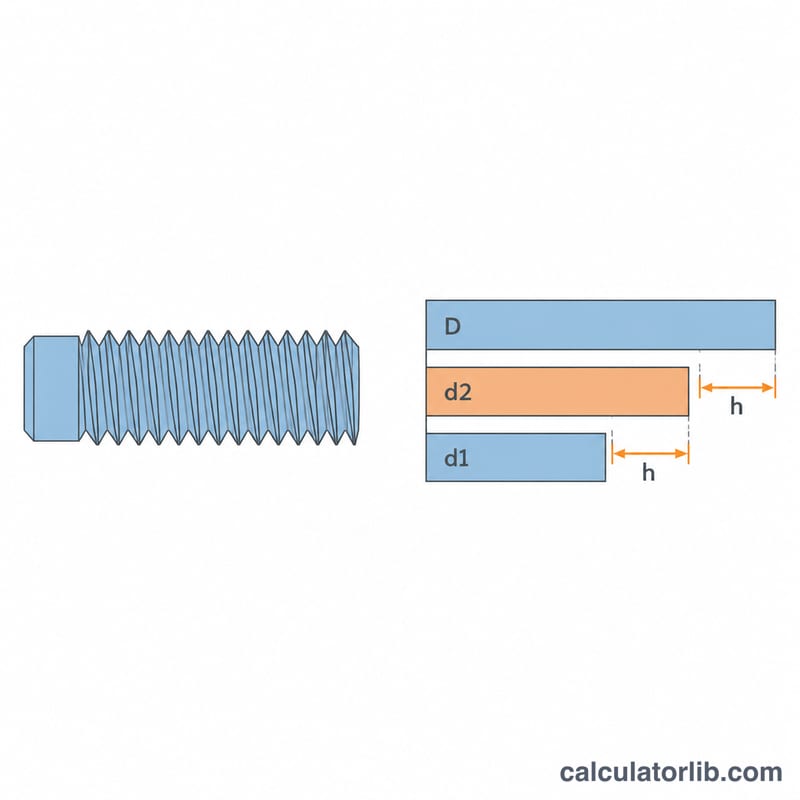
Standard BSW Thread Sizes (Whitworth Series)
British Standard Whitworth (BSW) is a British imperial coarse thread series, standardised in the UK as BS 84. It has a 55° flank angle with rounded crests and roots. Each nominal size has one fixed threads-per-inch (TPI) count, so you can't pick the pitch yourself. If a 1/2" thread is not 12 TPI, it is not BSW. It may be BSF (British Standard Fine) or a non-standard Whitworth-form thread.
The table lists the basic dimensions, worked out with the formulas below. They are not the tolerance limits for a particular thread class.
$$p = \frac{1}{\text{TPI}}, \qquad h = 0.640327\,p, \qquad d_2 = D - h, \qquad d_1 = D - 2h$$| Size | Major diameter D (in) | Major diameter D (mm) | TPI | Pitch p (in) | Pitch p (mm) | Thread depth h (in) | Pitch (effective) diameter d2 (in) | Core (minor) diameter d1 (in) |
|---|---|---|---|---|---|---|---|---|
| 1/8" | 0.1250 | 3.175 | 40 | 0.0250 | 0.635 | 0.0160 | 0.1090 | 0.0930 |
| 3/16" | 0.1875 | 4.763 | 24 | 0.0417 | 1.058 | 0.0267 | 0.1608 | 0.1341 |
| 1/4" | 0.2500 | 6.350 | 20 | 0.0500 | 1.270 | 0.0320 | 0.2180 | 0.1860 |
| 5/16" | 0.3125 | 7.938 | 18 | 0.0556 | 1.411 | 0.0356 | 0.2769 | 0.2414 |
| 3/8" | 0.3750 | 9.525 | 16 | 0.0625 | 1.588 | 0.0400 | 0.3350 | 0.2950 |
| 7/16" | 0.4375 | 11.113 | 14 | 0.0714 | 1.814 | 0.0457 | 0.3918 | 0.3460 |
| 1/2" | 0.5000 | 12.700 | 12 | 0.0833 | 2.117 | 0.0534 | 0.4466 | 0.3933 |
| 9/16" | 0.5625 | 14.288 | 12 | 0.0833 | 2.117 | 0.0534 | 0.5091 | 0.4558 |
| 5/8" | 0.6250 | 15.875 | 11 | 0.0909 | 2.309 | 0.0582 | 0.5668 | 0.5086 |
| 3/4" | 0.7500 | 19.050 | 10 | 0.1000 | 2.540 | 0.0640 | 0.6860 | 0.6219 |
| 7/8" | 0.8750 | 22.225 | 9 | 0.1111 | 2.822 | 0.0711 | 0.8039 | 0.7327 |
| 1" | 1.0000 | 25.400 | 8 | 0.1250 | 3.175 | 0.0800 | 0.9200 | 0.8399 |
Here is the 1"-8 row worked out step by step: \(p = 1/8 = 0.125\) in, \(h = 0.640327 \times 0.125 = 0.080041\) in, \(d_2 = 1.000 - 0.080041 = 0.919959 \approx 0.9200\) in, and \(d_1 = 1.000 - 2 \times 0.080041 = 0.839918 \approx 0.8399\) in.
Notes on the table:
- The millimetre values are exact conversions at 1 in = 25.4 mm. BSW itself is specified in inches.
- The 1/2" and 9/16" sizes share 12 TPI, so they have the same pitch and thread depth.
- Before cutting or gauging a real part, check against BS 84 for allowances and tolerance classes.
FAQ
Why 0.640327? It is two thirds of the Whitworth fundamental triangle height of \(0.960491\,p\), because the form truncates one sixth at the crest and one sixth at the root.
Is the pitch diameter the same as the effective diameter? Yes. For symmetrical threads the terms are interchangeable and describe where the flank width equals half the pitch.
Does this include tolerances? No. It gives the nominal theoretical dimensions; apply the relevant class of fit allowances for manufacturing limits.