
What this calculator does
The Manure Application Rate Calculator helps farmers and agronomists turn a crop nutrient requirement into a practical spreading rate. Applying manure by guesswork wastes nutrients, risks runoff, and can leave crops short. By matching the nutrient a crop needs with the nutrient a manure actually supplies, you spread exactly what the field requires and keep nutrient management plans on track.
The formula explained
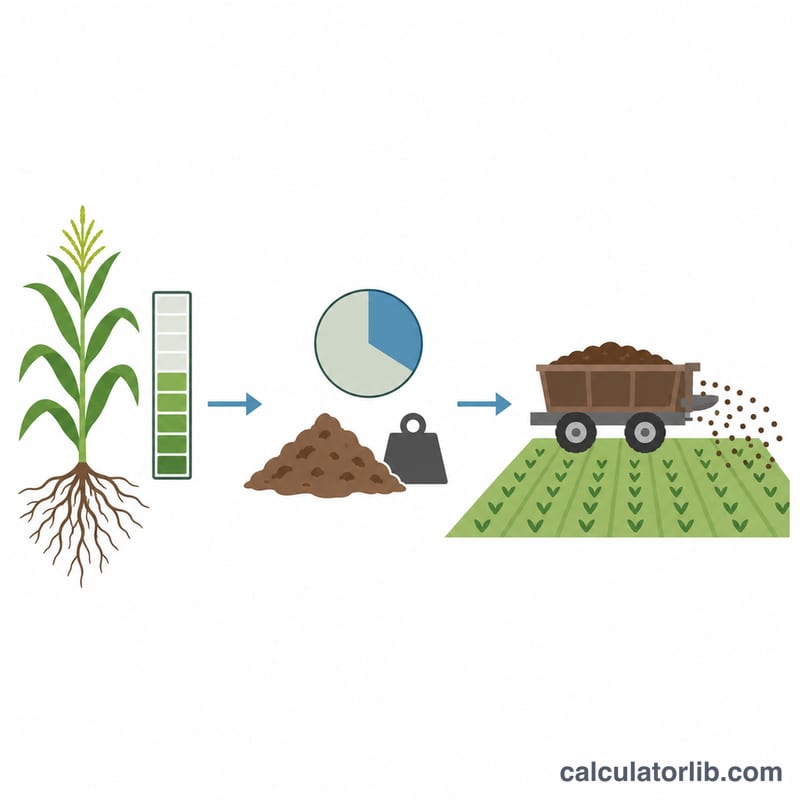
The calculation balances three numbers: how much nutrient the crop needs, how concentrated the manure is, and how much of that nutrient becomes available in the first season.
$$\text{Rate} = \frac{N_{need}}{C \times A}$$Here \(N_{need}\) is the crop requirement in pounds per acre, \(C\) is the manure nutrient content in pounds per ton, and \(A\) is the fraction between 0 and 1 of nutrient available in the first year. The result is tons of manure per acre.
How to use it
Enter your crop nutrient target, the nutrient content from a recent manure test, the first-year availability percentage, and your field size. The tool returns the per-acre rate and the total tonnage for the whole field, so you can plan hauling, storage, and spreader calibration.
Worked example
Suppose corn needs 150 lb of nitrogen per acre, the manure test shows 10 lb of nitrogen per ton, and 50% of it is available the first year. Then the rate is
$$\text{Rate} = \frac{150}{10 \times 0.5} = 30\ \text{tons/acre}$$Across a 40-acre field the total manure needed is
$$\text{Total} = 30 \times 40 = 1200\ \text{tons}.$$Typical Manure Nutrient Content and First-Year Nitrogen Availability
If you don't have a lab analysis, you can use book values to get a first estimate of the Nutrient Content (lb/ton) input. The ranges below are approximate values for solid manure as handled on the farm. They are based on U.S. references: MWPS-18 Manure Characteristics (MidWest Plan Service), USDA-NRCS Agricultural Waste Management Field Handbook, and extension guides such as the Penn State Agronomy Guide and University of Minnesota Extension manure publications. Actual values change a lot with species, ration, bedding type and amount, storage method and how much water gets in, so treat these numbers as rough starting points.
| Manure type | Total N (lb/ton) | P2O5 (lb/ton) | K2O (lb/ton) | Dry matter (%) |
|---|---|---|---|---|
| Dairy, solid (with bedding) | 8–12 | 3–6 | 7–12 | 18–30 |
| Beef, solid (feedlot/bedded pack) | 11–21 | 7–18 | 10–26 | 30–55 |
| Swine, solid (with bedding) | 8–12 | 6–10 | 7–10 | 18–30 |
| Broiler litter | 50–70 | 50–70 | 35–50 | 70–80 |
| Layer manure (no litter) | 25–40 | 30–55 | 20–35 | 25–50 |
| Horse (with bedding) | 8–14 | 3–6 | 8–14 | 25–45 |
Only part of the total N in manure is available to the crop in the first year. Ammonium N is lost as ammonia gas if manure stays on the soil surface, and organic N is released slowly over several seasons. That is why the calculator divides by an Availability (%) factor. The ranges below summarize typical first-year availability of total N, in the style of U.S. state extension tables such as those from the University of Minnesota and Penn State. Your state's nutrient management guidance may use somewhat different factors, and you should use its values where they apply.
| Manure type | Incorporated immediately (same day) | Incorporated within a few days | Left on the surface |
|---|---|---|---|
| Dairy / beef, solid | 30–45% | 25–40% | 20–30% |
| Swine, solid | 45–60% | 35–50% | 30–40% |
| Broiler litter / layer manure | 50–70% | 45–60% | 35–50% |
| Horse (high bedding) | 20–30% | 15–25% | 10–20% |
For crop planning, P2O5 and K2O in manure are usually counted as close to 100% available over the long term, though some guides credit less P in the first year. A lab analysis of your own manure is always better than book values. Sample from several spots in the storage or the spreader load, mix the samples together, and ask the lab to report results on an as-is basis in lb/ton.

Practical Tips for Applying Your Calculated Rate
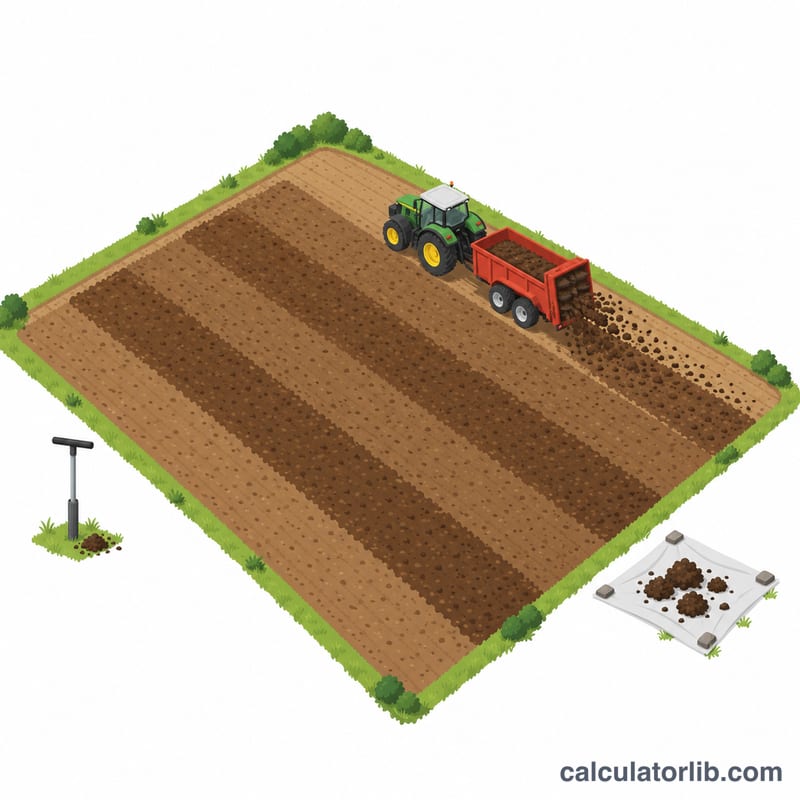
- Calibrate the spreader. The calculated rate only matters if the spreader actually delivers it. One common check is the tarp (weigh) method. Lay a tarp or plastic sheet of known area, for example 10 ft × 10 ft = 100 ft², and drive over it at your normal spreading setting. Weigh what lands on it, then convert to tons per acre using \(\text{t/ac} = \dfrac{\text{lb on tarp} \times 43{,}560}{\text{tarp area (ft}^2\text{)} \times 2{,}000}\). Repeat 2–3 times and average the results. You can also weigh full loads and divide by the acres each load covers.
- Check phosphorus before using an N-based rate. Manure usually supplies more P than crops need compared with N, so a rate based on N can over-apply P. Work out a P-based rate as well, using \(\text{P rate} = \text{P}_2\text{O}_5 \text{ need} \div \text{P}_2\text{O}_5 \text{ content}\) (availability usually taken as 100%), and apply the lower of the two rates. Example: a corn crop needs 150 lb N/acre and 60 lb P2O5/acre, and broiler litter tests 60 lb N and 60 lb P2O5 per ton with 50% first-year N availability. The N-based rate is $$\frac{150}{60 \times \frac{50}{100}} = \frac{150}{30} = 5 \text{ t/ac}$$ which is 5 tons/acre. That rate would apply 5 × 60 = 300 lb P2O5, five times what the crop needs. The P-based rate is $$\frac{60}{60 \times \frac{100}{100}} = 1 \text{ t/ac}$$ or 1 ton/acre. At 1 t/ac the litter supplies 1 × 60 × 0.50 = 30 lb of available N, so the remaining 150 − 30 = 120 lb N/acre comes from commercial fertilizer.
- Credit residual N from earlier applications. Manure applied in the past one to two years keeps releasing organic N. Many extension guides credit roughly 10% of total N in the second year and about 5% in the third year, but check your local guidance for the exact figures. Subtract these credits, plus any legume credit, from the crop's N need before you enter Nutrient Need.
- Follow your local rules. Setback distances from wells, streams and drainage inlets, application timing windows, and limits on spreading on frozen, snow-covered or saturated ground vary by country, state and permit. Follow your nutrient management plan and the regulations that apply to your farm. These rules can override the agronomic rate.
- Re-test the manure regularly. Sample at least once a year, and again whenever rations, bedding, animal type or storage and handling change. Nutrient content can easily shift by 25% or more between years.
- Round to a rate you can actually deliver. Spreaders can't hit an exact figure like 4.37 t/ac. Round to the nearest setting your calibrated spreader can apply consistently, and lean toward the lower setting if P or environmental limits are a concern. Then multiply by the field area to get the total tons to haul.
This is general agronomic information, not professional advice. For field-specific rates and regulatory compliance, consult a certified crop adviser, nutrient management planner or your local extension office.
FAQ
Which nutrient should I base the rate on? Use the most limiting nutrient, usually nitrogen, then check phosphorus and potassium against soil tests to avoid over-application.
Why apply an availability factor? Much of the nitrogen in manure is organic and mineralizes slowly, so only part of it is usable by the crop in the first year.
Can I use metric units? Yes. Enter kilograms per hectare for the need and per tonne for the content, and the rate reads as tonnes per hectare.