What this calculator does
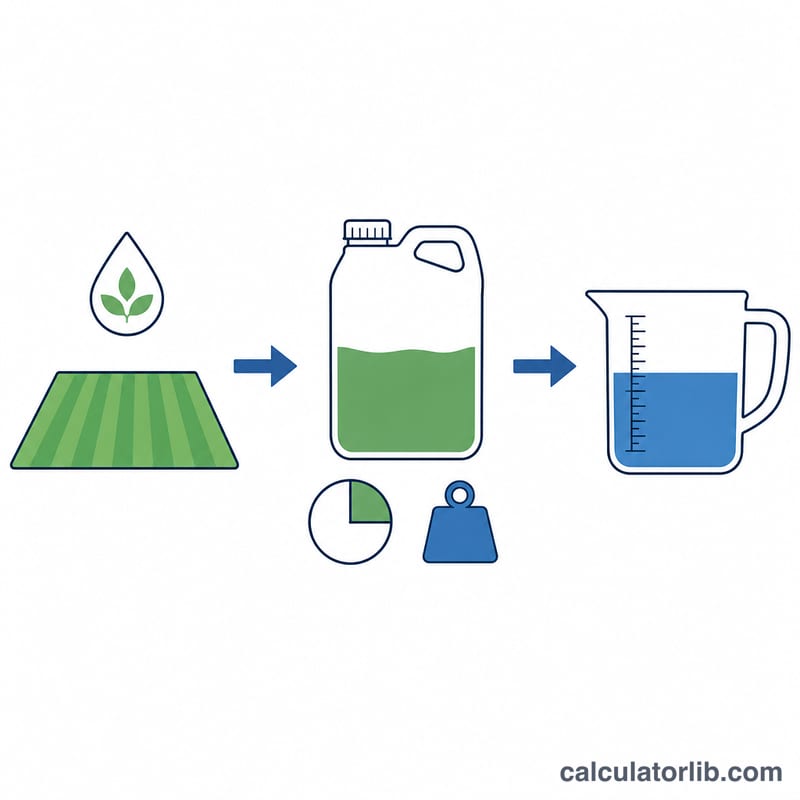
Liquid fertilizers are sold by volume but recommended by nutrient weight. A soil test may call for 40 lb of nitrogen per acre, yet the jug in your shed is rated 32-0-0 and weighs 11.06 lb per gallon. This tool bridges that gap: it converts a target nutrient rate into gallons per acre (or liters per hectare) of actual product, then scales the answer to your field size and sprayer tank so you know exactly how much fertilizer and how much water goes into each load. It works with any unit system as long as you stay consistent: US units use lb/acre, gal and lb/gal; metric uses kg/ha, L and kg/L.
The formula explained
Each gallon (or liter) of product carries a fixed weight of nutrient equal to its density times its analysis percentage. Dividing the target rate by that value gives the product rate:
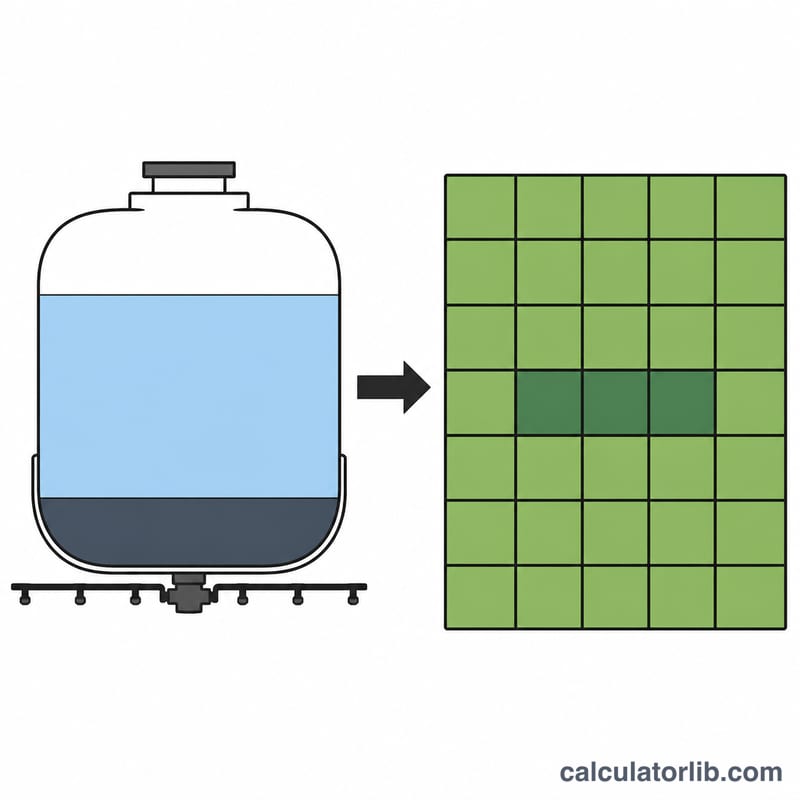
$$R = \frac{N_{target}}{\rho \times \frac{P}{100}}$$where \(N_{target}\) = target nutrient rate in lb/acre or kg/ha, \(\rho\) = product density in lb/gal or kg/L, and \(P\) = nutrient content in percent by weight. The tank figures follow directly: \(A_{tank} = T / V\) is the area one tank covers, \(P_{tank} = R \times A_{tank}\) is the product it should contain, and the remainder \(W_{tank} = T - P_{tank}\) is carrier water.
Worked example
Applying 40 lb N/acre with UAN 32-0-0 at 11.06 lb/gal, over 15 acres, spraying 20 gal/acre from a 300 gal tank:
$$\rho \times \frac{P}{100} = 11.06 \times 0.32 = 3.5392\ \text{lb N/gal}$$$$R = \frac{40}{3.5392} = 11.30\ \text{gal/acre}$$Total product for the field is \(11.30 \times 15 = 169.53\) gal. One 300 gal tank covers \(300 / 20 = 15\) acres, so it needs about 169.5 gal of UAN topped up with roughly 130.5 gal of water.
Unit Conversions for Liquid Fertilizer Rates
Liquid fertilizer paperwork mixes volume, weight, area and two different nutrient conventions. These are the exact factors needed to move a rate between US customary and metric units, and between oxide and elemental nutrient reporting.
Density
| From | To | Multiply by | Example |
|---|---|---|---|
| Specific gravity (dimensionless) | lb/gal (US) | 8.345 | sg 1.325 × 8.345 = 11.06 lb/gal |
| Specific gravity | kg/L | 1.000 | sg 1.325 = 1.325 kg/L |
| lb/gal (US) | kg/L | 0.1198 | 11.06 × 0.1198 = 1.325 kg/L |
| kg/L | lb/gal (US) | 8.345 | 1.40 × 8.345 = 11.68 lb/gal |
Volume, area and volume-per-area
| From | To | Multiply by |
|---|---|---|
| 1 US gallon | litres | 3.785 |
| 1 litre | US gallons | 0.2642 |
| 1 acre | hectares | 0.4047 |
| 1 hectare | acres | 2.471 |
| 1 gal/acre | L/ha | 9.354 |
| 1 L/ha | gal/acre | 0.1069 |
| 1 gal/acre | gal per 1,000 sq ft | 0.02296 (1 acre = 43,560 sq ft) |
| 1 gal/acre | fl oz per 1,000 sq ft | 2.939 |
Weight per area
| From | To | Multiply by |
|---|---|---|
| 1 lb/acre | kg/ha | 1.121 |
| 1 kg/ha | lb/acre | 0.892 |
| 1 lb | kg | 0.4536 |
Oxide ↔ elemental nutrient
North America and much of the fertilizer trade guarantee phosphorus as P2O5 and potassium as K2O. Several countries and most soil-science literature report elemental P and K, so a recommendation and a product label may not be in the same currency. Convert before you calculate:
| From | To | Multiply by | Example |
|---|---|---|---|
| P₂O₅ | P | 0.436 | 40 lb P₂O₅/acre = 17.4 lb P/acre |
| P | P₂O₅ | 2.29 | 20 kg P/ha = 45.8 kg P₂O₅/ha |
| K₂O | K | 0.830 | 60 lb K₂O/acre = 49.8 lb K/acre |
| K | K₂O | 1.205 | 50 kg K/ha = 60.3 kg K₂O/ha |
Nitrogen and sulfur need no such conversion — both are always guaranteed elementally. Combining the volume-per-area and weight-per-area factors is a useful cross-check: a rate of 8.48 gal/acre equals \(8.48 \times 9.354 = 79.3\) L/ha, and the same nutrient dose of 30 lb/acre equals \(30 \times 1.121 = 33.6\) kg/ha.
How to Calculate Liquid Fertilizer Rate by Hand
The whole calculation is one division followed by bookkeeping for the field and the tank. Worked below in US units, with the metric equivalent of every step: apply 30 lb N/acre (33.6 kg N/ha) of UAN 32-0-0 to an 80-acre (32.4-ha) field, spraying 20 gal/acre (187 L/ha) from a 1,000-gal (3,785-L) tank.
-
Read the analysis and density off the label or SDS. UAN 32-0-0 is 32% N with a density of 11.06 lb/gal (1.326 kg/L). If the label gives only specific gravity, convert: \(1.325 \times 8.345 = 11.06\) lb/gal, or take specific gravity directly as kg/L.
-
Convert the analysis into nutrient per unit volume.
$$D \times \frac{N}{100} = 11.06 \times \frac{32}{100} = 3.539\ \text{lb N per gallon}$$Metric: \(1.326 \times 0.32 = 0.4243\) kg N per litre.
-
Divide the target nutrient rate by that figure to get the product rate.
$$R_p = \frac{T}{D \cdot \frac{N}{100}} = \frac{30}{3.539} = 8.48\ \text{gal/acre}$$So the product rate is 8.48 gallons of UAN per acre. Metric: \(33.6 \div 0.4243 = 79.2\) L/ha, which matches \(8.48 \times 9.354 = 79.3\) L/ha.
-
Multiply by the field area for the total product to order.
$$Q = R_p \cdot A = 8.48 \times 80 = 678\ \text{gallons}$$Metric: \(79.2 \times 32.4 = 2{,}566\) L (≈2,570 L). The field total is 678 gallons — order with a margin for line fill and rinse.
-
Work out how many acres one tank covers from the total spray volume (product plus water) per acre:
$$K = \frac{C}{S} = \frac{1000}{20} = 50\ \text{acres per tank}$$Metric: \(3{,}785 \div 187 = 20.2\) ha per tank.
-
Product per tank = product rate × acres per tank: \(8.48 \times 50 = 424\) gallons of UAN. Metric: \(79.2 \times 20.2 = 1{,}600\) L.
-
Water per tank = tank capacity − product per tank: \(1000 - 424 = 576\) gallons of water. Metric: \(3{,}785 - 1{,}600 = 2{,}185\) L. Load the carrier first, add the fertilizer under agitation, and finish filling — never pour concentrate into an empty tank.
-
Number of tank loads = area ÷ acres per tank: \(80 \div 50 = 1.6\) loads. That means one full load plus a partial load covering the remaining 30 acres: \(8.48 \times 30 = 254\) gal of product and \(20 \times 30 = 600\) gal total spray volume, so 346 gal of water — the same product-to-water ratio, just scaled down.
Checks before you mix
- Product per tank must be well below tank capacity. If \(R_p\) approaches or exceeds the spray volume \(S\), there is no room for carrier water: either raise the spray volume, split the application, or use a more concentrated grade.
- Batch partial loads at the same ratio rather than adding a fixed amount of product to a half-full tank; matching the ratio keeps the applied rate identical across the field.
- Re-check the sprayer output. The calculated rate is only delivered if the boom actually applies \(S\) gal/acre at the chosen speed, pressure and nozzle — calibrate rather than assume.
- Confirm compatibility and grade. Thiosulfates, polyphosphates and calcium-containing products can precipitate when mixed; run a jar test first.
This is general agronomic information, not a fertilizer recommendation. Nutrient rates, permitted products and application timing are governed by local regulations, nutrient-management plans and the product label, which take precedence — consult your agronomist or extension service for your field.
FAQ
Where do I find the density? It is printed on the product label or safety data sheet, often as specific gravity; multiply specific gravity by 8.34 to get lb/gal, or use it directly as kg/L.
Which number of the N-P-K analysis do I enter? Enter the percentage for the nutrient you are targeting, and make sure your target rate is for that same nutrient. For phosphate and potash the label percentages are already expressed as P2O5 and K2O.
What if the product volume exceeds my spray volume? Then the requested rate cannot fit in the carrier; raise the spray volume, split the application, or choose a more concentrated product. Always confirm with the label and calibrate the sprayer before mixing.