What this calculator does
Titrating a peptide means adding a strong acid or base until every titratable group on the molecule has reacted. This calculator works out the equivalence point of that titration: either how many millilitres of a titrant of known strength you must deliver, or how concentrated the titrant must be to reach equivalence in a fixed delivered volume. It applies to any peptide or protein solution and uses no country-specific rules.
The formula
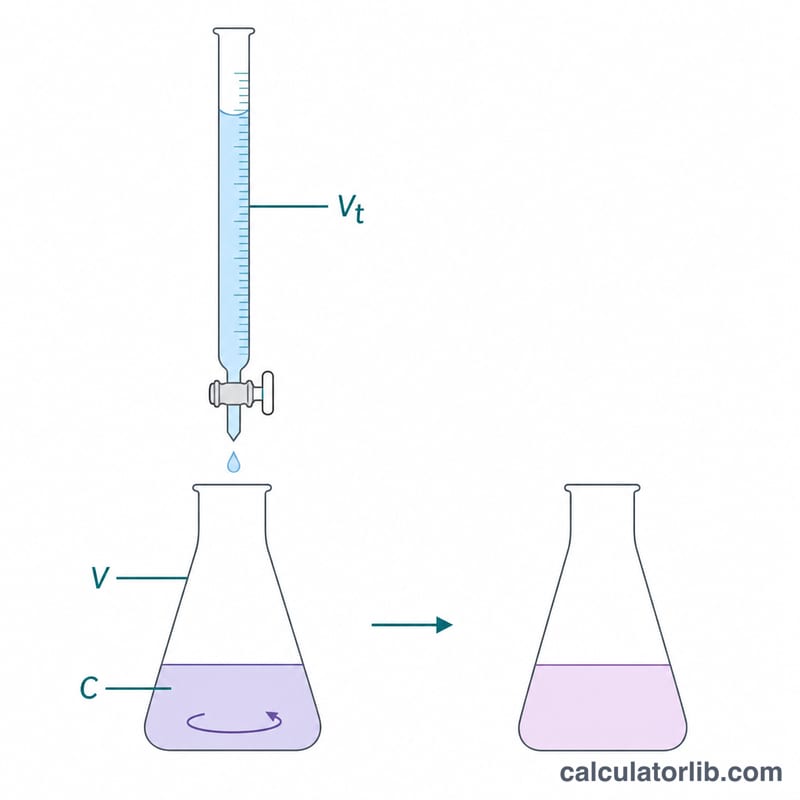
The equivalence point is pure stoichiometry: moles of titrant equal moles of titratable groups. With \(C_p\) = peptide concentration in mM, \(V_s\) = sample volume in mL, \(n\) = titratable groups per peptide (equivalents) and \(C_t\) = titrant concentration in mM:
$$V_t = \frac{C_p \times V_s \times n}{C_t}$$Because millimolar times millilitre gives micromoles, the units cancel cleanly and \(V_t\) comes out in mL. Solving the same identity for concentration gives \(C_t = \frac{C_p \times V_s \times n}{V_t}\). Count \(n\) from the sequence: free alpha-amino and alpha-carboxyl termini plus the ionisable side chains (Asp, Glu, His, Lys, Arg, Cys, Tyr) that your titrant will actually reach in the pH window scanned.
Worked example
A 10 mL sample of a 2 mM peptide carrying 3 titratable groups is titrated with 50 mM NaOH. The peptide amount is \(2 \times 10 = 20\,\mu\text{mol}\), so the equivalents to neutralise are \(20 \times 3 = 60\,\mu\text{mol}\):
$$V_t = \frac{2 \times 10 \times 3}{50} = 1.2\,\text{mL}$$Total volume at equivalence is 11.2 mL, diluting the peptide to about 1.79 mM.
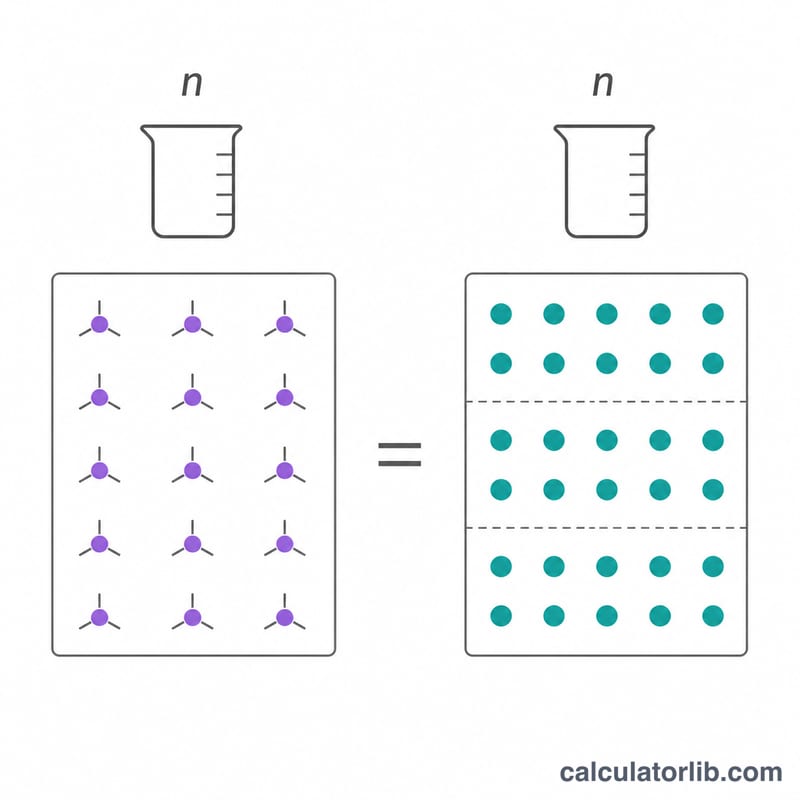
Key Terms and Variables
The equivalence-point calculation uses five quantities. Keeping their units straight (mM and mL, which multiply to micromoles) is what makes the arithmetic trivial.
| Symbol | Term | Definition and units |
|---|---|---|
| \(C_p\) | Peptide concentration | Molar concentration of the peptide in the sample, in millimolar (mM = mmol/L). If you start from a weighed mass, obtain it from mass ÷ molecular weight ÷ volume. |
| \(V_s\) | Sample volume | Volume of peptide solution placed in the titration vessel, in millilitres (mL). Solvent added only to submerge the electrode is not part of \(V_s\) for the mole count, though it does dilute the final solution. |
| \(n\) | Equivalents per peptide | Dimensionless count of titratable protons (or reactive sites) exchanged per peptide molecule over the pH range you actually titrate. A peptide with a free C-terminus, a free N-terminus and one Asp has \(n = 3\) for a full acid-to-base sweep. |
| \(C_t\) | Titrant concentration | Molar concentration of the standardised titrant (e.g. NaOH or HCl), in mM. |
| \(V_t\) | Titrant volume | Volume of titrant delivered to reach the equivalence point, in mL — the primary unknown. |
Equivalence point vs endpoint. The equivalence point is the stoichiometric ideal: the moles of titrant added exactly equal the moles of titratable sites, \(C_t V_t = C_p V_s n\). The endpoint is what you actually observe — a colour change of an indicator or the inflection in a pH-electrode trace. The two differ by the titration error; with a well-matched indicator or a derivative-based inflection search the difference is usually small, but the calculator returns the equivalence point, not a predicted endpoint reading.
Titratable (ionizable) group. Any chemical group on the peptide that gains or loses a proton within the pH window being scanned: the α-amino terminus, the α-carboxyl terminus, and the side chains of Asp, Glu, His, Cys, Tyr, Lys and Arg. Amide-blocked termini (Ac- or -NH₂ capped peptides) are not titratable and must not be counted.
Equivalent. One mole of protons transferred (in acid–base work). A peptide bearing three titratable protons supplies three equivalents per mole, which is exactly what the factor \(n\) encodes.
Normality vs molarity. Molarity counts moles of solute per litre; normality counts equivalents per litre. For monoprotic titrants such as NaOH or HCl the two are numerically identical. For a polyprotic titrant they are not: 0.1 M H₂SO₄ is 0.2 N, and 0.1 M Ba(OH)₂ is 0.2 N. This calculator works in molarity, so if a titrant is labelled in normality, convert first — \(C_t(\text{mM}) = 1000 \times N / z\), where \(z\) is the number of exchangeable protons per titrant molecule.
Isoelectric point (pI). The pH at which the peptide carries zero net charge. In a titration curve it is the pH midway between the pKa values flanking the neutral species, and it is a useful cross-check: a peptide rich in Asp/Glu should show a low pI and consume much more base than acid.
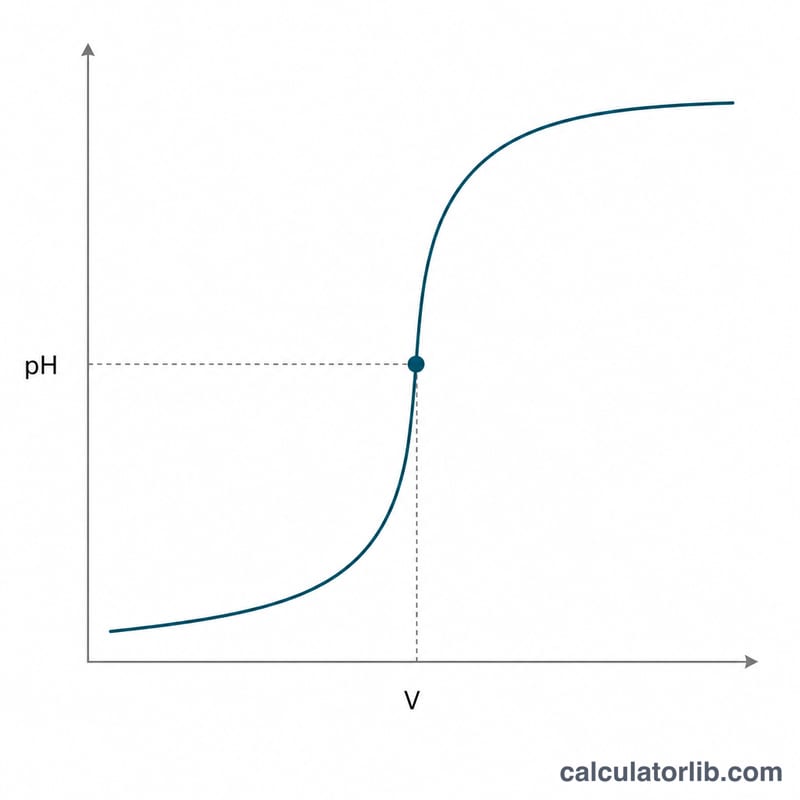
Buffering region and inflection point. Near each pKa the pH changes slowly as titrant is added — the buffering region, centred on the half-equivalence point where pH = pKa. Between buffering regions the curve steepens; the steepest point (maximum of \(dpH/dV\), zero of the second derivative) is the inflection used to locate an equivalence point experimentally. Peptides with pKa values closer than about 2 units give merged, poorly resolved inflections.
Standardised titrant. A titrant whose concentration has been verified against a primary standard (potassium hydrogen phthalate for base, tris or sodium carbonate for acid) rather than trusted from the label. NaOH absorbs atmospheric CO₂ and drifts, so an unstandardised \(C_t\) is the most common source of a systematically wrong \(V_t\).
Titratable Groups and pKa Values for Counting n
The equivalents factor \(n\) is not a property you look up for the whole peptide — you build it by counting the ionizable groups that actually change protonation state inside the pH window you scan. The table lists the standard reference pKa values, which are the values measured for the free amino acids and are the ones quoted in most biochemistry texts.
| Group | Typical pKa | Charge change on adding strong base | Titrated within a pH 2 → 11 sweep? |
|---|---|---|---|
| α-carboxyl terminus (–COOH) | ≈ 2.0–3.5 | 0 → −1 | Yes (usually already partly deprotonated at pH 2, so start low) |
| Asp side chain (β-carboxyl) | ≈ 3.9 | 0 → −1 | Yes |
| Glu side chain (γ-carboxyl) | ≈ 4.3 | 0 → −1 | Yes |
| His imidazole | ≈ 6.0 | +1 → 0 | Yes |
| Cys thiol | ≈ 8.3 | 0 → −1 | Yes (free thiol only; disulfide-bonded Cys is not titratable) |
| α-amino terminus (–NH₃⁺) | ≈ 9.0–9.6 | +1 → 0 | Yes |
| Tyr phenol | ≈ 10.1 | 0 → −1 | Partially — needs pH ≳ 11.5 for full conversion |
| Lys ε-amino | ≈ 10.5 | +1 → 0 | Partially — only ~76 % deprotonated at pH 11 |
| Arg guanidinium | ≈ 12.5 | +1 → 0 | No — normally out of range and excluded from \(n\) |
Important caveat. These are free-amino-acid reference values. Inside a peptide the same group typically shifts by roughly ±1 pH unit — sometimes more — because of the neighbouring backbone, charge–charge interactions, hydrogen bonding and burial in structured peptides. Terminal groups shift the most: an α-carboxyl in a peptide is commonly nearer 3.1–3.6 and an α-amino nearer 7.7–8.5. Treat the table as a counting aid for \(n\), not as a source of exact titration-curve positions.
Worked count. Take the tripeptide H-Asp-Ala-Lys-OH (DAK) with both termini free, titrated with standardised NaOH from pH 2 to pH 11:
- α-carboxyl of the C-terminal Lys — counts, +1
- Asp side chain — counts, +1
- α-amino of the N-terminal Asp — counts, +1
- Lys ε-amino (pKa ≈ 10.5) — only partly titrated by pH 11; include it (+1) only if you sweep to pH ≈ 12, otherwise leave it out
- Ala — no ionizable side chain, contributes nothing
So \(n = 3\) for a pH 2 → 11 titration and \(n = 4\) for a sweep taken past pH 12. If the same sequence were supplied acetylated and C-terminally amidated (Ac-DAK-NH₂), both termini would be blocked and \(n\) would drop to 1 (Asp only) over the pH 2 → 11 window. Always confirm the terminal chemistry on the supplier's certificate of analysis before choosing \(n\).
How to Calculate the Equivalence Point by Hand
The whole calculation is one stoichiometric balance — moles of titrant equal moles of titratable protons:
$$C_t \times V_t = C_p \times V_s \times n \qquad\Longrightarrow\qquad V_t = \frac{C_p \times V_s \times n}{C_t}$$
- Convert the peptide amount to mM. If you started from a weighed solid, use $$C_p(\text{mM}) = \frac{ \text{mass (mg)}}{MW\,(\text{g/mol}) \times V_s(\text{mL})} \times 1000$$ Use the peptide's net peptide content where known — lyophilised peptides carry counter-ions (TFA, acetate) and residual water, so the weighed mass typically overstates the true peptide by 10–30 %.
- Compute the peptide amount in micromoles. \(n_{pep} = C_p \times V_s\). Because 1 mM × 1 mL = 1 µmol, no unit conversion is needed.
- Determine \(n\) from the sequence and the pH window. Count free termini plus ionizable side chains whose pKa falls inside the range you will actually scan (see the pKa table above). Exclude blocked termini, disulfide-bonded cysteines and, in a normal aqueous sweep, arginine.
- Compute the required titrant micromoles. \(n_{eq} = C_p \times V_s \times n\).
- Solve for the unknown. Divide by the titrant concentration to get volume, \(V_t = n_{eq}/C_t\); or divide by a fixed deliverable volume to get the concentration you must prepare, \(C_t = n_{eq}/V_t\).
- Check the units. mM × mL = µmol, and µmol ÷ mM = mL. If your answer is out by a factor of 1000, you almost certainly mixed M with mM or L with mL.
- Compute the volume and dilution at equivalence. \(V_{total} = V_s + V_t\), and the diluted peptide concentration is \(C_{final} = C_p V_s / V_{total}\). The dilution factor \(V_{total}/V_s\) matters if you plan a spectroscopic reading on the titrated solution.
- Sanity-check that \(V_t\) is practical. Aim for a titrant volume that uses a good fraction of the burette — roughly 20–80 % of its nominal capacity, or at least a few hundred microlitres on an automated microtitrator. If \(V_t\) comes out below about 0.1 mL, dilute the titrant; if it exceeds the burette volume or dilutes the sample more than about twofold, concentrate the titrant or reduce \(V_s\).
Worked example
You dissolve 12.0 mg of a peptide of molecular weight 1200 g/mol in 5.00 mL of water and titrate with standardised 50 mM NaOH. The peptide has a free C-terminus, a free N-terminus and one Glu residue, and you scan pH 2 → 11, so \(n = 3\).
- Peptide amount: \(12.0 \div 1200 = 0.0100\) mmol = 10.0 µmol.
- Concentration: \(C_p = 10.0\ \mu\text{mol} \div 5.00\ \text{mL} = 2.00\) mM.
- Equivalents needed: \(n_{eq} = 2.00 \times 5.00 \times 3 = 30.0\) µmol of OH⁻.
- Titrant volume: $$V_t = \frac{2.00\ \text{mM} \times 5.00\ \text{mL} \times 3}{50\ \text{mM}} = \frac{30.0\ \mu\text{mol}}{50\ \text{mM}} = 0.600\ \text{mL}$$
The equivalence point is reached after 0.600 mL of 50 mM NaOH. Total volume at equivalence is \(5.00 + 0.600 = 5.60\) mL, and the diluted peptide concentration is \(C_{final} = 10.0 \div 5.60 = 1.786\) mM — a dilution factor of 1.12. Note that 0.6 mL is a small read on a 50 mL burette; a 1 mL or 2.5 mL micro-burette, or a 10 mM titrant giving \(V_t = 3.00\) mL, would be delivered more precisely.
Equivalence Point Across Typical Titration Scenarios
Every row below follows \(V_t = C_p V_s n / C_t\), with \(V_{total} = V_s + V_t\) and \(C_{final} = C_p V_s / V_{total}\). Rows 1–3 are the same peptide sample titrated over different pH windows (different \(n\)), which is the single largest source of confusion in practice.
| Scenario | Cp (mM) | Vs (mL) | n | Ct (mM) | Vt (mL) | Total volume (mL) | Cfinal (mM) |
|---|---|---|---|---|---|---|---|
| Standard case: 3 titratable groups, 50 mM NaOH | 2 | 10 | 3 | 50 | 1.200 | 11.200 | 1.786 |
| Same sample, blocked termini — only 1 group titrated | 2 | 10 | 1 | 50 | 0.400 | 10.400 | 1.923 |
| Same sample, acidic peptide swept past pH 12 — 5 groups | 2 | 10 | 5 | 50 | 2.000 | 12.000 | 1.667 |
| Dilute sample, dilute titrant (matched pair) | 0.2 | 25 | 2 | 10 | 1.000 | 26.000 | 0.192 |
| Concentrated small-volume sample, 100 mM titrant | 20 | 5 | 4 | 100 | 4.000 | 9.000 | 11.111 |
| Titrant far too strong — impractical delivery | 0.5 | 10 | 2 | 1000 | 0.010 | 10.010 | 0.4995 |
Reading the table
- \(n\) scales \(V_t\) linearly. Rows 1–3 differ only in the equivalents count, and \(V_t\) moves from 0.400 to 2.000 mL. Miscounting a single ionizable group on a tripeptide is a 33 % error in the predicted equivalence volume, which is far larger than any realistic burette error.
- Match titrant strength to sample load. The dilute row (0.2 mM in 25 mL) contains only 10 µmol of titratable protons and needs a 10 mM titrant to give a readable 1.000 mL; the concentrated row carries 400 µmol and needs 100 mM to stay under 5 mL. A useful rule of thumb is to pick \(C_t \approx C_p \times n \times V_s / V_{target}\), with \(V_{target}\) set to a comfortable burette reading.
- The last row is a failure mode, not a recipe. A 1 M titrant against 10 µmol of protons requires 10 µL — below the resolution of most manual burettes, and a single stray drop (~50 µL) would overshoot the equivalence point fivefold. Diluting that titrant 100-fold to 10 mM moves \(V_t\) to 1.000 mL and restores usable precision.
- Watch the dilution. The n = 5 row dilutes the peptide from 2 mM to 1.667 mM (a factor of 1.20) by the time equivalence is reached. If you plan to measure absorbance, fluorescence or a subsequent assay on the titrated solution, correct for \(V_{total}/V_s\) rather than assuming the starting concentration.
FAQ
Is the equivalence point the same as pH 7? No. For a peptide titrated with a strong base the equivalence point usually sits well above 7 because the conjugate base is weakly basic; use the calculated volume as the target and read the actual pH from your curve.
What if I only know mass, not molarity? Divide the mass in milligrams by the peptide molecular weight in g/mol to get micromoles, then divide by the sample volume in mL to get mM.
Why is my measured endpoint larger than the prediction? Buffer salts, dissolved CO2 and counter-ions in a lyophilised peptide all consume titrant. Run a blank titration on the buffer alone and subtract it.