What this eGFR calculator does
Your kidneys filter waste from blood at a rate called the glomerular filtration rate (GFR). Measuring it directly is slow and expensive, so clinicians estimate it from a routine blood test. This calculator uses the CKD-EPI 2021 creatinine equation, the race-free formula now recommended by the NKF-ASN task force and used by most laboratories worldwide. It applies to adults aged 18 and over and reports eGFR in mL/min/1.73 m2, together with the matching KDIGO stage from G1 to G5.
How to use it
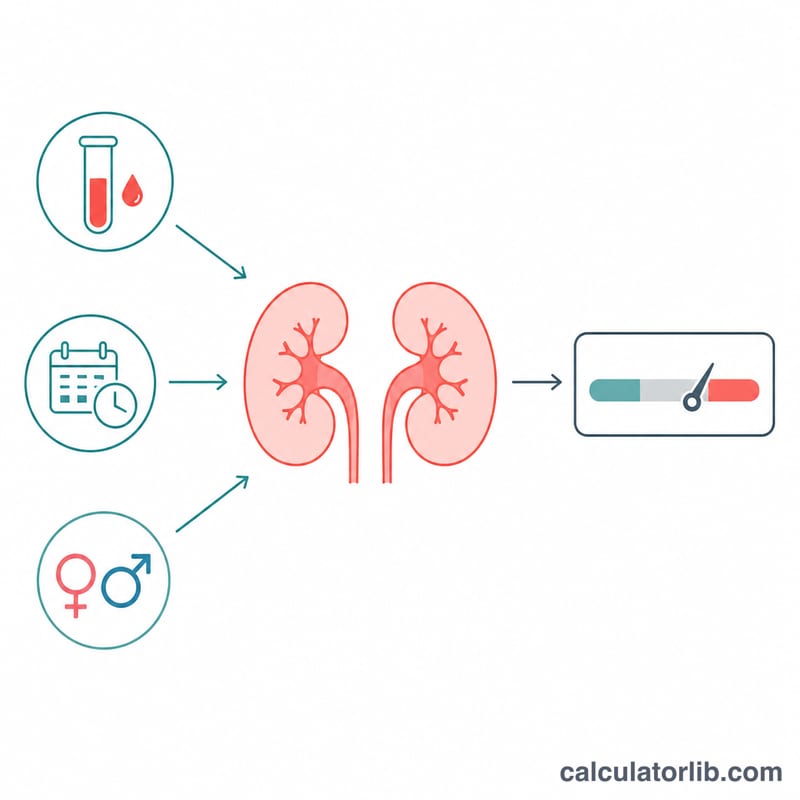
Enter your serum creatinine exactly as your lab report shows it, choose the matching unit (mg/dL or micromol/L), then add your age and sex. Values reported in micromol/L are converted with \(S_{cr}[\text{mg/dL}] = S_{cr}[\mu\text{mol/L}] / 88.4\) before the equation is applied.
The formula explained
The equation is a power model fitted to measured GFR data:
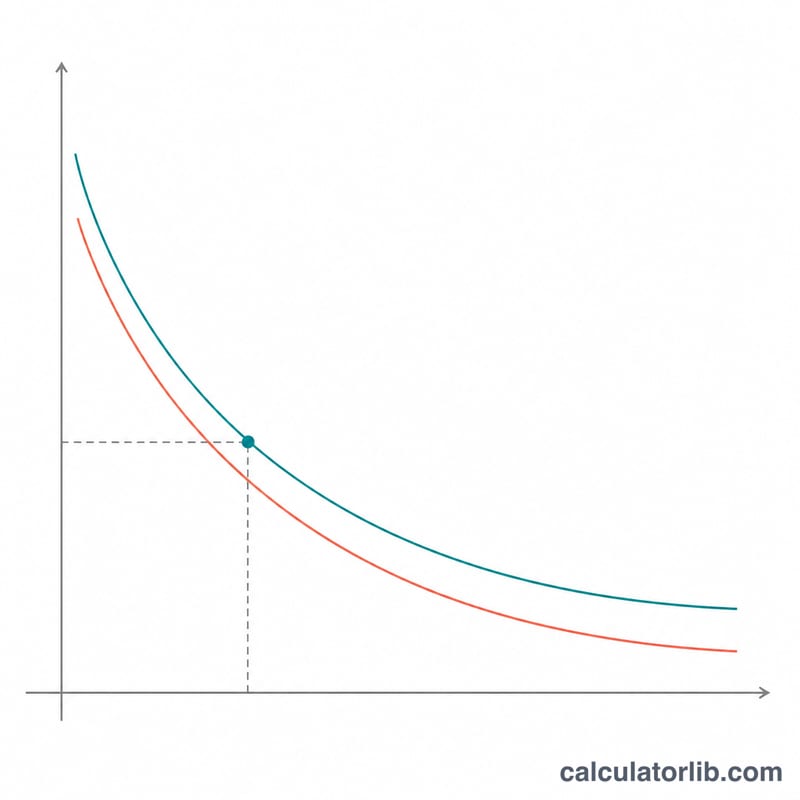
$$\text{eGFR} = 142 \times \min\!\left(\frac{S_{cr}}{\kappa},1\right)^{\alpha} \times \max\!\left(\frac{S_{cr}}{\kappa},1\right)^{-1.200} \times 0.9938^{\text{Age}} \times 1.012_{\,[\text{female}]}$$Here \(S_{cr}\) = serum creatinine in mg/dL, \(\kappa = 0.7\) for females and \(0.9\) for males, and \(\alpha = -0.241\) for females and \(-0.302\) for males. The two-piece min/max structure lets the curve bend more steeply once creatinine rises above the sex-specific threshold \(\kappa\), and \(0.9938^{\text{Age}}\) captures the roughly 0.6% per year decline in filtration with age.
Worked example
A 60-year-old man with a creatinine of 1.1 mg/dL: the ratio is \(1.1/0.9 = 1.2222\), which is above 1, so the min term equals 1 and only the max term applies.
$$\text{eGFR} = 142 \times 1.2222^{-1.200} \times 0.9938^{60} = 142 \times 0.7860 \times 0.6886 \approx 76.9$$That is 76.9 mL/min/1.73 m2, or stage G2 (mildly decreased).
Interpreting Your eGFR Result
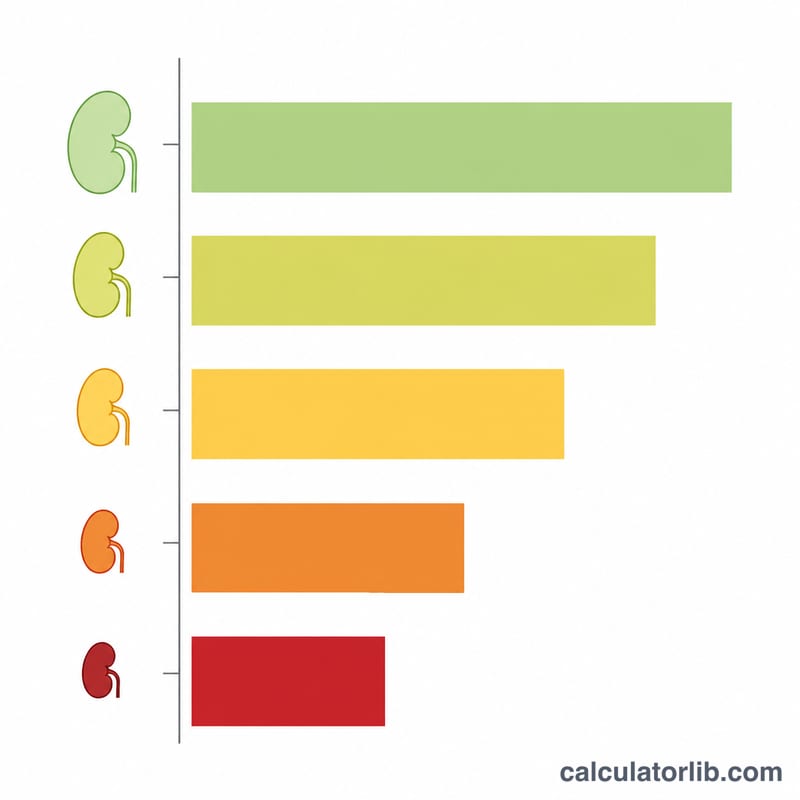
Your estimated glomerular filtration rate (eGFR) is reported in mL/min/1.73 m² — a filtration rate normalised to a standard adult body surface area. The value is placed into one of the GFR categories (G1–G5) defined by the international KDIGO chronic kidney disease guideline:
- G1 — eGFR ≥ 90: normal or high filtration. On its own this is not chronic kidney disease. G1 is only labelled CKD when a marker of kidney damage is also present, such as albuminuria, urine sediment abnormalities, electrolyte abnormalities of tubular origin, histological or imaging evidence of structural disease, or a history of kidney transplantation.
- G2 — eGFR 60–89: mildly decreased. Again, this is common with increasing age and, without a damage marker, is not classified as CKD by itself.
- G3a — eGFR 45–59: mildly to moderately decreased.
- G3b — eGFR 30–44: moderately to severely decreased.
- G4 — eGFR 15–29: severely decreased.
- G5 — eGFR < 15: kidney failure (the suffix D is added when the person is treated with dialysis).
CKD requires persistence. A diagnosis of chronic kidney disease requires the abnormality of kidney structure or function to be present for at least 3 months. A single low eGFR — for example after dehydration, an acute illness or a new medication — does not establish CKD and may instead reflect acute kidney injury. KDIGO also asks that staging be written as CGA: the Cause of kidney disease, the GFR category (G1–G5) and the Albuminuria category (A1–A3), e.g. "diabetic kidney disease, G3a A2". A GFR number alone is an incomplete stage.
Worked example
For a male, age 55 years, serum creatinine 1.3 mg/dL, the race-free CKD-EPI 2021 equation gives \(\kappa = 0.9\), \(\alpha = -0.302\), sex factor \(F = 1.000\):
$$\text{eGFR} = 142 \times \min\left(\frac{1.3}{0.9},\,1\right)^{-0.302} \times \max\left(\frac{1.3}{0.9},\,1\right)^{-1.200} \times 0.9938^{\,55} \times 1.000$$$$= 142 \times 1^{-0.302} \times 1.4444^{-1.200} \times 0.9938^{\,55} = 142 \times 1 \times 0.6433 \times 0.7103 \approx 65$$The result, about 65 mL/min/1.73 m², falls in category G2 (mildly decreased) — which would only be called CKD if a damage marker such as albuminuria were also present and persisted for 3 months or more.
Where the estimate is unreliable
eGFR is an estimate derived from serum creatinine, which depends on muscle mass and diet as well as on kidney filtration. The CKD-EPI 2021 creatinine equation is validated for stable adults aged 18 and over and should be interpreted with caution or not used at all in:
- acute kidney injury or any rapidly changing creatinine (the equation assumes a steady state);
- pregnancy;
- extremes of muscle mass — amputation, bodybuilding or high muscularity, sarcopenia, cachexia, paralysis, advanced cirrhosis;
- vegetarian or vegan diets, very low protein intake, large cooked-meat meals before the blood draw, and creatine supplementation;
- children and adolescents, who require paediatric equations instead.
When a creatinine-based estimate is doubted, a cystatin-C-based CKD-EPI equation (cystatin C alone, or the combined creatinine–cystatin C equation, which is the most accurate of the three) is used for confirmation; measured clearance studies are reserved for special cases. Even under ideal conditions the equation's accuracy is expressed as P30 — the proportion of estimates within 30% of measured GFR — which is roughly 85–90%. In practical terms, an eGFR of 50 is compatible with a true GFR of about 35–65, so trends over repeated tests matter more than a single number.
This is general educational information, not medical advice, and no diagnosis or treatment can be inferred from it. Discuss your eGFR, your albuminuria result and any change over time with a doctor or other qualified clinician, who will interpret them alongside your history, medications and other tests.
CKD Stages (KDIGO G1–G5) Reference Table
| Stage | eGFR (mL/min/1.73 m²) | Description |
|---|---|---|
| G1 | ≥ 90 | Normal or high |
| G2 | 60–89 | Mildly decreased |
| G3a | 45–59 | Mildly to moderately decreased |
| G3b | 30–44 | Moderately to severely decreased |
| G4 | 15–29 | Severely decreased |
| G5 | < 15 | Kidney failure |
Source: KDIGO Clinical Practice Guideline for the Evaluation and Management of Chronic Kidney Disease (2012, updated 2024) — an international guideline, used worldwide rather than being specific to one country.
Footnote: "Decreased" is relative to the normal level in a young adult. Categories G1 and G2 are not classified as CKD in the absence of markers of kidney damage (for example albuminuria, urine sediment or electrolyte abnormalities, structural findings on imaging or biopsy, or kidney transplantation); the abnormality must also persist for at least 3 months.
Albuminuria categories, which complete the CGA stage, are based on the urine albumin-to-creatinine ratio (ACR):
| Category | Urine ACR | Description |
|---|---|---|
| A1 | < 30 mg/g (< 3 mg/mmol) | Normal to mildly increased |
| A2 | 30–300 mg/g (3–30 mg/mmol) | Moderately increased |
| A3 | > 300 mg/g (> 30 mg/mmol) | Severely increased |
CKD-EPI 2021 Coefficients (κ and α) by Sex
This calculator uses the race-free CKD-EPI 2021 creatinine equation (Inker et al., New England Journal of Medicine, 2021), which is the equation recommended for adults by the US National Kidney Foundation–American Society of Nephrology task force and widely adopted internationally. It is not the same as the 2009 CKD-EPI equation, which used a constant of 141 and included a separate race coefficient for Black patients; the 2021 version replaces that coefficient and re-fits the constant to 142 with slightly revised sex terms, so values from the two equations differ modestly.
$$\text{eGFR} = 142 \times \min\left(\frac{S_{cr}}{\kappa},\,1\right)^{\alpha} \times \max\left(\frac{S_{cr}}{\kappa},\,1\right)^{-1.200} \times 0.9938^{\,A} \times F$$| Sex | κ (mg/dL) | α | Sex factor F | Constant |
|---|---|---|---|---|
| Female | 0.7 | −0.241 | 1.012 | 142 |
| Male | 0.9 | −0.302 | 1.000 | 142 |
Terms shared by both sexes:
| Term | Value | Note |
|---|---|---|
| max-term exponent | −1.200 | Applies to \(\max(S_{cr}/\kappa,\,1)\); active when creatinine is above κ |
| Age term | \(0.9938^{\,A}\) | \(A\) = age in whole years; about −0.62% per year of age |
| Creatinine unit | mg/dL | Serum (or plasma) creatinine, IDMS-traceable assay |
| Unit conversion | µmol/L ÷ 88.4 = mg/dL | e.g. 115 µmol/L ÷ 88.4 ≈ 1.30 mg/dL; mg/dL × 88.4 = µmol/L |
| Result unit | mL/min/1.73 m² | Body-surface-area indexed; de-index by × BSA/1.73 for drug dosing decisions made by a clinician |
Because \(\min(S_{cr}/\kappa,1)\) equals 1 whenever creatinine is at or above κ, the α exponent only shapes the curve at low creatinine values, while the −1.200 exponent governs the steeper decline at higher creatinine values.
FAQ
Is a low eGFR the same as kidney disease? No. Chronic kidney disease requires an eGFR below 60 that persists for at least three months, or other markers such as albuminuria. One low reading may simply reflect dehydration or a recent high-protein meal.
Why does the result stop at around 90-120? Creatinine-based estimates are imprecise in the normal range, so many labs report anything above 90 or 120 as normal rather than as an exact figure.
Does the 2021 equation use race? No. The older 2009 CKD-EPI and MDRD equations included a Black race coefficient; the 2021 version removes it, which slightly lowers estimates for Black patients and slightly raises them for others.