What This Calculator Does
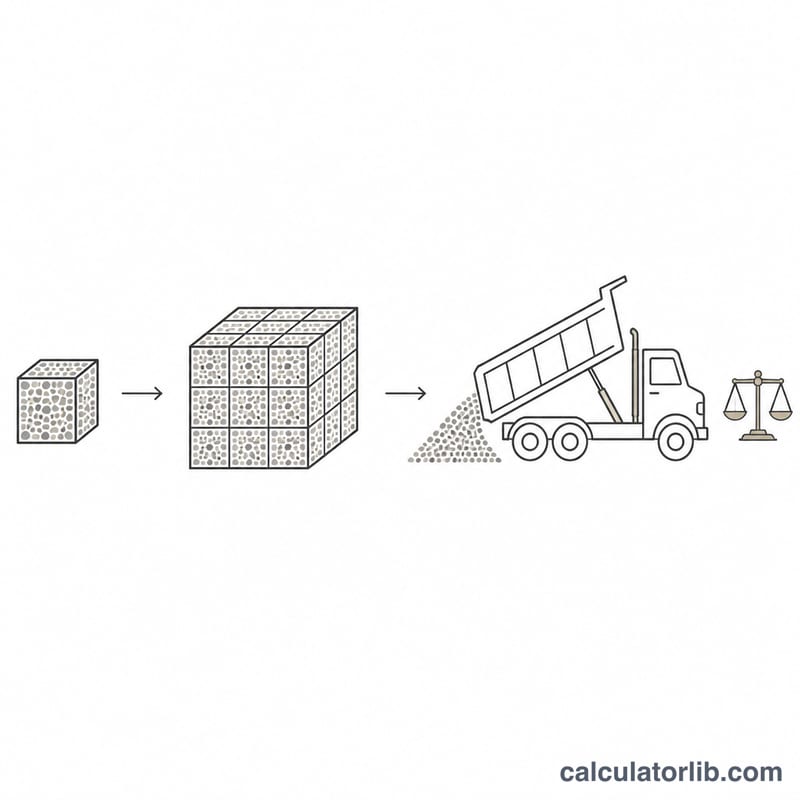
A gravel driveway is priced by volume, not by area, so the only way to budget it accurately is to convert your driveway footprint into cubic yards first. This calculator takes the length, width and desired gravel depth of your drive, converts the result into cubic feet, cubic yards and approximate tons, then multiplies by your supplier price per cubic yard and adds any delivery or labor fee. Dimensions use feet and inches and volume is reported in cubic yards, the standard bulk-aggregate unit; the prices are your own, so any currency works.
The Formula Explained
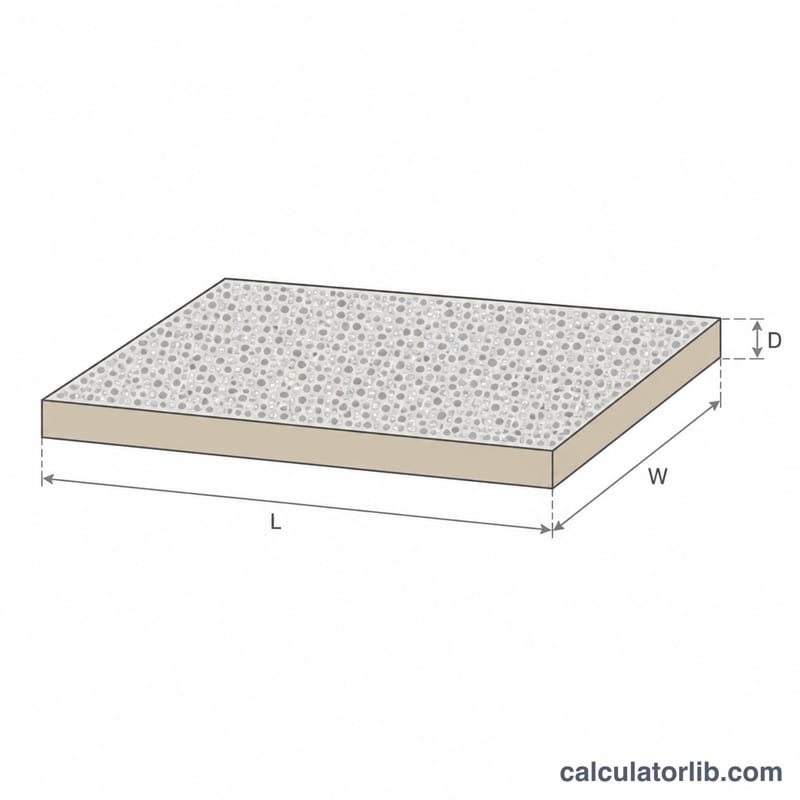
With \(L\) = length in feet, \(W\) = width in feet, \(D\) = depth in inches, \(w\) = waste allowance as a decimal, \(P\) = price per cubic yard and \(F\) = delivery fee:
$$C = \frac{L \times W \times \frac{D}{12}}{27} \times (1 + w) \times P + F$$Dividing the depth by 12 converts inches to feet; dividing by 27 converts cubic feet to cubic yards. Weight is estimated as \(1.4\) tons per cubic yard, a common figure for crushed stone, though densities range from about 1.2 to 1.7.
Worked Example
A 40 ft by 10 ft driveway with 4 inches of gravel, priced at 45 per cubic yard with a 100 delivery fee and a 10% waste allowance:
$$V = \frac{40 \times 10 \times \frac{4}{12}}{27} = 4.94\,\text{yd}^3$$$$C = 4.94 \times 1.10 \times 45 + 100 = 344.44$$That is about 5.43 cubic yards to order, roughly 7.6 tons, or about 0.86 per square foot installed.
Gravel Types, Densities and Typical Prices
Driveway aggregate is sold by volume (cubic yards) or by weight (short tons) in the United States, and the two are linked by the material's loose density — the density as it sits in the truck, before compaction. Most driveway aggregates fall between roughly 1.2 and 1.7 tons per cubic yard. To convert a density in tons per cubic yard into pounds per cubic foot, multiply by 2000 and divide by 27:
$$\rho_{lb/ft^3} = \rho_{t/yd^3} \times \frac{2000}{27} \qquad \text{e.g.}\quad 1.4 \times \frac{2000}{27} \approx 103.7\ \text{lb/ft}^3$$
| Material | Typical loose density (tons/yd³) | Approx. lb/ft³ | Typical price per yd³ (USD) | Typical price per ton (USD) | Usual role in the driveway |
|---|---|---|---|---|---|
| Crushed stone #57 (¾ in, clean) | 1.3 – 1.4 | 96 – 104 | $30 – $60 | $20 – $45 | Middle layer, or top layer where a clean, free-draining stone is wanted |
| Crusher run / QP / ABC / Item 4 (stone + fines) | 1.4 – 1.6 | 104 – 119 | $25 – $50 | $18 – $35 | Base and middle layers; binds and compacts into a firm surface |
| Pea gravel (⅜ in, rounded) | 1.3 – 1.4 | 96 – 104 | $40 – $80 | $30 – $60 | Decorative top layer only; rounded stone migrates under traffic |
| #3 base stone (1–2 in) | 1.3 – 1.4 | 96 – 104 | $25 – $55 | $18 – $40 | Bottom/base layer on soft or wet subgrade |
| Decomposed granite (DG) | 1.4 – 1.5 | 104 – 111 | $50 – $100 | $35 – $70 | Top layer; compacts to a firm, fine surface (common in the US Southwest) |
| River rock (rounded, 1–3 in) | 1.3 – 1.5 | 96 – 111 | $60 – $130 | $45 – $100 | Decorative top layer, borders and drainage areas |
| Recycled crushed concrete | 1.2 – 1.4 | 89 – 104 | $15 – $40 | $10 – $28 | Budget base layer; behaves much like crusher run |
Important qualifications. The size designations #57 and #3 are US aggregate size numbers from ASTM D448 / AASHTO M43; elsewhere you will see different names (for example UK Type 1 / MOT sub-base, or EN 13242 gradings) for broadly equivalent materials. Densities depend on the parent rock (limestone, granite, basalt, trap rock), the gradation and the moisture content, so always ask your supplier for their conversion factor before ordering by weight. The price bands above are broad US supplier bands for material only, picked up at the quarry or before delivery, and they vary by a factor of two or more with region, haul distance, quarry proximity and season — treat them as a sanity check on a quote, never as a quote.
Recommended Depths, Widths and Waste Allowances
These are widely used North American rules of thumb for residential gravel drives, expressed in feet and inches with metric equivalents in parentheses. Local codes, HOA rules, frost depth and soil conditions can all override them, and a soft, organic or clay subgrade always needs more stone than a firm one.
Depth
- Per layer: place gravel in lifts of about 4 in (100 mm) loose and compact each lift before adding the next. Thicker lifts do not compact all the way through.
- Refresh / top-up of an existing drive: 2–3 in (50–75 mm) of new surface stone.
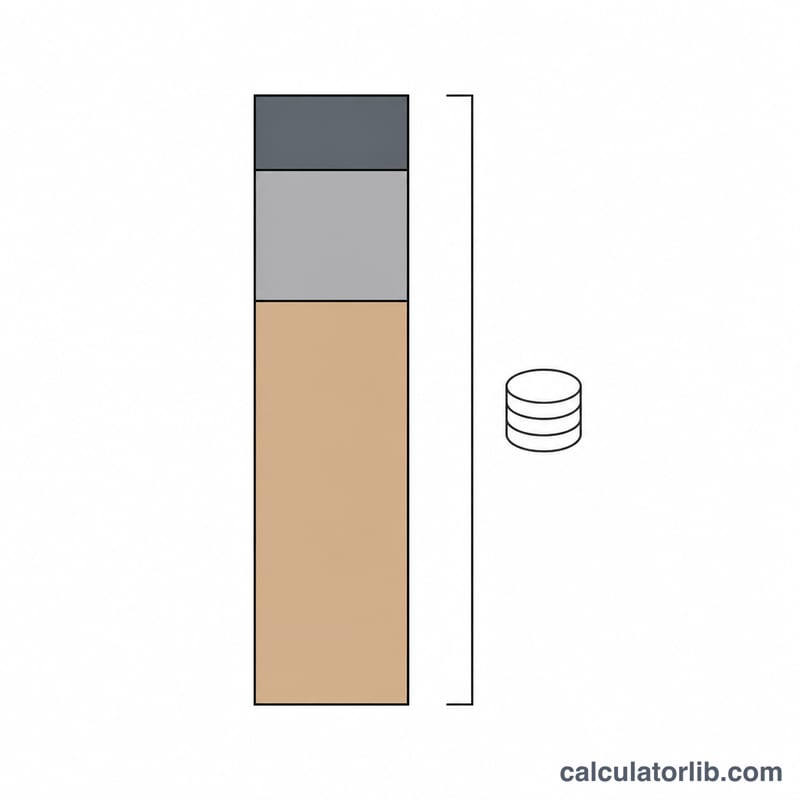
- New residential driveway over a compacted subgrade: 8–12 in (200–300 mm) total, typically a coarse base lift, a middle lift and a surface lift.
- Heavy vehicles, farm/truck access, or soft or poorly drained soil: 12–18 in (300–450 mm) total, sometimes more where the subgrade pumps under load.
Width
- Single lane: 10–12 ft (3.0–3.7 m).
- Double lane / two cars side by side: 20–24 ft (6.1–7.3 m).
- Add roughly 2 ft (0.6 m) of extra width on curves and at turns so wheels do not run off the stone, and measure turnarounds, aprons and parking pads as separate rectangles.
Waste allowance and compaction
- Waste allowance: 5–15%. Use 5–8% on a flat, firm, well-shaped site with clean edges; 10–15% where the ground is soft, sloped, rutted or irregular, or where stone will spread past the intended edge. This is the Waste (%) input in the calculator.
- Compaction loss: about 15–20%. Loose delivered gravel loses roughly this much volume when it is rolled or plate-compacted, so a finished 4 in compacted lift needs closer to 4¾–5 in of loose material. If you specify the compacted depth you want, either enter a depth about 20% greater or fold the compaction factor into your waste allowance — but do not double-count it if your supplier already quotes compacted volume.
Site preparation
Common practice before any stone is placed: strip topsoil and vegetation, grade the subgrade to shed water (a crown or cross-slope of roughly 2%), compact the subgrade, and lay a woven geotextile separation fabric between soil and stone on soft or wet ground. Fabric is inexpensive relative to aggregate and markedly reduces the rate at which stone disappears into the subgrade. Edging (timber, steel or a shallow trench) keeps the surface layer from spreading and lowers the amount of top-up stone needed later.
How to Calculate Gravel Driveway Cost by Hand
The whole calculation is one volume conversion plus a price lookup. In US customary units:
$$V_{yd} = \frac{L \times W \times \frac{D}{12}}{27} \times \left(1 + \frac{w}{100}\right)$$
where \(L\) and \(W\) are in feet, \(D\) is depth in inches, \(w\) is the waste allowance in percent, 12 converts inches to feet and 27 converts cubic feet to cubic yards.
- Measure length and width in feet. For an irregular drive, average several width measurements, and treat turnarounds, aprons and parking pads as separate rectangles that you add on.
- Choose the depth in inches and convert it to feet by dividing by 12.
- Multiply \(L \times W \times D/12\) to get cubic feet.
- Divide by 27 to get cubic yards (1 yd³ = 27 ft³).
- Multiply by \((1 + w/100)\) to add the waste allowance.
- Multiply cubic yards by the supplier's density (a common default is 1.4 tons/yd³) if you need tons.
- Multiply cubic yards by the price per cubic yard, or tons by the price per ton — whichever way your supplier sells.
- Add delivery. Delivery is charged per truckload, so round up to whole loads: a tandem dump truck typically hauls on the order of 10–14 yd³ (about 15 tons) per trip, but ask your supplier for their load size and per-load fee.
- Repeat per layer and sum if the base, middle and top layers use different materials at different prices.
Worked example: 50 ft × 12 ft at 4 in, 10% waste, $45/yd³, $100 delivery
- Area: \(50 \times 12 = 600\ \text{ft}^2\)
- Depth in feet: \(4 \div 12 = 0.3333\ \text{ft}\)
- Volume: \(600 \times 0.3333 = 200\ \text{ft}^3\)
- Cubic yards: \(200 \div 27 = 7.41\ \text{yd}^3\)
- With waste: \(7.41 \times 1.10 = 8.15\ \text{yd}^3\)
- Tons at 1.4 t/yd³: \(8.15 \times 1.4 = 11.4\ \text{tons}\)
- Material: \(8.15 \times \$45 = \$366.67\)
- Plus delivery: \(\$366.67 + \$100 = \$466.67\)
Total estimated cost: $466.67, or about $0.78 per square foot. Sanity-check the weight before you order: 11.4 tons is close to a single tandem load, so one delivery fee is realistic here.
Cost by Driveway Size and Depth
Assumptions used in every row: a single blended material price of $45 per cubic yard, a 10% waste allowance, a density of 1.4 tons per cubic yard, and delivery at $100 per truckload with each load carrying up to about 14 yd³ (rounded up to whole loads). Prices are illustrative US figures in USD; substitute your own supplier quote, because a real quote can easily be half or double this. Volumes shown are loose delivered volume — if you need a compacted finished depth, allow a further 15–20%.
| Scenario | Square feet | Depth | Cubic yards (incl. 10% waste) | Approx. tons at 1.4 t/yd³ | Material at $45/yd³ | Delivery | Total | Cost per ft² |
|---|---|---|---|---|---|---|---|---|
| Top-up of an existing drive, 40 × 10 ft | 400 | 3 in | 4.07 | 5.7 | $183.33 | 1 load — $100 | $283.33 | $0.71 |
| New residential drive, 50 × 12 ft | 600 | 4 in | 8.15 | 11.4 | $366.67 | 1 load — $100 | $466.67 | $0.78 |
| Rural / long drive, 100 × 12 ft | 1,200 | 6 in | 24.44 | 34.2 | $1,100.00 | 2 loads — $200 | $1,300.00 | $1.08 |
| Parking pad, 24 × 24 ft | 576 | 4 in | 7.82 | 11.0 | $352.00 | 1 load — $100 | $452.00 | $0.78 |
| Heavy-duty drive, 150 × 12 ft, three 4 in lifts | 1,800 | 12 in total | 73.33 | 102.7 | $3,300.00 | 6 loads — $600 | $3,900.00 | $2.17 |
Reading the table. Cost scales linearly with area and with depth, so doubling the depth doubles the material bill — depth, not width, is usually what pushes a project from a few hundred dollars to a few thousand. Delivery is a step function: a small top-up pays a full load fee for a partly filled truck, which is why per-square-foot cost is relatively high on small jobs and why combining nearby work into one delivery saves money. The heavy-duty row is deliberately priced with one blended rate for clarity; in practice you would price a cheaper crusher-run or recycled-concrete base separately from the surface stone, which typically lowers that total. None of these figures include subgrade excavation, geotextile fabric, edging, compaction equipment rental or labor — on a contracted installation those items can equal or exceed the cost of the stone itself.
FAQ
How deep should the gravel be? Two to three inches is enough for a top-up layer, while a new driveway usually needs four inches per layer and often three layers totalling 8 to 12 inches over compacted subgrade.
Why add a waste allowance? Gravel compacts under traffic, settles into soft soil and spills at the edges. A 5 to 15 percent allowance keeps you from ordering a second short load, which usually carries a second delivery fee.
Should I buy by the ton or the yard? Either works. If your supplier quotes tons, divide the tonnage shown here by the load size, or multiply cubic yards by the density the supplier gives you instead of the default 1.4.