
What is the Titration Calculator?
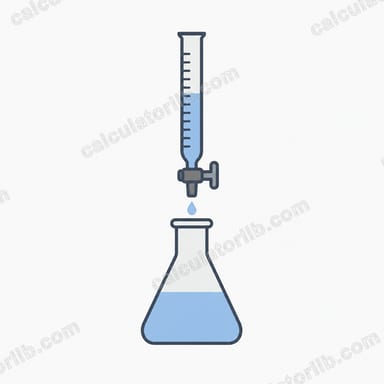
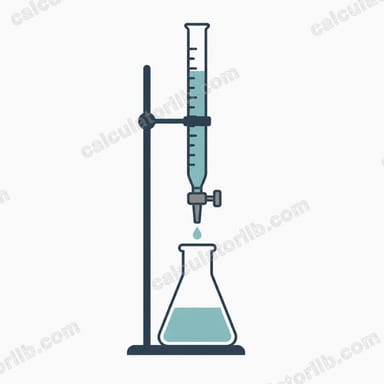
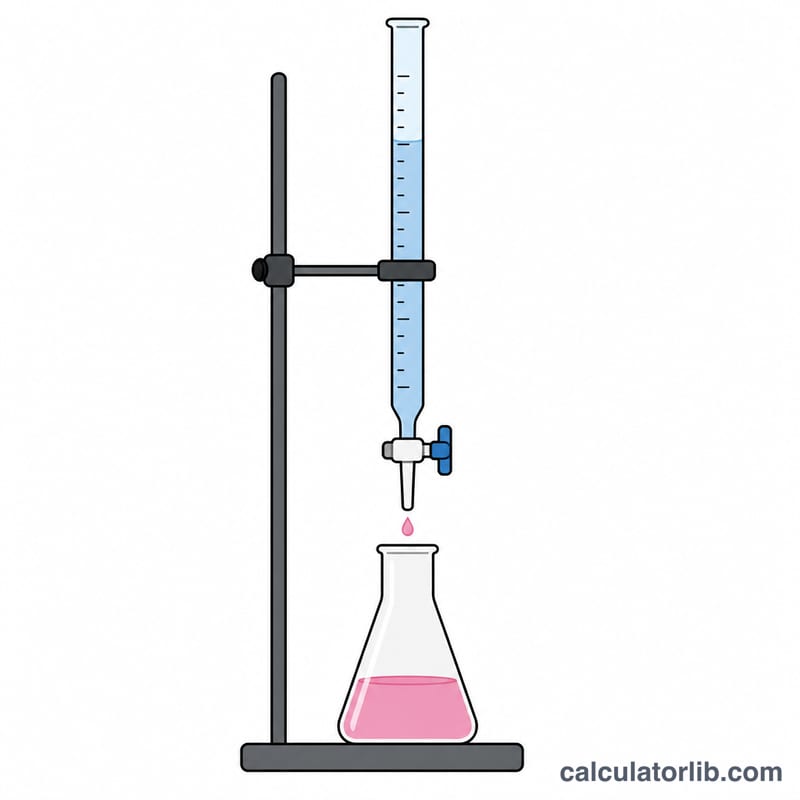
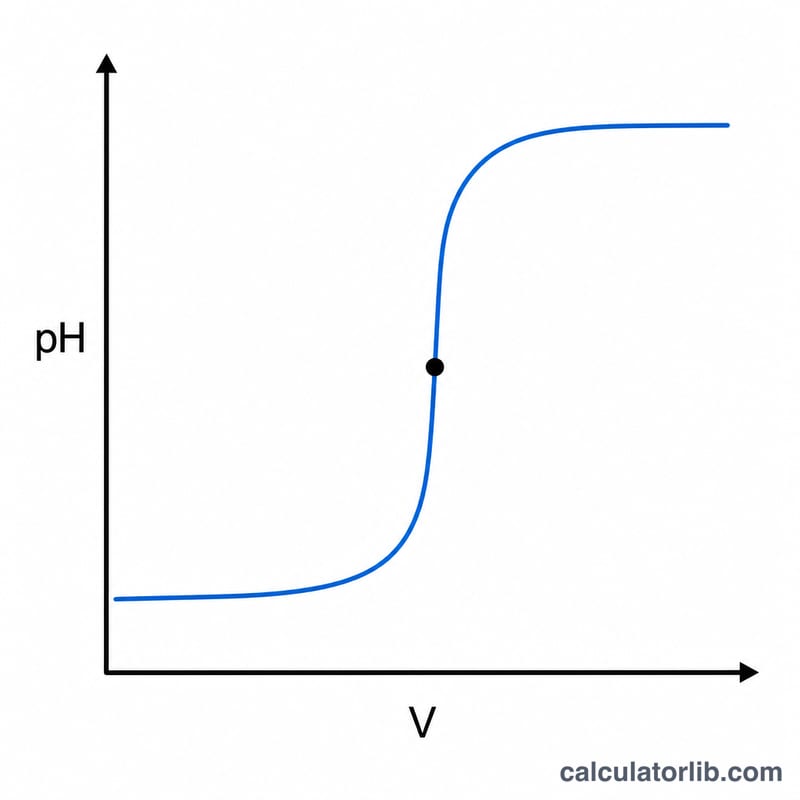
Titration is a quantitative laboratory technique used to determine the unknown concentration of a substance (the analyte) by reacting it with a solution of known concentration (the titrant). When the reaction reaches its equivalence point — usually signalled by an indicator colour change or a pH/potential jump — the moles of titrant added are stoichiometrically equivalent to the moles of analyte present. This calculator turns those readings into the analyte concentration instantly.
How to use it
Enter the titrant's molar concentration, the volume of titrant dispensed to reach the endpoint, and the volume of the analyte sample. Then enter the stoichiometric coefficients from the balanced equation — for a 1:1 reaction like HCl + NaOH, both are 1. For H₂SO₄ + 2NaOH, the analyte (H₂SO₄) coefficient is 1 and the titrant (NaOH) coefficient is 2. Click calculate to get the analyte concentration in mol/L plus the moles reacted.
The formula explained
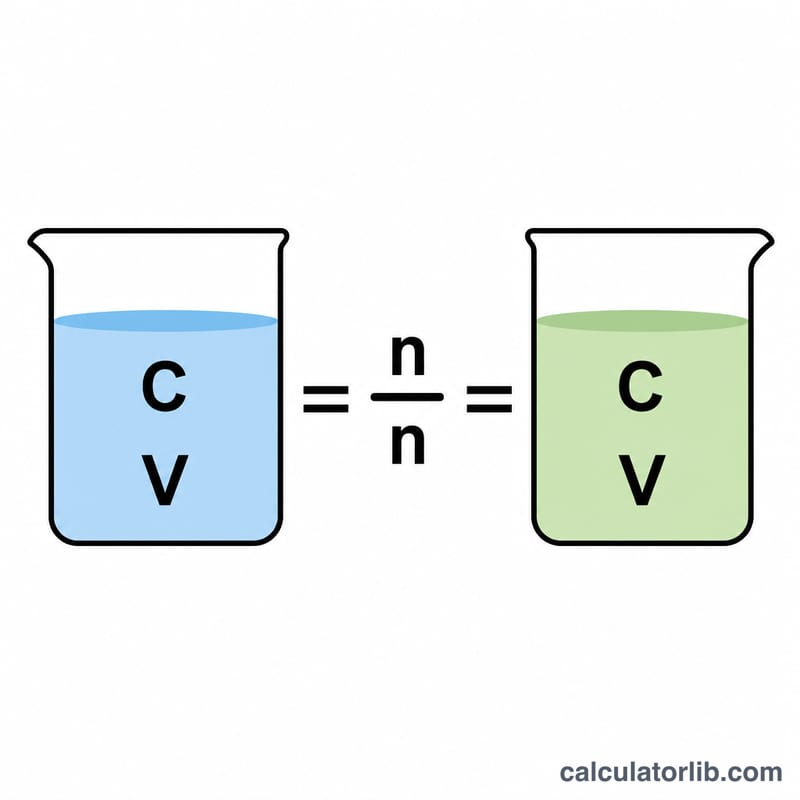
The core relationship is $$C_{\text{analyte}} = \frac{C_{\text{titrant}} \times V_{\text{titrant}} \times n_{\text{analyte}}}{V_{\text{analyte}} \times n_{\text{titrant}}}$$ Because the same volume unit (mL) appears in both numerator and denominator as a ratio, it cancels — so you can enter volumes in millilitres directly. The stoichiometric ratio \(n_{\text{analyte}}/n_{\text{titrant}}\) scales the result to account for reactions that are not 1:1.
Worked example
A 20.00 mL sample of HCl is titrated with 0.100 mol/L NaOH, requiring 25.00 mL to reach the endpoint (1:1 reaction). $$C_{\text{analyte}} = \frac{0.100 \times 25.00 \times 1}{20.00 \times 1} = \frac{2.5}{20} = \mathbf{0.125 \text{ mol/L}}$$ Moles of titrant = \(0.100 \times 25/1000 = 0.0025\) mol.
FAQ
Do I need to convert mL to L? No. Since volumes appear as a ratio they cancel, so use any consistent unit for both volumes.
What if my reaction is not 1:1? Use the coefficients from the balanced chemical equation. For example, titrating sulfuric acid with sodium hydroxide gives \(n_{\text{analyte}} = 1\) and \(n_{\text{titrant}} = 2\).
Does this work for redox titrations? Yes — use the mole ratio of analyte to titrant from the balanced redox equation as the coefficients.