What This Calculator Does
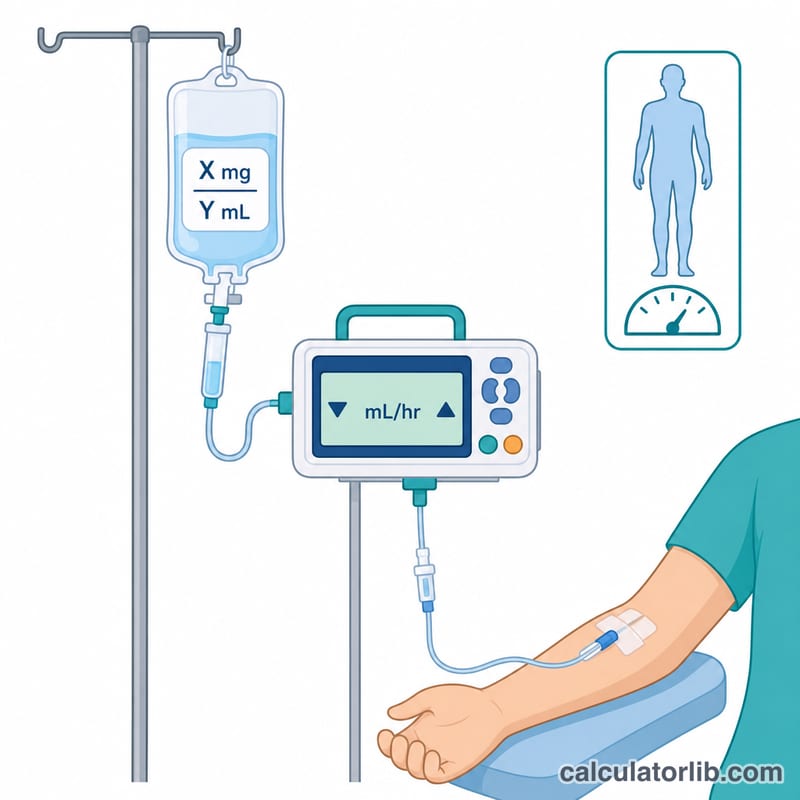
This tool converts a weight-based drug dose into a continuous IV infusion pump rate expressed in millilitres per hour (mL/hr). It is widely used for vasoactive and titratable medications such as dopamine, dobutamine, norepinephrine and nitroglycerin, where the prescribed dose is given in micrograms per kilogram per minute (mcg/kg/min) but the infusion pump must be programmed in mL/hr. This is a general clinical calculation tool — always verify against your local protocols and a second clinician before administration.
How to Use It
Enter three values: the prescribed dose in mcg/kg/min, the patient weight in kilograms, and the concentration of the prepared solution in mcg/mL. The calculator returns the pump rate in mL/hr, plus the total dose delivered per minute and per hour for cross-checking.
The Formula Explained
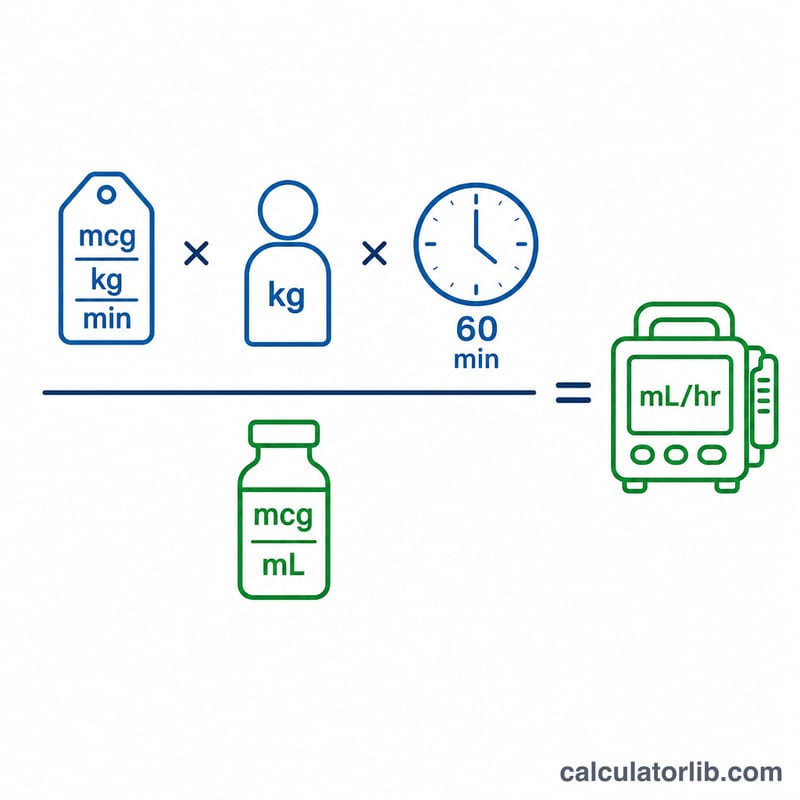
The dose per minute is the dose multiplied by body weight (mcg/min). Multiplying by 60 converts this to an hourly dose (mcg/hr). Dividing by the solution concentration (mcg/mL) cancels the micrograms and leaves the volume per hour:
$$\text{Rate (mL/hr)} = \frac{\text{Dose (mcg/kg/min)} \times \text{Weight (kg)} \times 60}{\text{Concentration (mcg/mL)}}$$If your concentration is labelled in mg/mL, multiply it by 1000 to convert to mcg/mL before entering it.
Worked Example
A 70 kg patient is prescribed dopamine at 5 mcg/kg/min. The bag contains 400 mg dopamine in 250 mL, giving a concentration of \(400{,}000 \text{ mcg} \div 250 \text{ mL} = 1600 \text{ mcg/mL}\). Dose per minute = \(5 \times 70 = 350 \text{ mcg/min}\). Hourly dose = \(350 \times 60 = 21{,}000 \text{ mcg/hr}\). Rate = \(21{,}000 \div 1600 =\) 13.13 mL/hr.
Concentration and Unit Conversions for Infusions
Infusion rate calculations only work when every quantity uses consistent units. The calculator needs a dose in mcg/kg/min, a weight in kg, and a concentration in mcg/mL. These are the conversions most often needed to get there.
| Conversion | Rule | Example |
|---|---|---|
| mg to mcg | 1 mg = 1000 mcg | 4 mg = 4000 mcg |
| g to mg | 1 g = 1000 mg | 2 g = 2000 mg |
| mg/mL to mcg/mL | × 1000 | 1.6 mg/mL = 1600 mcg/mL |
| mcg/kg/hr to mcg/kg/min | ÷ 60 | 300 mcg/kg/hr = 5 mcg/kg/min |
| mg/hr to mcg/min | × 1000 ÷ 60 | 60 mg/hr = 1000 mcg/min |
| lb to kg | ÷ 2.2046 | 154 lb ≈ 69.9 kg |
Example: drug amount and bag volume to concentration
A bag contains 400 mg of drug in 250 mL of solution.
- Convert mg to mcg: \(400 \text{ mg} \times 1000 = 400{,}000 \text{ mcg}\).
- Divide by the volume: \(400{,}000 \text{ mcg} \div 250 \text{ mL} = 1600 \text{ mcg/mL}\).
Use this 1600 mcg/mL value in the concentration field. Always check whether a stated bag volume includes the drug volume, and use the final total volume as labeled on the product or pharmacy preparation.
Pump Rate Comparison Across Doses and Concentrations
Each row uses \(\text{Rate (mL/hr)} = \dfrac{\text{Dose} \times \text{Weight} \times 60}{\text{Concentration}}\). The values are illustrations of the arithmetic only, not dosing recommendations.
| Scenario | Dose (mcg/kg/min) | Weight (kg) | Concentration (mcg/mL) | Calculation | Rate (mL/hr) |
|---|---|---|---|---|---|
| Dopamine 400 mg/250 mL | 2 | 70 | 1600 | 2 × 70 × 60 ÷ 1600 = 8400 ÷ 1600 | 5.25 |
| Dopamine 400 mg/250 mL | 5 | 70 | 1600 | 21,000 ÷ 1600 | 13.125 (≈ 13.1) |
| Dopamine 400 mg/250 mL | 10 | 70 | 1600 | 42,000 ÷ 1600 | 26.25 |
| Dobutamine 250 mg/250 mL | 5 | 70 | 1000 | 21,000 ÷ 1000 | 21 |
| Dobutamine 250 mg/250 mL | 10 | 70 | 1000 | 42,000 ÷ 1000 | 42 |
| Lighter patient, same dose | 5 | 50 | 1600 | 15,000 ÷ 1600 | 9.375 (≈ 9.4) |
| Heavier patient, same dose | 5 | 100 | 1600 | 30,000 ÷ 1600 | 18.75 |
| Standard concentration | 5 | 70 | 1600 | 21,000 ÷ 1600 | 13.125 (≈ 13.1) |
| Double-strength (800 mg/250 mL) | 5 | 70 | 3200 | 21,000 ÷ 3200 | 6.5625 (≈ 6.56) |
Takeaways: the rate scales linearly with both dose and weight, so doubling either one doubles the mL/hr. It scales inversely with concentration, so doubling the concentration halves the mL/hr. Always confirm the actual concentration on the bag label before programming a pump.
Key Terms and Units
- mcg/kg/min
- Micrograms of drug delivered per kilogram of body weight per minute. It is the common unit for weight-based continuous infusions.
- Concentration (mcg/mL)
- The amount of drug in micrograms contained in each milliliter of solution. It equals total drug in mcg divided by total volume in mL.
- Pump rate (mL/hr)
- The volume of solution an infusion pump delivers per hour. It is the number programmed into the pump.
- Titration
- Adjusting the infusion dose up or down in steps in response to a patient's measured response, according to a prescriber's order or protocol.
- Weight-based dosing
- Calculating a dose in proportion to body weight (usually in kg), so the total amount delivered scales with the patient's size.
- Dose per minute vs per hour
- The same dose can be written per minute or per hour. A per-hour value is 60 times the per-minute value, so mcg/kg/hr ÷ 60 = mcg/kg/min. Mixing the two is a common source of error.
- Standard (premixed) concentration
- A fixed drug concentration prepared by a manufacturer or pharmacy for a given drug, for example 1600 mcg/mL (400 mg in 250 mL). Standard concentrations are meant to reduce calculation and preparation errors.
This is general educational information, not professional medical advice. Doses and concentrations must follow a prescriber's order, institutional protocols, and independent verification.
FAQ
What if my dose is in mcg/min (not weight-based)? Enter a weight of 1 kg and put the full dose in the dose field; the weight term then has no effect.
How do I find the concentration? Divide the total drug amount (in mcg) by the total volume of the bag (in mL).
Is this safe to use clinically? It is a calculation aid only. Always double-check with hospital protocols and an independent verification before infusing any medication.