
What This Calculator Does
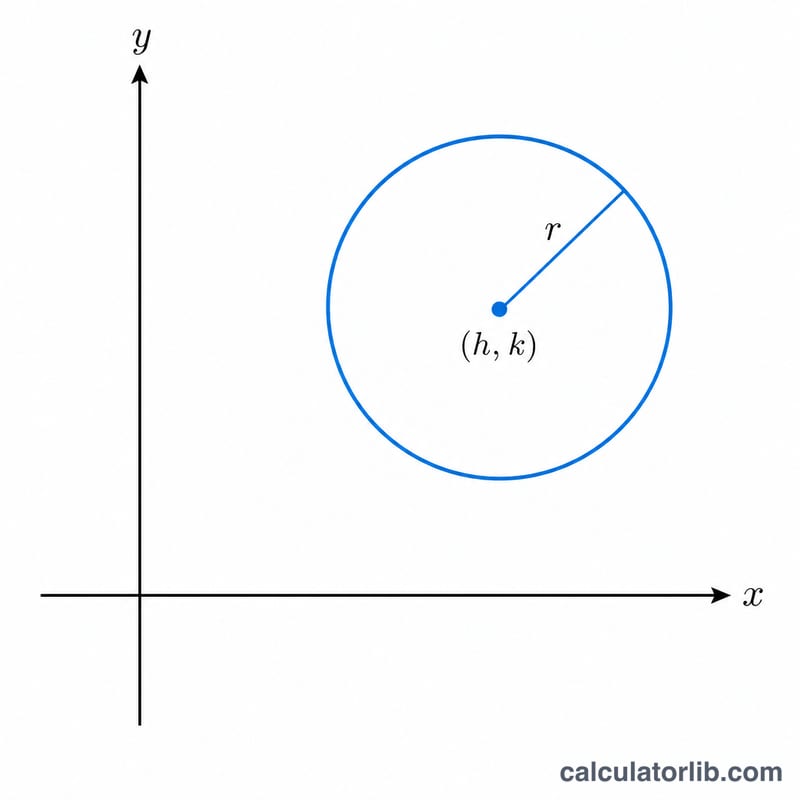
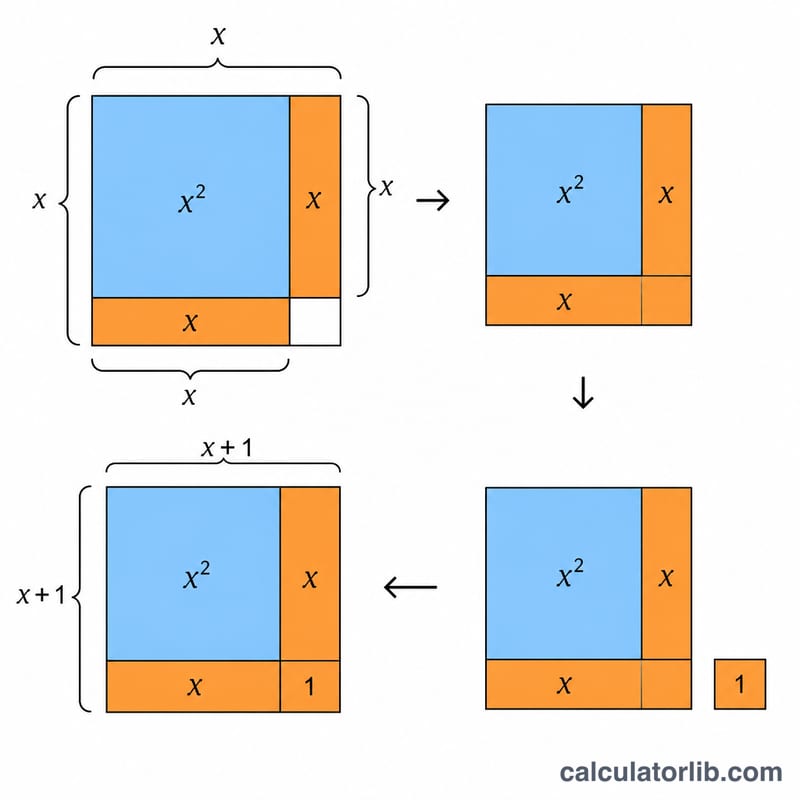
A circle written in general form as \(x^{2}+y^{2}+Dx+Ey+F=0\) hides its center and radius. This calculator uses the algebraic technique of completing the square to rewrite the equation in standard form \((x-h)^{2}+(y-k)^{2}=r^{2}\), revealing the center \((h, k)\) and the radius \(r\) at a glance.
How to Use It
Read the three coefficients directly off your equation: \(D\) is the number multiplying \(x\), \(E\) is the number multiplying \(y\), and \(F\) is the constant term. Enter each value (including its sign) and the calculator returns the center coordinates and the radius. A negative \(r^{2}\) value means the equation has no real circle (the points are imaginary).
The Formula Explained
Completing the square groups the x-terms and y-terms: \((x^{2}+Dx)+(y^{2}+Ey)=-F\). Adding \((D/2)^{2}\) and \((E/2)^{2}\) to both sides forms perfect squares, giving $$\left(x+\frac{D}{2}\right)^{2}+\left(y+\frac{E}{2}\right)^{2}=\frac{D^{2}}{4}+\frac{E^{2}}{4}-F.$$ Comparing with the standard form shows the center is \(\left(-\frac{D}{2}, -\frac{E}{2}\right)\) and the radius is the square root of the right-hand side.
Worked Example
Take \(x^{2}+y^{2}-6x+8y+9=0\), so \(D=-6\), \(E=8\), \(F=9\). Center $$x=-\frac{-6}{2}=3$$ and center $$y=-\frac{8}{2}=-4,$$ giving center \((3, -4)\). Then $$r^{2}=\frac{36}{4}+\frac{64}{4}-9=9+16-9=16,$$ so \(r=\sqrt{16}=4\). The standard form is $$(x-3)^{2}+(y+4)^{2}=16.$$
FAQ
What if \(r^{2}\) is negative? The equation describes no real circle — there is no set of real points satisfying it.
What if \(r^{2}\) equals zero? The "circle" collapses to a single point at the center, called a degenerate or point circle.
Does this work if the \(x^{2}\) and \(y^{2}\) coefficients are not 1? Divide the entire equation by that common coefficient first so both squared terms have coefficient 1, then enter \(D\), \(E\), and \(F\).