
What is the Square in a Circle Calculator?
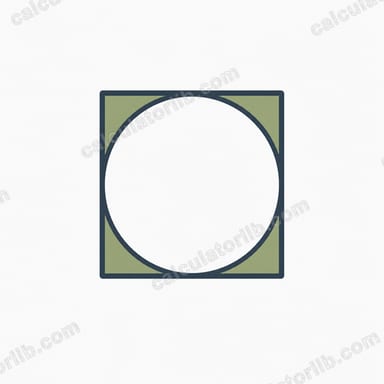
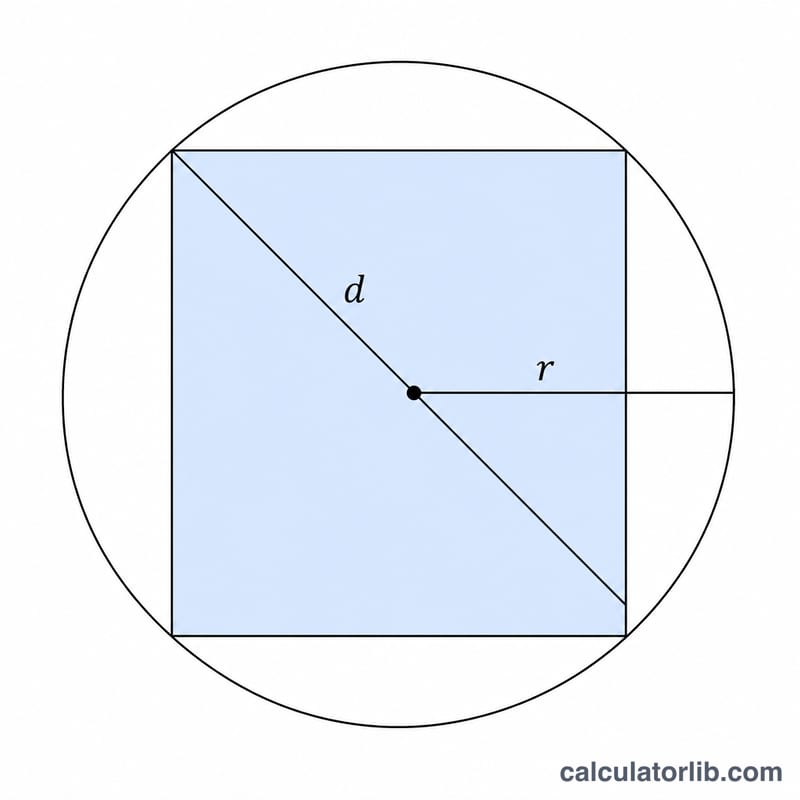
This tool finds the largest square that can be drawn inside a circle (an inscribed square). For the biggest possible square, all four corners touch the circle, which means the square's diagonal is exactly the circle's diameter. From a single input — the circle's radius — the calculator returns the square's side length, diagonal, area, perimeter and how much of the circle the square fills.
How to use it
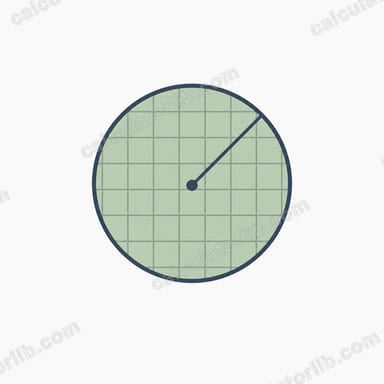
Enter the radius \(r\) of your circle in any unit (cm, inches, metres — the answers come out in the same unit). Click calculate to see the inscribed square's dimensions. Use it for design layouts, woodworking, CNC cutting, tiling, or geometry homework.
The formula explained
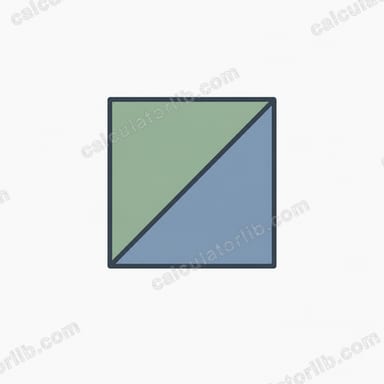
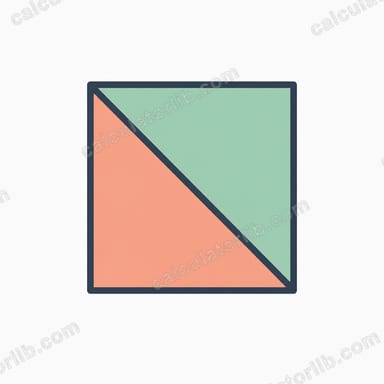
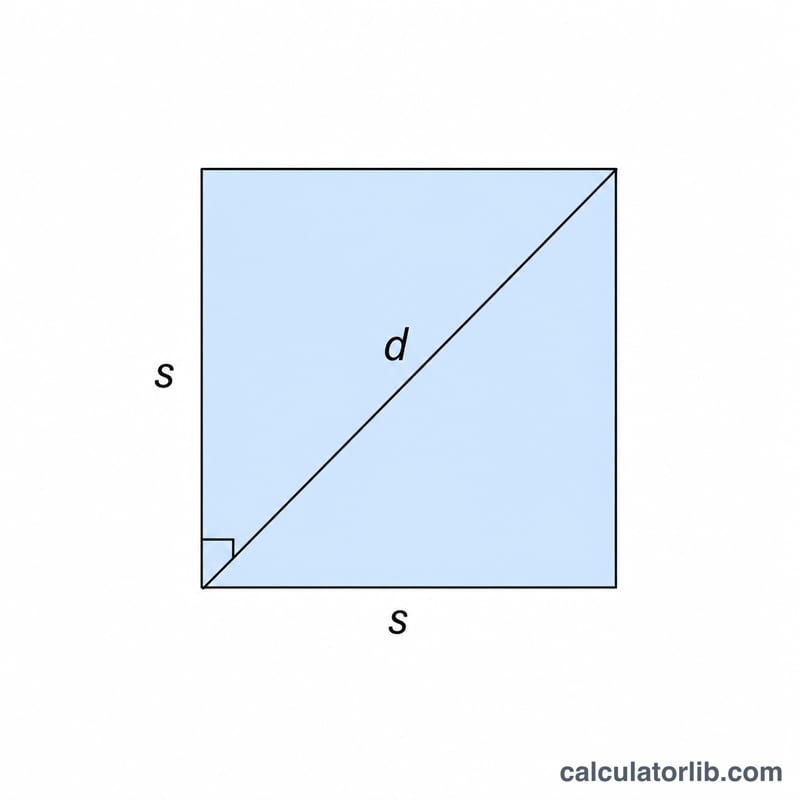
Because the square's diagonal equals the circle's diameter, the diagonal is \(d = 2r\). A square with side \(s\) has a diagonal of \(s\sqrt{2}\), so setting \(s\sqrt{2} = 2r\) gives the side:
$$s = r\sqrt{2}$$. The area is then \(A = s^2 = 2r^2\), and the perimeter is \(P = 4s\). The fill ratio compares the square area to the circle area (\(\pi r^2\)): \(2r^2 / (\pi r^2) = 2/\pi \approx 63.66\%\).
Worked example
Suppose \(r = 5\). The side is $$s = 5 \times \sqrt{2} \approx 7.07.$$ The diagonal is \(2 \times 5 = 10\) (the diameter). The area is \(2 \times 5^2 = 50\). The perimeter is \(4 \times 7.07 \approx 28.28\). The square covers about \(63.66\%\) of the circle's area.
FAQ
Why is the diagonal the diameter? The largest inscribed square has its four vertices on the circle, so the line between opposite corners passes through the centre — that line is a diameter.
What fraction of the circle does the square cover? Always \(2/\pi \approx 63.66\%\), regardless of radius.
Can I work backwards from the side? Yes: if you know the side \(s\), the radius is \(r = s / \sqrt{2}\) and the circle's diameter is the square's diagonal \(s\sqrt{2}\).