
What this square calculator does
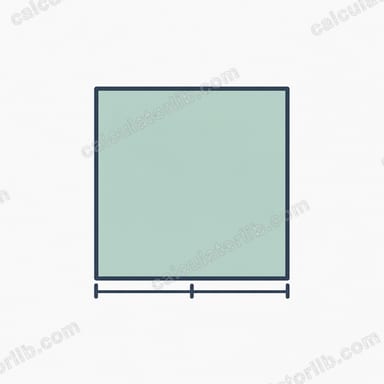
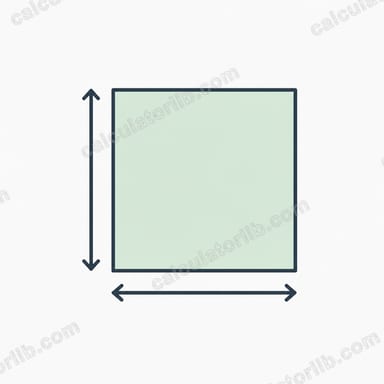
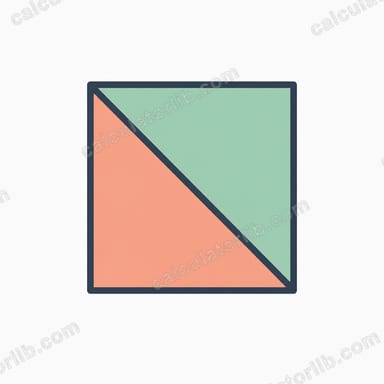
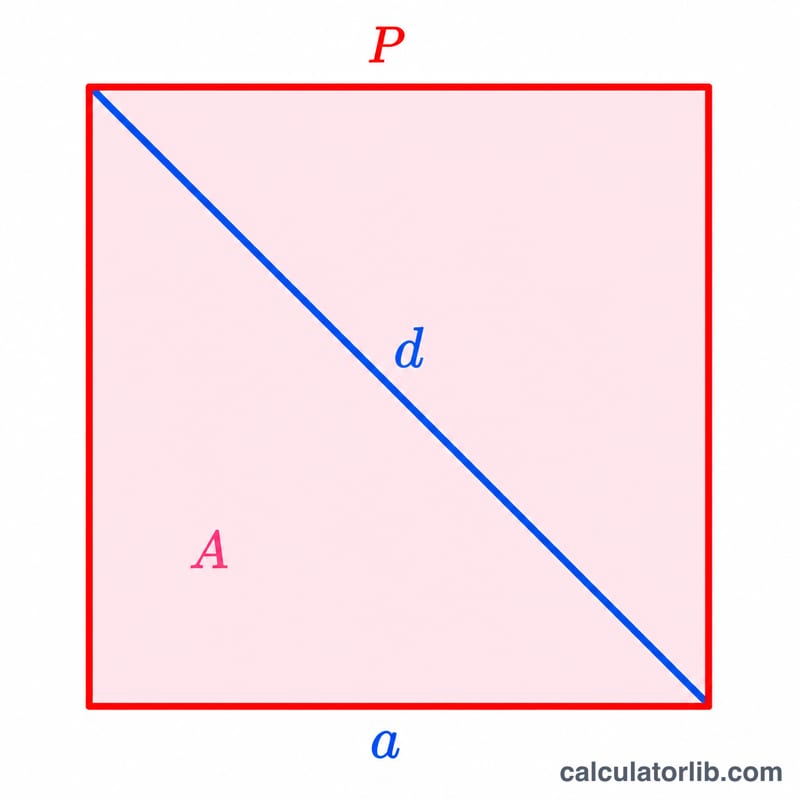
A square is a quadrilateral with four equal sides and four right angles. Because every measurement of a square is tied to a single value, the side length, you only need one known property to determine all the others. This tool lets you enter any one of the side length, diagonal, perimeter, or area and instantly returns the complete set: side, diagonal, perimeter, and area.
How to use it
Choose which property you already know from the "Known property" dropdown, type its value, then pick a display unit and how many significant figures you want. The calculator first recovers the side length and then derives the remaining three quantities. Units are cosmetic labels only, no unit conversion is applied, so the numbers are independent of which unit you select. Linear results (side, diagonal, perimeter) show the unit; area shows the unit squared.
The formulas explained
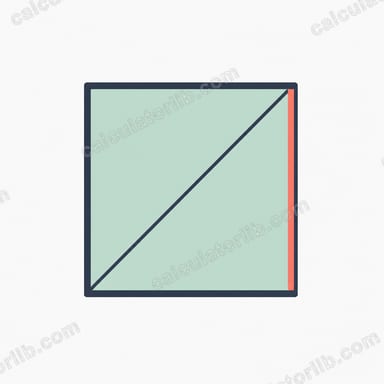
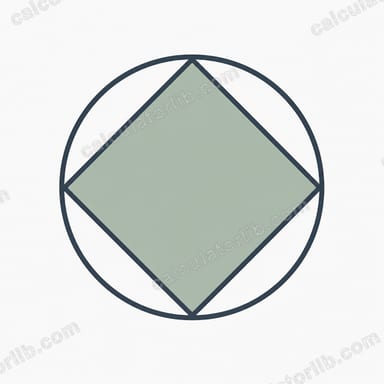
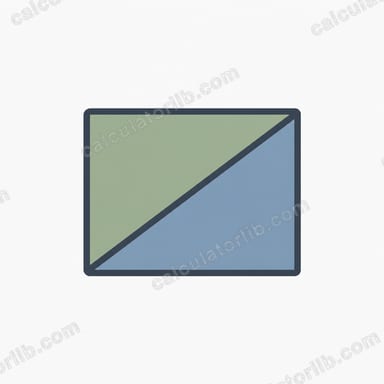
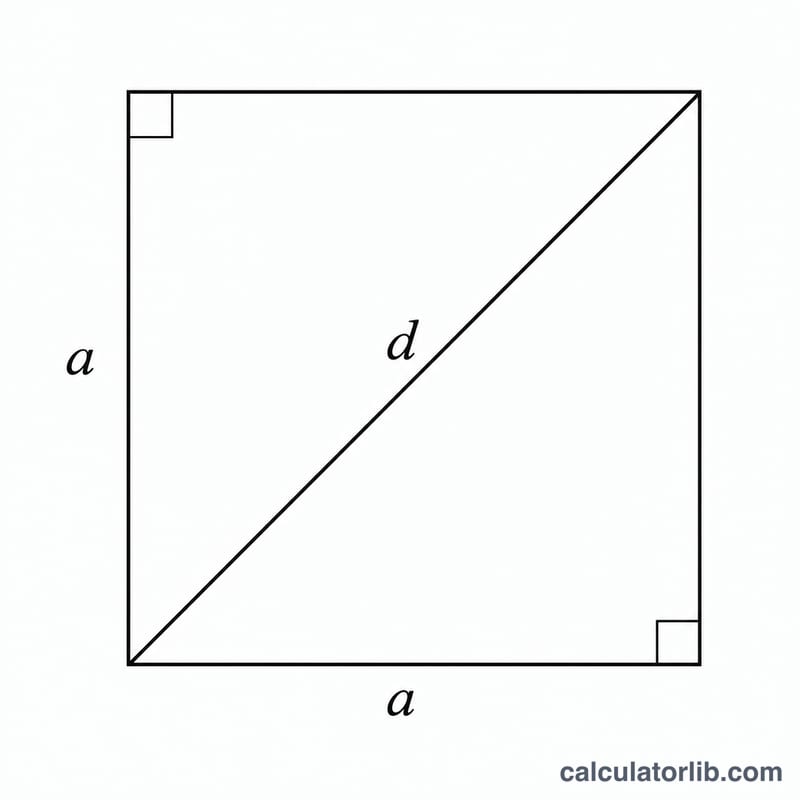
The defining relationships for a square with side \(a\) are: diagonal \(q = a\sqrt{2}\) (from the Pythagorean theorem on two equal legs), perimeter \(P = 4a\) (four equal sides), and area \(A = a^2\).
$$q = a\sqrt{2}, \quad P = 4a, \quad A = a^2$$
To work backward, the side is recovered with \(a = q/\sqrt{2}\) when the diagonal is known, \(a = P/4\) from the perimeter, and \(a = \sqrt{A}\) from the area.
$$a = \frac{q}{\sqrt{2}} = \frac{P}{4} = \sqrt{A}$$
Once \(a\) is known, the other three follow directly from the core relations.
Worked example
Suppose the diagonal \(q = 10\). First find the side:
$$a = \frac{10}{\sqrt{2}} = 7.07107$$
Then perimeter and area:
$$P = 4 \times 7.07107 = 28.2843$$
$$A = 7.07107^2 = 50$$
So a square with a diagonal of 10 has a side of about 7.07107, a perimeter of about 28.2843, and an area of exactly 50.
FAQ
Why is the diagonal always longer than the side? Because the diagonal spans corner to corner across two perpendicular sides, it equals the side multiplied by \(\sqrt{2} \approx 1.41421\), so it is always about 41% longer than a side.
Does the unit setting change the math? No. The unit is only a printed label; no conversion is performed. Enter the value in whatever unit you like and read the answers in that same unit.
What does "auto" significant figures mean? It shows the full computed value without rounding, which is handy when you need maximum precision.