
What is water hardness?
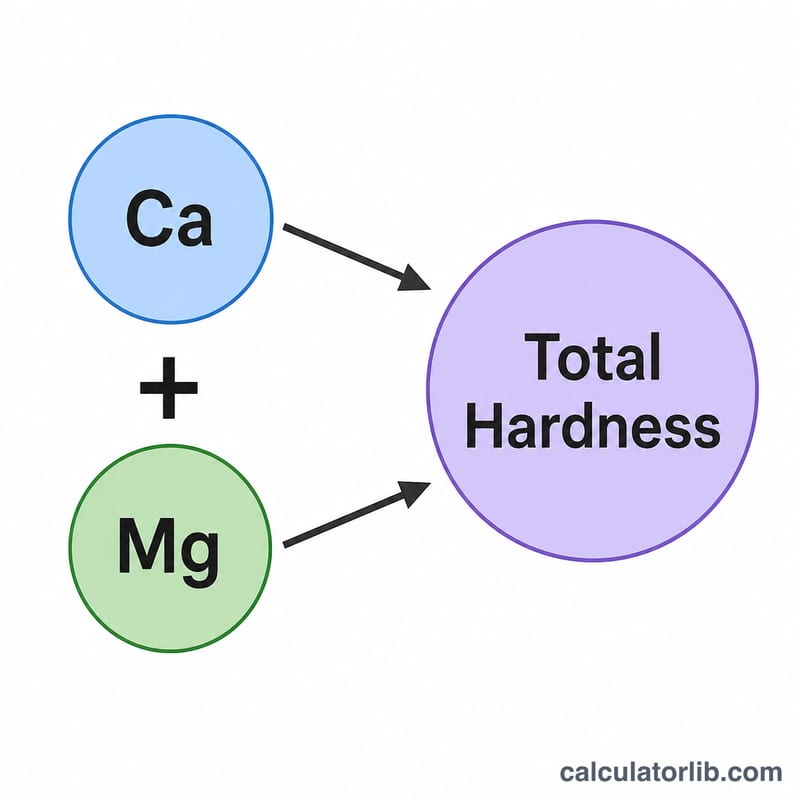
Water hardness measures the amount of dissolved calcium and magnesium in water. It is conventionally expressed as the equivalent concentration of calcium carbonate (CaCO₃) in milligrams per litre (mg/L), which is the same as parts per million (ppm). Hard water can cause scale buildup in pipes, kettles and appliances, while very soft water can be corrosive.
How to use this calculator
Enter the calcium concentration and magnesium concentration of your water sample in mg/L (these values usually come from a lab report or test kit). The calculator converts each ion to its CaCO₃ equivalent, adds them together to give total hardness, also reports the value in grains per gallon (gpg), and classifies the water from soft to very hard.
The formula explained
Each ion is converted using the ratio of CaCO₃ molar mass (100.09 g/mol) to the ion's effective equivalent mass. For calcium the factor is about \(2.497\) and for magnesium about \(4.118\):
$$\text{Hardness (mg/L as CaCO}_3\text{)} = \text{Ca} \times 2.497 + \text{Mg} \times 4.118$$
To express hardness in grains per gallon, divide the result by \(17.118\).
Worked example
Suppose a water sample contains 80 mg/L calcium and 25 mg/L magnesium. Calcium contributes \(80 \times 2.497 = 199.76\) mg/L and magnesium contributes \(25 \times 4.118 = 102.95\) mg/L. Total hardness:
$$\text{Total hardness} = 199.76 + 102.95 = 302.71 \text{ mg/L as CaCO}_3$$
equal to about 17.68 gpg — classified as "very hard".
FAQ
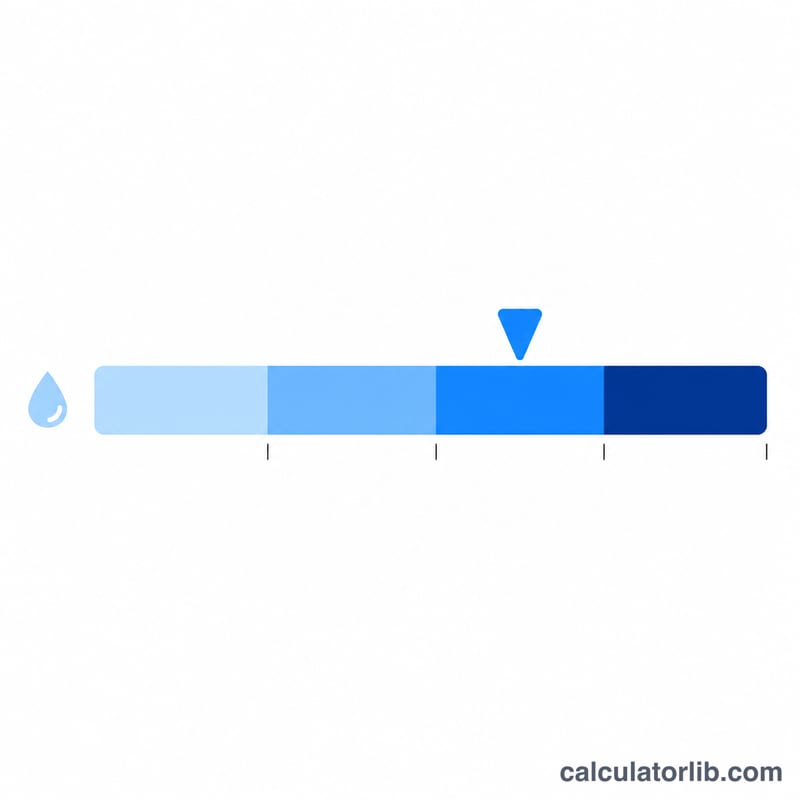
What counts as hard water? A common scale: under 60 mg/L is soft, 60–120 is moderately hard, 120–180 is hard, and above 180 mg/L is very hard.
Is hard water bad for health? No. Hard water is not a health risk and actually supplies dietary calcium and magnesium; the main drawback is scale and reduced soap lathering.
How do I convert ppm to grains per gallon? Divide the mg/L (ppm) value by \(17.118\). So 171.18 mg/L equals exactly 10 gpg.