
What Is the Actual Yield Calculator?
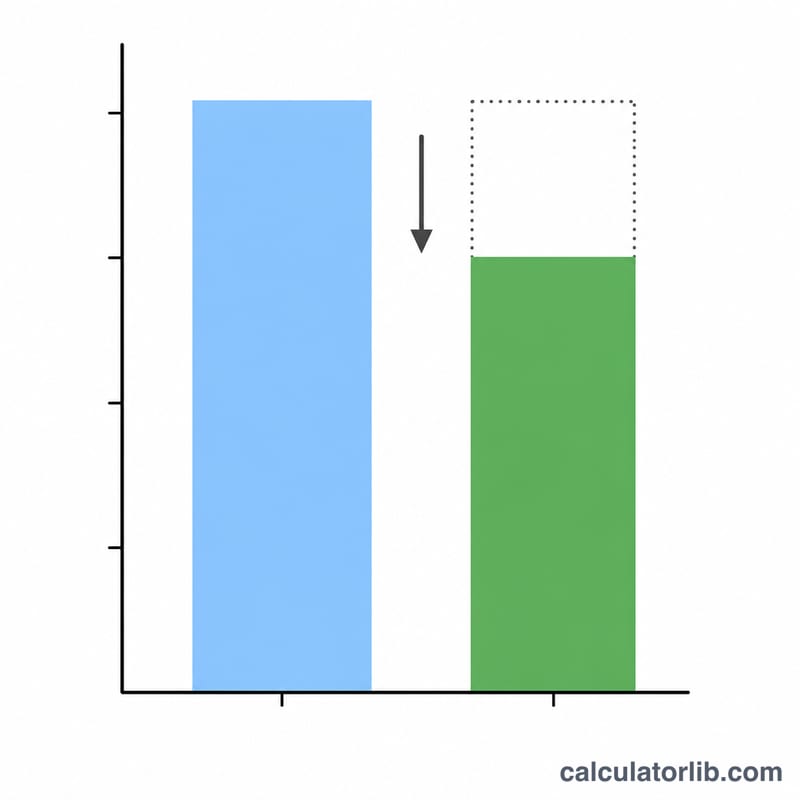
In chemistry, the actual yield is the real amount of product obtained from a reaction, measured in the laboratory. It is almost always less than the theoretical yield — the maximum amount predicted by stoichiometry — because of side reactions, incomplete reactions, and losses during purification. This calculator works backward from the percent yield and the theoretical yield to tell you how much product you should expect to actually recover.
How to Use It
Enter the percent yield (as a percentage, e.g. 85 for 85%) and the theoretical yield (the maximum possible product mass in grams). The calculator instantly returns the actual yield in grams.
The Formula Explained
The relationship between the three quantities is:
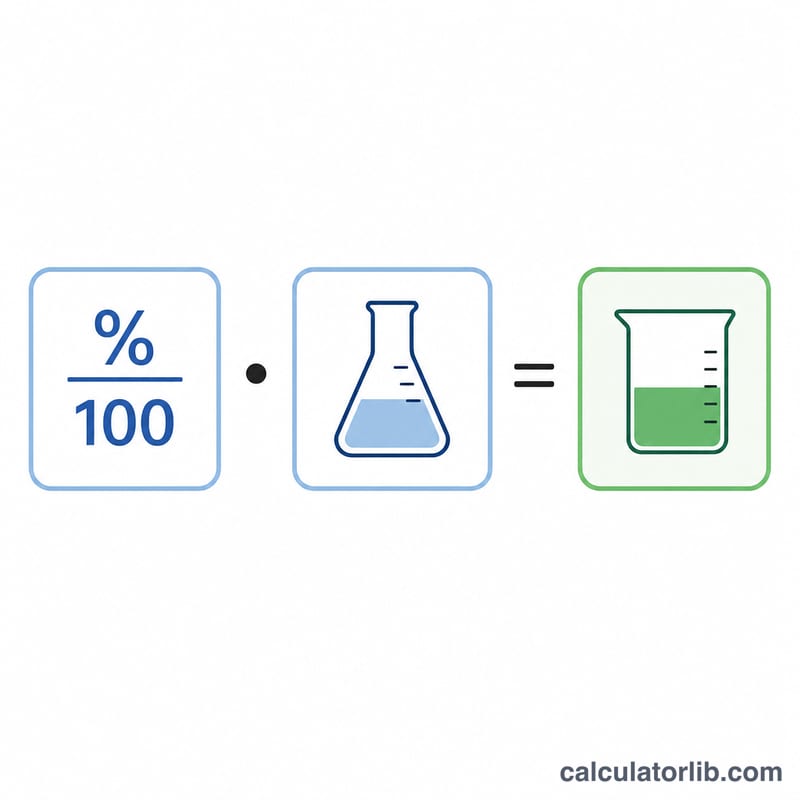
$$\text{Actual Yield} = \dfrac{\text{Percent Yield}}{100} \times \text{Theoretical Yield}$$
This is simply a rearrangement of the standard percent yield equation, \(\text{percent yield} = \dfrac{\text{actual}}{\text{theoretical}} \times 100\). Dividing the percent by 100 converts it to a decimal fraction, which is then multiplied by the theoretical yield to recover the actual mass produced.
Worked Example
Suppose a reaction has a theoretical yield of 50 g and the reported percent yield is 85%. The actual yield is:
$$(85 \div 100) \times 50 = 0.85 \times 50 = \textbf{42.5 g}$$
So you would expect to recover 42.5 grams of product.
Key Terms Defined
- Actual yield
- The measured mass (or amount) of product genuinely obtained from a chemical reaction, typically reported in grams (g) or moles (mol). It is determined experimentally — by weighing the purified product — rather than calculated from theory.
- Theoretical yield
- The maximum mass of product that could form if the reaction proceeded perfectly to completion with no losses and the limiting reactant were fully converted. Expressed in grams (g) or moles (mol) and obtained from the balanced equation and the moles of limiting reactant.
- Percent yield
- The ratio of actual yield to theoretical yield expressed as a percentage: \(\text{Percent Yield} = \dfrac{\text{Actual Yield}}{\text{Theoretical Yield}} \times 100\%\). It is dimensionless (units of %) and measures reaction efficiency. Rearranging gives the actual yield used by this calculator.
- Limiting reactant
- The reactant that is fully consumed first and therefore caps how much product can form. The theoretical yield is always calculated from the limiting reactant (in moles), not from reactants present in excess.
- Stoichiometry
- The quantitative relationships between reactants and products in a balanced chemical equation. The mole ratios from these coefficients convert moles of limiting reactant into moles — and then grams — of theoretical product.
Interpreting Your Result
The actual yield this calculator returns is simply the fraction of the theoretical maximum that you actually recovered. For example, a reaction with a theoretical yield of 50 g and a percent yield of 85% gives an actual yield of 42.5 g.
Percent yield is the most useful gauge of how efficient a reaction was:
- 90–100%: An excellent, highly efficient reaction with minimal side reactions or product loss. Common for simple, clean reactions and well-optimized industrial processes.
- 70–90%: A good yield typical of many successful laboratory syntheses, where modest losses occur during transfer, filtration, or purification.
- 50–70%: A moderate yield, often acceptable for multi-step or organic reactions where side products and workup losses are unavoidable.
- Below 50%: A low yield, suggesting significant side reactions, an incomplete reaction, an equilibrium that does not favor products, or substantial loss during isolation.
A result near the theoretical yield (percent yield approaching 100%) means almost all of the limiting reactant was converted to the desired product and very little was lost — the practical ideal, though true 100% is rarely reached.
A percent yield greater than 100% is not physically possible for the pure product, so it signals a problem rather than an unusually good reaction. The usual causes are an impure product (residual solvent, water, or unreacted starting material adding extra mass), an incompletely dried sample, weighing or calibration errors, or a mistake in calculating the theoretical yield. When you see >100%, re-dry and re-weigh the product and recheck the stoichiometry before trusting the number.
FAQ
Can actual yield be higher than theoretical yield? No. In theory the actual yield cannot exceed the theoretical yield (percent yield over 100% usually signals impurities such as leftover solvent or unreacted reagent).
What units should I use? Use the same mass unit for both yields — grams is standard. The actual yield is returned in the same unit as the theoretical yield.
How do I find theoretical yield? Calculate it from the balanced equation using the moles of the limiting reactant and the molar mass of the product.