
What is theoretical yield?
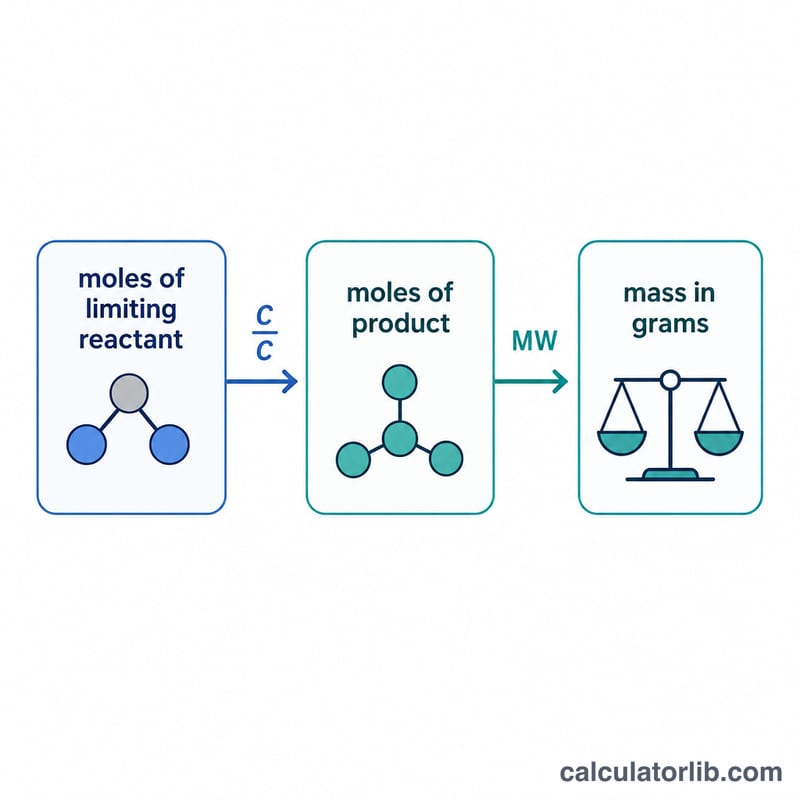
The theoretical yield is the maximum mass of product a chemical reaction can produce, assuming the limiting reactant is completely converted and no product is lost. It is calculated from the moles of the limiting reactant, the balanced equation mole ratio, and the molar mass of the product. This calculator works for any reaction and is unit-agnostic (universal chemistry math).
How to use this calculator
Enter the moles of the limiting reactant, the stoichiometric coefficient of that reactant from the balanced equation, the coefficient of the product you want, and the product molar mass in g/mol. The tool multiplies moles by the mole ratio and the molar mass to give the theoretical mass. If you also enter the actual mass obtained in the lab, it returns the percent yield.
The formula explained
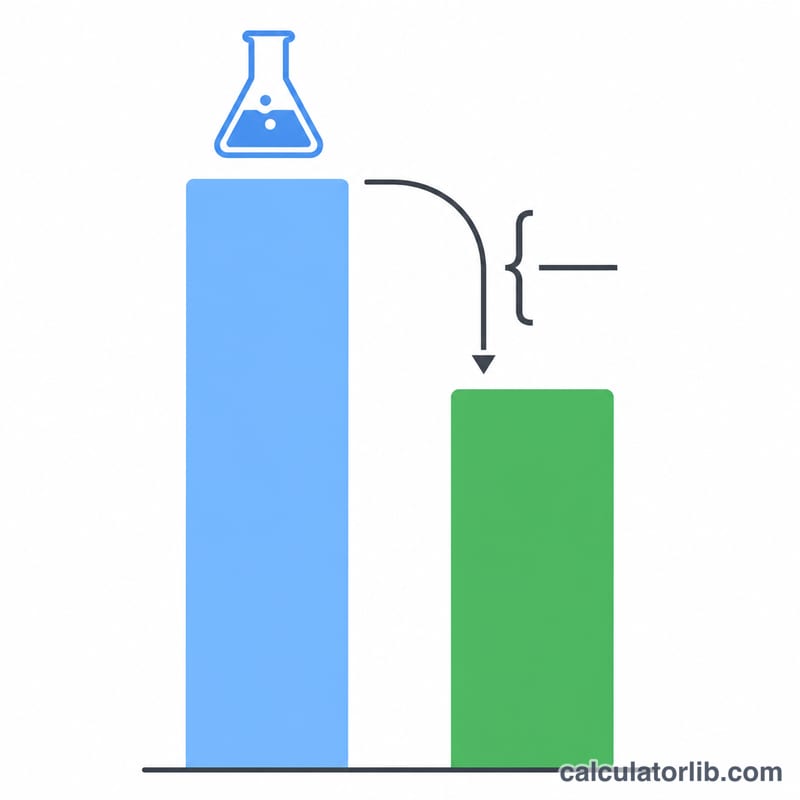
First the moles of product are found from the mole ratio: \(n_{\text{product}} = n_{\text{limiting}} \times (c_{\text{product}} / c_{\text{reactant}})\). Multiplying by the molar mass converts moles to grams: \(m_{\text{theo}} = n_{\text{product}} \times MW_{\text{product}}\). Percent yield then compares your real result to this ideal: \((m_{\text{actual}} / m_{\text{theo}}) \times 100\).
Worked example
Burning 0.5 mol of hydrogen in the reaction 2H2 + O2 → 2H2O, with H2 as the limiting reactant (coefficient 2) and water as the product (coefficient 2, MW 18.02 g/mol): moles of water $$0.5 \times (2/2) = 0.5 \text{ mol}$$ so theoretical mass $$0.5 \times 18.02 = 9.01 \text{ g}$$ If you actually collected 8.0 g, percent yield $$(8.0 / 9.01) \times 100 \approx 88.8\%$$
FAQ
What is the limiting reactant? It is the reactant that runs out first and therefore caps how much product can form. Always base theoretical yield on it.
Why is my percent yield over 100%? Usually impurities, leftover solvent, or weighing a wet product. A value far above 100% signals an error.
Do I need balanced coefficients? Yes — the mole ratio comes directly from a balanced chemical equation.