
What this calculator does
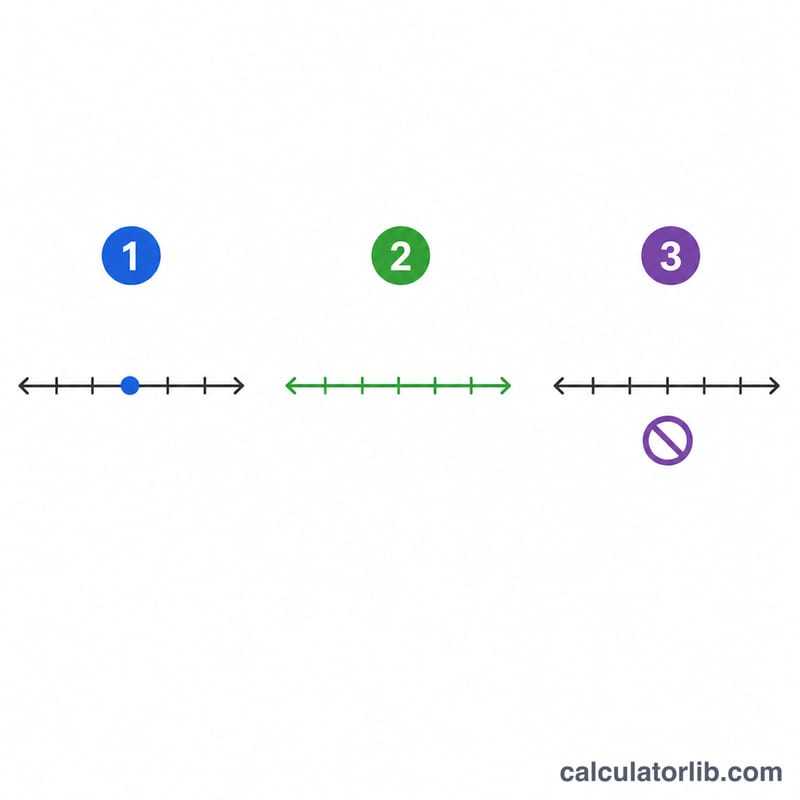
This tool rearranges and solves a linear equation written in the standard form \(a\cdot x + b = c\cdot x + d\). By collecting the variable terms on one side and the constants on the other, it isolates the unknown x and reports the exact value — or tells you when the equation has infinitely many solutions or none at all.
How to use it
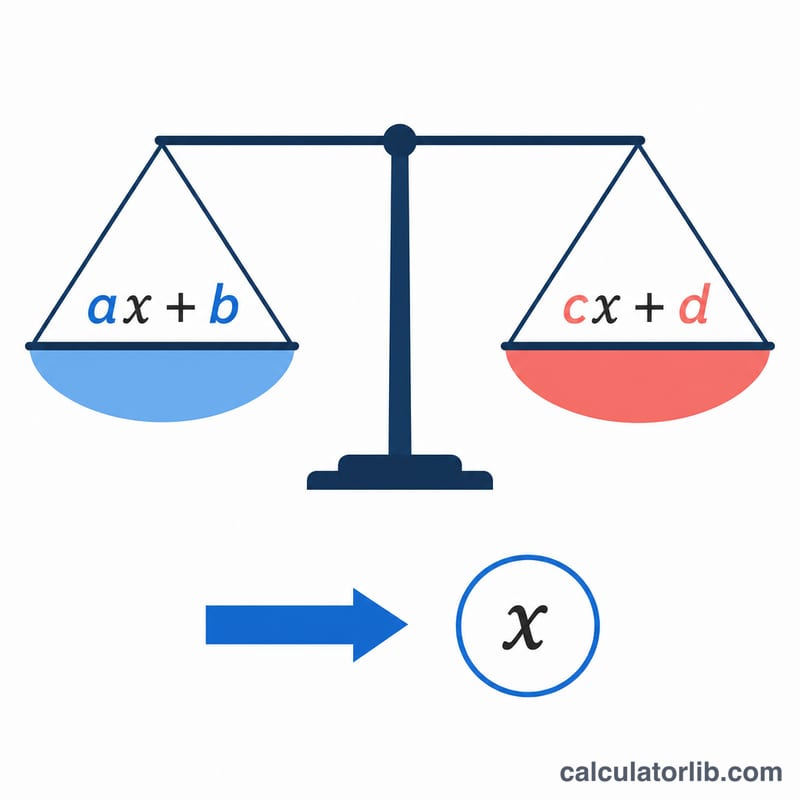
Rewrite your equation so each side is a coefficient times x plus a constant. Enter a and b for the left side, then c and d for the right side. For example, the equation \(3x + 4 = x + 10\) gives a=3, b=4, c=1, d=10. Press calculate to see the isolated value of x.
The formula explained
Starting from \(a\cdot x + b = c\cdot x + d\), subtract \(c\cdot x\) from both sides and subtract b from both sides to get \((a - c)\cdot x = d - b\). Dividing by the coefficient gives $$x = \frac{d - b}{a - c}$$ The denominator \((a - c)\) is the key: if it is zero the x terms cancel and no division is possible.
Worked example
Solve \(3x + 4 = x + 10\). Here a=3, b=4, c=1, d=10. Numerator \(= d - b = 10 - 4 = 6\). Denominator \(= a - c = 3 - 1 = 2\). So $$x = \frac{6}{2} = 3$$ Check: \(3(3)+4 = 13\) and \((3)+10 = 13\). ✓
FAQ
What if a equals c? The x-terms cancel. If the remaining constants are equal (\(b = d\)) every value of x works — an identity. If they differ, the equation is contradictory and has no solution.
Can I solve a formula like \(P = 2L + 2W\) for L? Yes — rewrite it in the \(a\cdot x + b = c\cdot x + d\) shape with L as your unknown, then enter the coefficients. Here it becomes \(0\cdot L + P = 2\cdot L + 2W\), so a=0, b=P, c=2, d=2W.
Does it handle decimals and negatives? Yes, any real coefficients are accepted, including negatives and fractions entered as decimals.