
What This Calculator Does
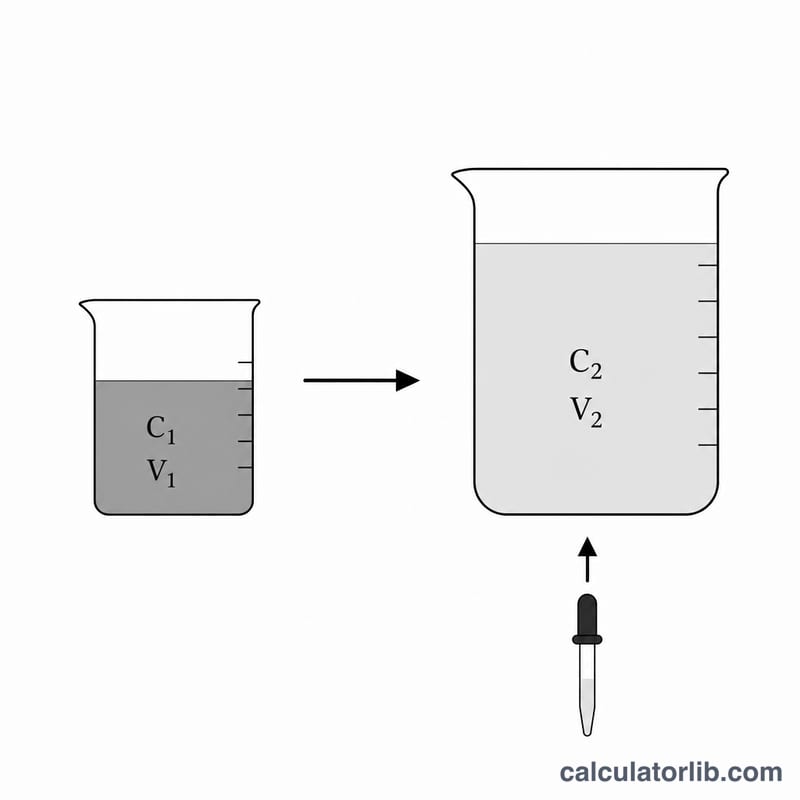
This tool answers a common lab question: if I have a fixed amount of stock solution, what final volume must I dilute it to in order to reach a desired (lower) concentration? It rearranges the dilution equation \(C_1 V_1 = C_2 V_2\) to solve for the final volume \(V_2\), then tells you exactly how much solvent (diluent) to add.
How to Use It
Enter the concentration of your stock solution (C1), the volume of stock you plan to use (V1), and the target concentration you want (C2). Keep both concentrations in the same unit (e.g. molarity, mg/mL, %) and both volumes in the same unit (mL, L). The result gives the total final volume \(V_2\) and the volume of solvent you need to add (V2 minus V1).
The Formula Explained
The dilution principle states that the amount of solute stays constant: concentration times volume before equals concentration times volume after. Written as \(C_1 V_1 = C_2 V_2\) and solved for the unknown final volume:
$$V_2 = \frac{\text{C1} \times \text{V1}}{\text{C2}}$$Because you are diluting (making it weaker), \(C_2\) is smaller than \(C_1\), so \(V_2\) is always larger than \(V_1\).
Worked Example
You have 5 mL of a 10 M stock and need a 2 M solution.
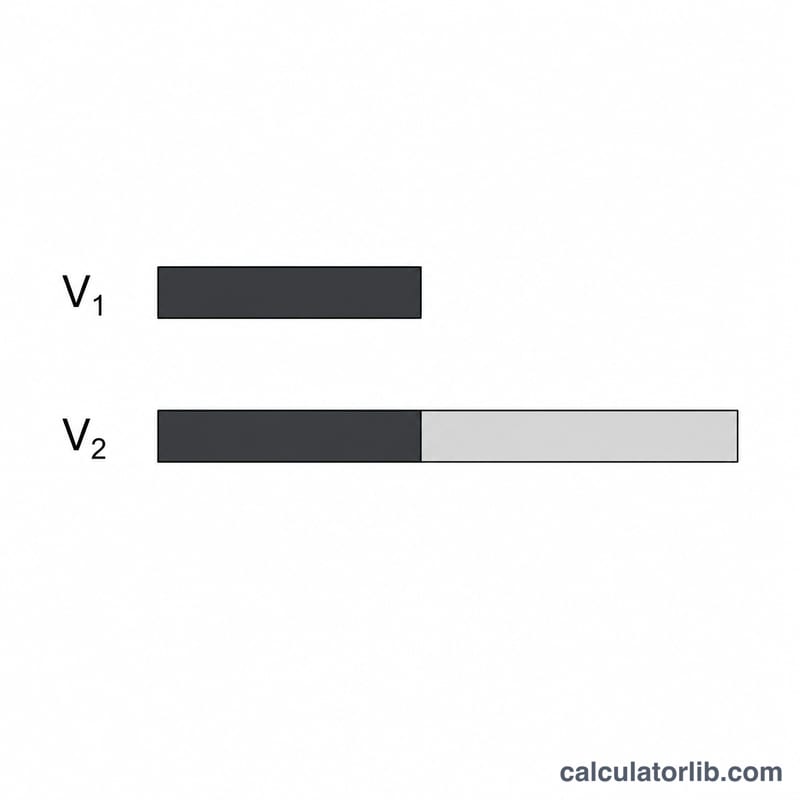
$$V_2 = \frac{10 \times 5}{2} = 25 \text{ mL}$$So dilute the 5 mL of stock up to a total of 25 mL, which means adding \(25 - 5 = 20\) mL of solvent.
FAQ
Do the units have to match? Yes. \(C_1\) and \(C_2\) must share a unit, and \(V_1\) and the resulting \(V_2\) share a unit. The calculator does not convert units for you.
Can I get a smaller final volume? No. If \(C_2\) is larger than \(C_1\) you are concentrating, not diluting, which cannot be done by adding solvent. Make sure \(C_2\) is less than \(C_1\).
What does solvent to add mean? It is the extra diluent (water, buffer, etc.) you mix with your stock so the total reaches \(V_2\).