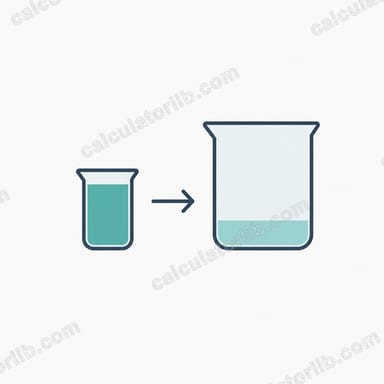

What This Calculator Does
This tool computes the final concentration of a solution after dilution, given the original (stock) concentration and the dilution factor (DF). It is a universal laboratory and chemistry tool that works with any concentration unit — molarity (M), mg/mL, percent, parts per million, and so on — as long as you stay consistent.
How to Use It
Enter your stock concentration in whatever unit you are working with, then enter the dilution factor. A dilution factor of 10 means a "1-in-10" dilution (one part stock plus enough diluent to make ten parts total). Press calculate and the result reports the diluted concentration in the same units as your stock.
The Formula Explained
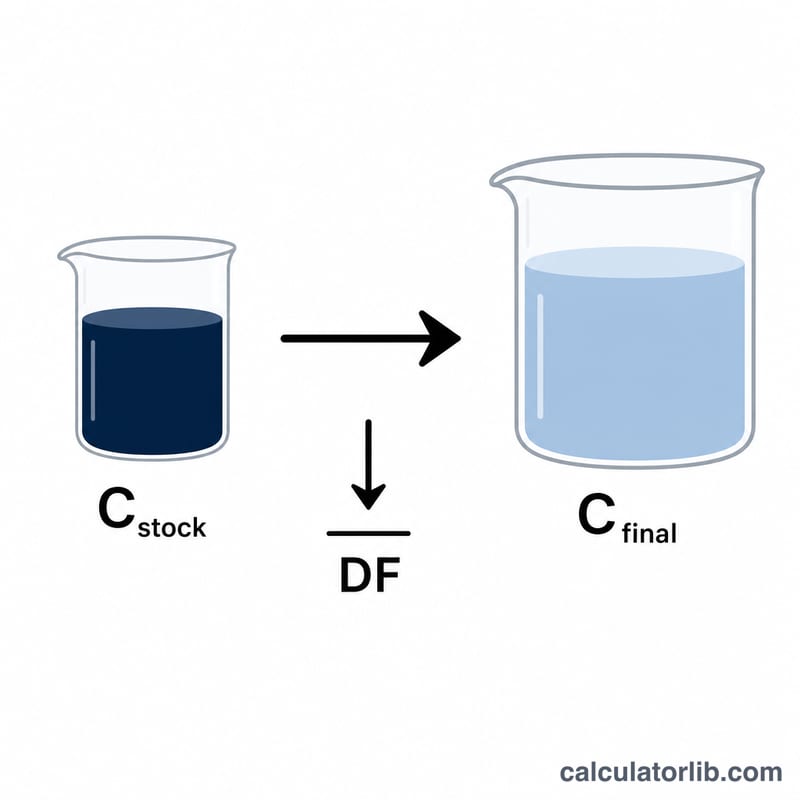
The relationship is simply $$C_{final} = \frac{C_{stock}}{DF}$$ Diluting a solution spreads the same amount of solute over a larger volume, so the concentration falls by exactly the dilution factor. If you perform serial dilutions, multiply the individual factors together to get the overall DF (e.g. two 1:10 steps give an overall DF of 100).
Worked Example
Suppose you have a 500 mM stock solution and you make a 1:25 dilution (DF = 25). The final concentration is $$500 / 25 = 20 \text{ mM}.$$ To go the other way, multiply: \(20 \text{ mM} \times 25 = 500 \text{ mM}\) confirms the stock.
FAQ
What is a dilution factor? It is the ratio of final volume to the volume of stock used. A DF of 5 means the solution is five times less concentrated than the stock.
Does the unit matter? No — the output is always in the same units as the stock you entered, because division by a unitless factor does not change units.
What if DF is 1? A factor of 1 means no dilution, so the final concentration equals the stock concentration.