
What This Calculator Does
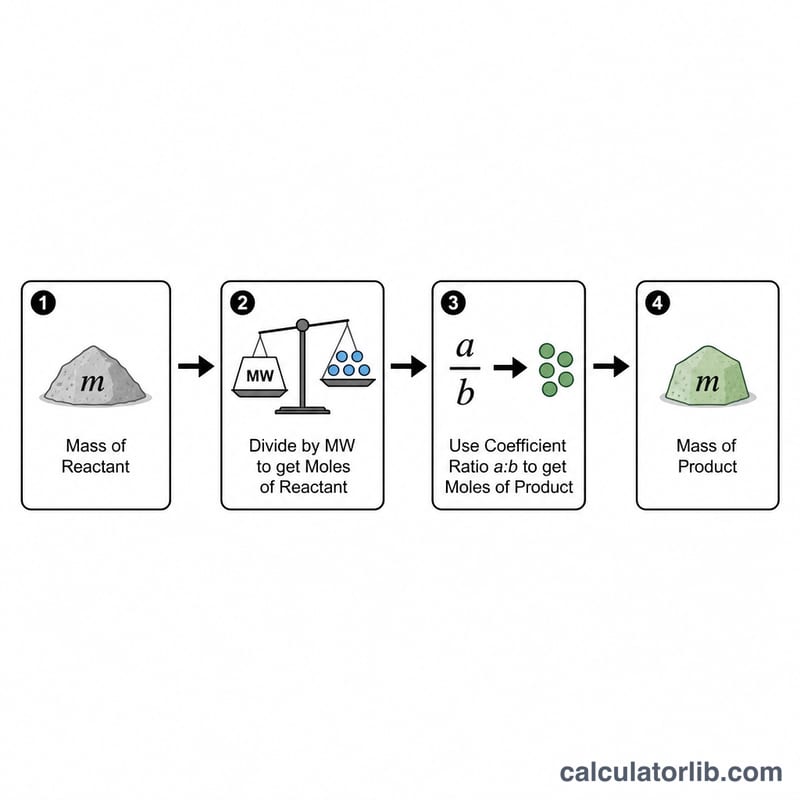
This stoichiometry calculator determines how much product a chemical reaction will produce from a given mass of one reactant. It uses the mole concept: convert the reactant mass to moles, scale by the mole ratio from the balanced equation, then convert back to mass using the product molar mass. It works for any balanced reaction and any choice of reactant-product pair.
How to Use It
Enter the mass of the reactant you start with, its molar mass (g/mol), the balanced-equation coefficient in front of that reactant, the coefficient in front of the product you care about, and the molar mass of that product. The calculator returns the theoretical mass of product, along with the moles of reactant and product.
The Formula Explained
The core relationship is:
$$m_{\text{prod}} = \frac{m_{\text{react}}}{M_{\text{react}}} \cdot \frac{c_{\text{prod}}}{c_{\text{react}}} \cdot M_{\text{prod}}$$
The first term gives moles of reactant. Multiplying by the coefficient ratio \(\frac{c_{\text{prod}}}{c_{\text{react}}}\) converts to moles of product using the stoichiometric mole ratio from the balanced equation. Multiplying by the product molar mass converts moles back to grams.
Worked Example
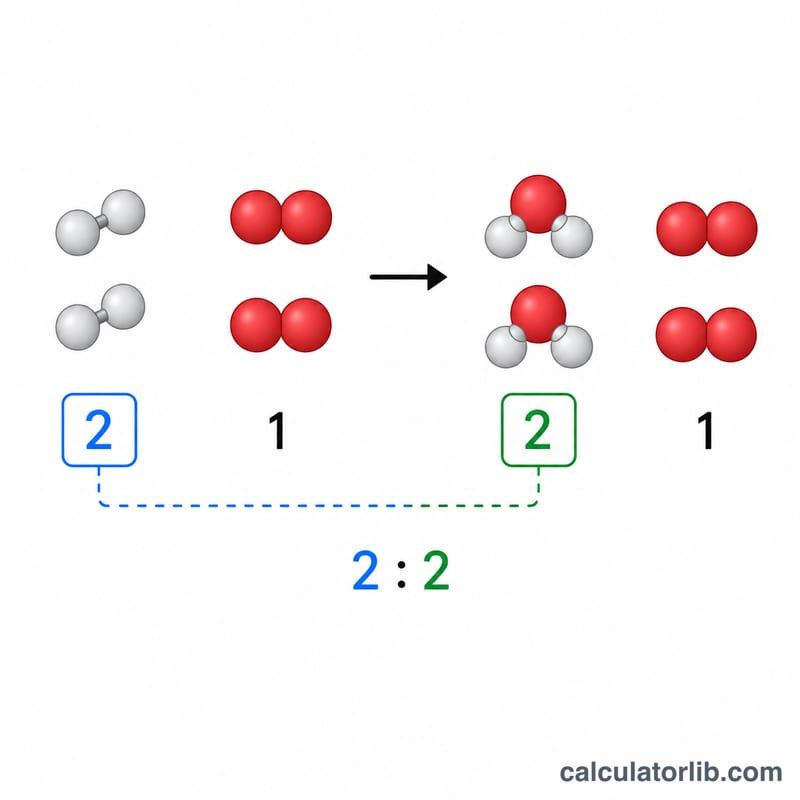
Consider \(2\,\text{H}_2\text{O} \rightarrow 2\,\text{H}_2 + \text{O}_2\). Starting with 10 g of water (MW = 18.015 g/mol), how much hydrogen gas (MW = 2.016 g/mol) forms? Moles of water $$= \frac{10}{18.015} = 0.5551 \text{ mol}.$$ Mole ratio \(\text{H}_2 : \text{H}_2\text{O} = 2 : 2 = 1\), so moles of \(\text{H}_2 = 0.5551\). Mass of \(\text{H}_2\) $$= 0.5551 \times 2.016 = 1.119 \text{ g}.$$
FAQ
Is this the theoretical or actual yield? It is the theoretical (maximum) yield assuming the reactant is fully consumed and is the limiting reactant. Real yields are lower.
Where do the coefficients come from? From the balanced chemical equation — the numbers in front of each species.
Can I use this for the limiting reactant? Yes — run it with the reactant that runs out first; that gives the maximum product the reaction can make.