
What Is Percent Change?
Percent change measures how much a value has grown or shrunk relative to its starting point, expressed as a percentage. It is one of the most common calculations in finance, statistics, science, and everyday comparisons — from tracking a price rise to measuring a drop in test scores. A positive result means an increase, while a negative result means a decrease.
How to Use This Calculator
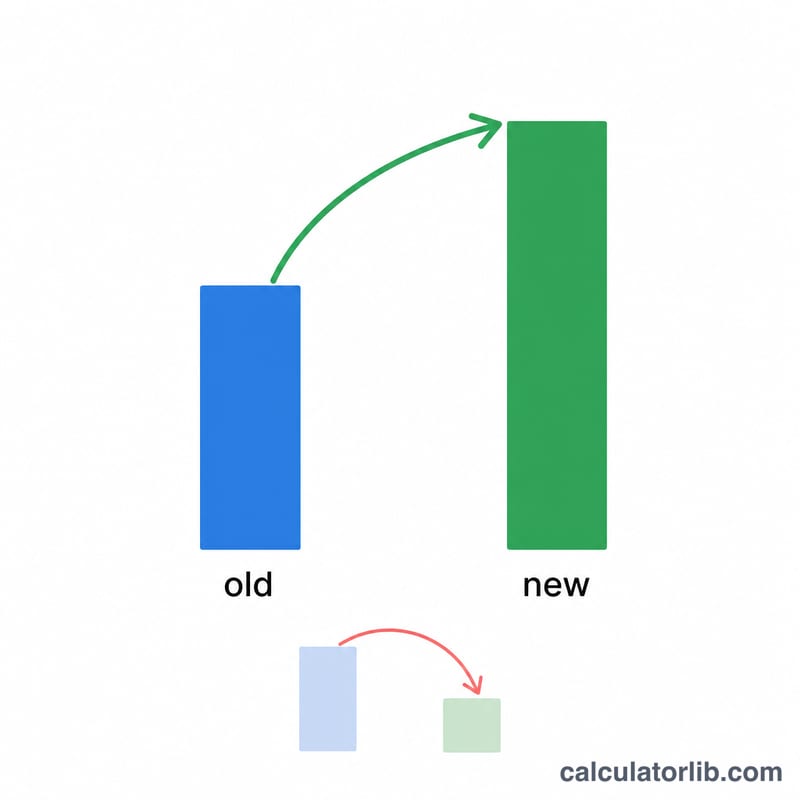
Enter the original value (the starting or older number) and the new value (the ending or current number). The calculator returns the percent change, the absolute change, and restates both inputs. There is no need to manually decide increase versus decrease — the sign of the answer tells you automatically.
The Formula Explained
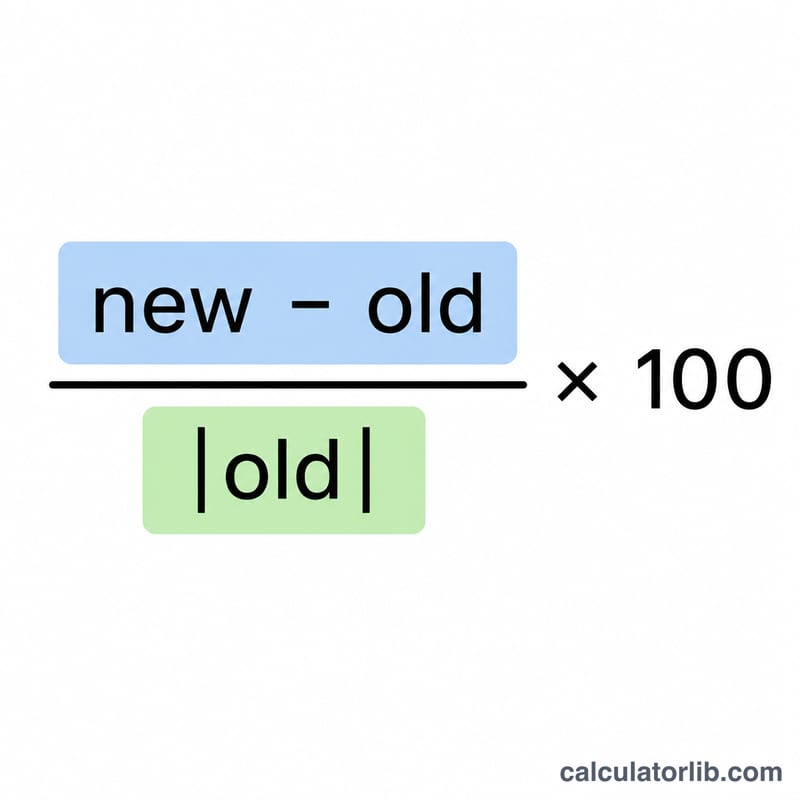
The formula is:
$$\text{Percent Change} = \frac{\text{New Value} - \text{Original Value}}{\left|\text{Original Value}\right|} \times 100\%$$
First, subtract the original value from the new value to get the absolute change. Then divide by the absolute value of the original (so the percentage direction stays intuitive even with negative starting numbers) and multiply by 100 to convert it into a percentage.
Worked Example
Suppose a product cost $50 last year and now costs $75. The absolute change is \(75 - 50 = 25\). Dividing by the original 50 gives 0.5, and multiplying by 100 gives a 50% increase. If instead the price had fallen from 75 to 50, the change would be $$\frac{50 - 75}{75} \times 100 \approx -33.33\%$$ a decrease of about 33.3%.
FAQ
What if the original value is zero? Percent change is undefined when the original is zero, because dividing by zero has no meaning. This tool returns 0 in that case to avoid an error — interpret it carefully.
Why use the absolute value of the old number? Using |old| keeps the meaning of "increase" and "decrease" consistent even when the starting value is negative, so a move toward a larger number always reads as a positive change relative to magnitude.
Is percent change the same as percent difference? No. Percent change has a clear before-and-after direction, while percent difference compares two values symmetrically using their average as the base.