
What this calculator does
This tool computes the final concentration (C2) of a solution after dilution using the rearranged dilution equation \(C_2 = \frac{\text{C}_1 \times \text{V}_1}{\text{V}_2}\). It is a universal chemistry relationship that works with any consistent concentration unit (molarity, mg/mL, % w/v, ppm) as long as the volume units match.
How to use it
Enter the initial concentration (C1) of your stock solution, the initial volume (V1) you are taking from it, and the final total volume (V2) after adding solvent. The calculator returns the diluted concentration C2, the dilution factor (V2/V1), and the amount of solvent you need to add (V2 − V1).
The formula explained
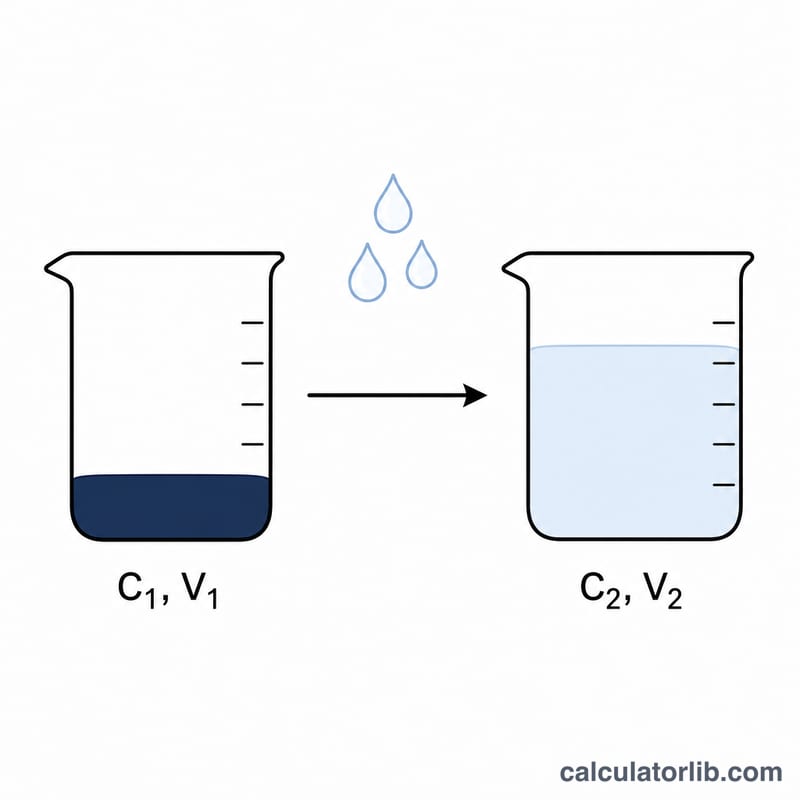
The dilution principle states that the amount of solute does not change during dilution, only the volume increases. Since amount = concentration × volume, we have \(\text{C}_1 \times \text{V}_1 = \text{C}_2 \times \text{V}_2\). Solving for the final concentration gives $$C_2 = \frac{\text{C}_1 \times \text{V}_1}{\text{V}_2}$$ Because both sides describe the same moles (or mass) of solute, only the units of C and V must each be internally consistent.
Worked example
Suppose you dilute 10 mL of a 1 M stock solution up to a final volume of 100 mL. Then $$C_2 = \frac{1 \times 10}{100} = 0.1 \text{ M}$$ The dilution factor is \(100/10 = 10\times\), and you must add \(100 - 10 = 90\) mL of solvent.
FAQ
Do C1 and C2 need the same units? Yes — whatever unit you use for C1 (M, mg/mL, %), C2 comes out in the same unit.
Must V1 and V2 be in the same units? Yes. Use mL and mL, or L and L; the ratio cancels the unit.
Can I find the volume of stock needed instead? Rearrange to \(V_1 = \frac{\text{C}_2 \times \text{V}_2}{\text{C}_1}\) if you know the target concentration and final volume.