
What is the Darcy-Weisbach pressure drop?
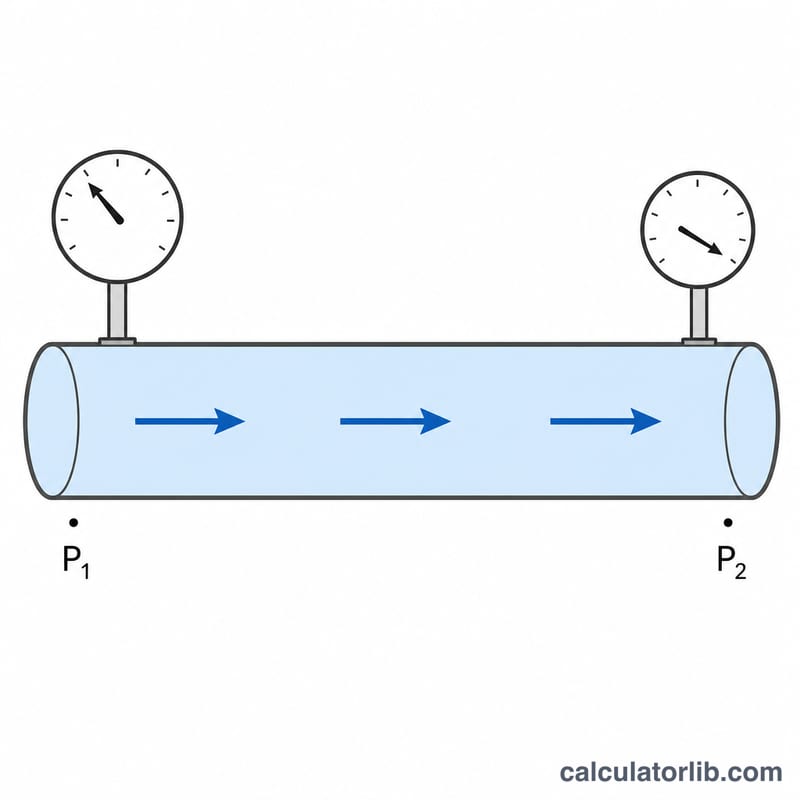
The Darcy-Weisbach equation is the standard engineering relationship for predicting the pressure loss caused by friction as a fluid flows through a pipe. It is universally applicable to any incompressible Newtonian fluid (water, oil, air at low speeds) in any consistent unit system. Using SI units (meters, kg/m³, m/s), the result comes out in pascals.
How to use this calculator
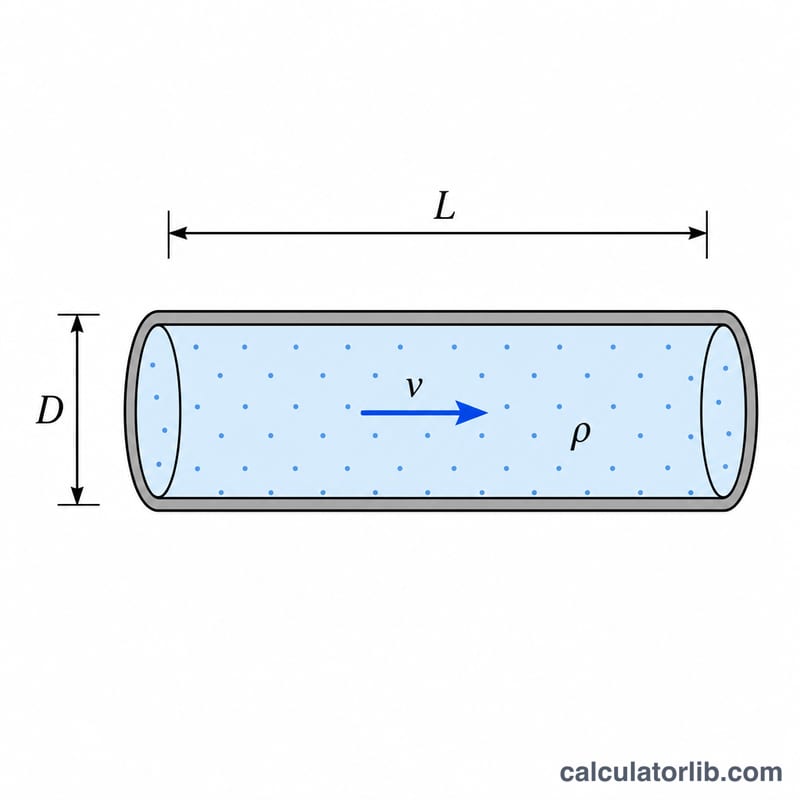
Enter the Darcy friction factor (\(f\)), the pipe length (\(L\)) and inner diameter (\(D\)) in meters, the fluid density (\(\rho\)) in kg/m³, and the mean flow velocity (\(v\)) in m/s. The calculator returns the pressure drop in pascals, kilopascals, and bar.
The friction factor itself depends on the Reynolds number and pipe roughness. For laminar flow it equals \(64/\text{Re}\); for turbulent flow use the Moody chart or the Colebrook equation to find \(f\) first.
The formula explained
$$\Delta P = f \cdot \frac{L}{D} \cdot \frac{\rho \cdot v^{2}}{2}$$ The term \(\rho v^{2}/2\) is the dynamic pressure of the flow. Multiplying by \(L/D\) scales it by how many diameters long the pipe is, and the friction factor \(f\) captures how rough and turbulent the flow is.
Worked example
For water (\(\rho = 1000\ \text{kg/m}^3\)) flowing at 2 m/s through a 100 m pipe of 0.1 m diameter with \(f = 0.02\): $$\Delta P = 0.02 \times \frac{100}{0.1} \times \frac{1000 \times 2^{2}}{2} = 0.02 \times 1000 \times 2000 = 40{,}000\ \text{Pa} = 40\ \text{kPa} = 0.4\ \text{bar}$$
FAQ
Where do I get the friction factor? From the Moody chart or Colebrook/Swamee-Jain equation, based on Reynolds number and relative roughness.
Can I use flow rate instead of velocity? Convert volumetric flow \(Q\) to velocity with \(v = Q / A\), where \(A = \pi D^{2}/4\) is the pipe cross-section.
Is this for compressible gas flow? It works for gases at low Mach numbers where density is roughly constant; for high-speed or long gas lines use a compressible formulation.