
What Is Percent Decrease?
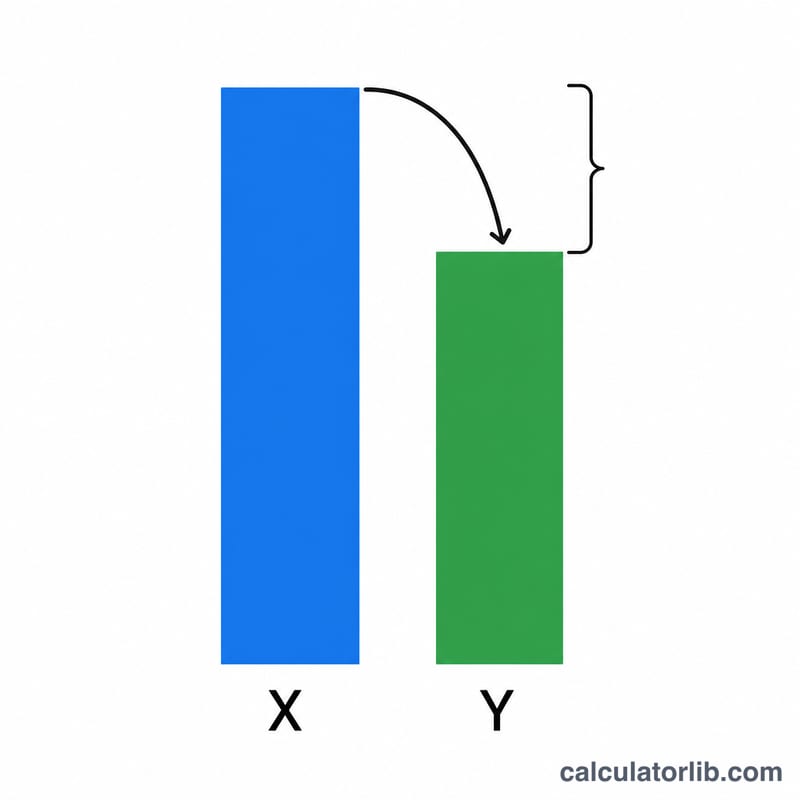
Percent decrease measures how much a value has dropped, expressed as a percentage of the original (starting) value. It is a quick way to describe a reduction in price, weight, population, score, or any quantity. A larger percentage means a bigger relative fall.
How to Use This Calculator
Enter the starting value (X) and the ending value (Y). The calculator returns the percent decrease, along with the absolute change between the two numbers. If Y is larger than X, the result will be negative — which actually represents an increase rather than a decrease.
The Formula Explained
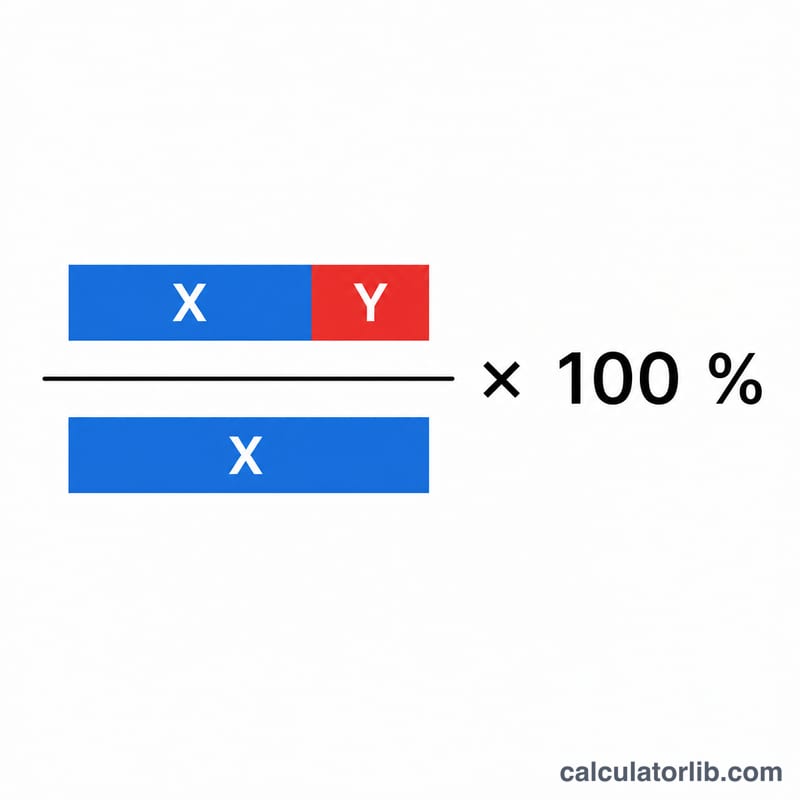
The percent decrease is found by dividing the drop in value by the original value, then multiplying by 100:
$$\text{pct} = \frac{X - Y}{X} \times 100$$
The numerator \((X - Y)\) is the absolute amount lost. Dividing by \(X\) converts it into a proportion of the original quantity, and multiplying by 100 turns that proportion into a percentage.
Worked Example
Suppose a jacket was priced at $200 and is now on sale for $150. The decrease is \(200 - 150 = 50\). Dividing by the original price gives \(50 / 200 = 0.25\), and multiplying by 100 yields a 25% decrease. So the jacket is 25% cheaper than before.
FAQ
What if my result is negative? A negative percent decrease means the value actually went up. For example, going from 100 to 120 gives \(-20\%\), which is a 20% increase.
Can the starting value be zero? No. Dividing by zero is undefined, so X must be a non-zero number. This calculator returns 0 when X is zero to avoid an error.
Is percent decrease the same as percent change? Percent decrease is a percent change that happens to be a reduction. Percent change can be positive (increase) or negative (decrease).