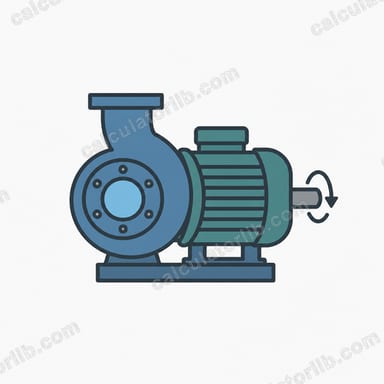

What is pump brake power?
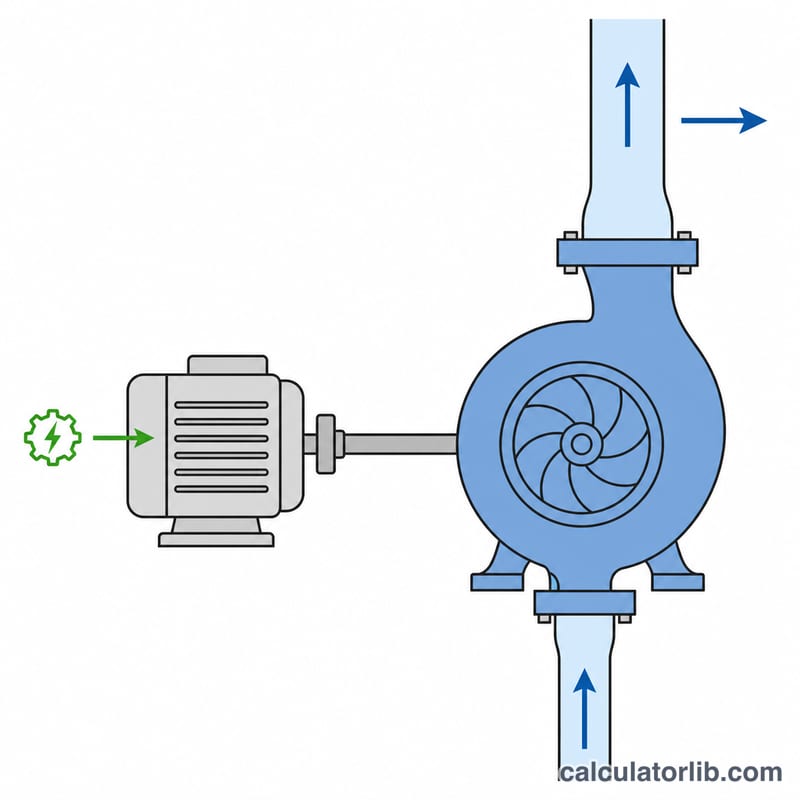
Brake power (also called shaft power) is the mechanical power that must be supplied to a pump shaft to move a fluid against a given head. It is always larger than the useful hydraulic power delivered to the fluid because no pump is 100% efficient — the difference is lost to friction, recirculation and other internal losses. Knowing the brake power lets you size the driving motor correctly.
How to use this calculator
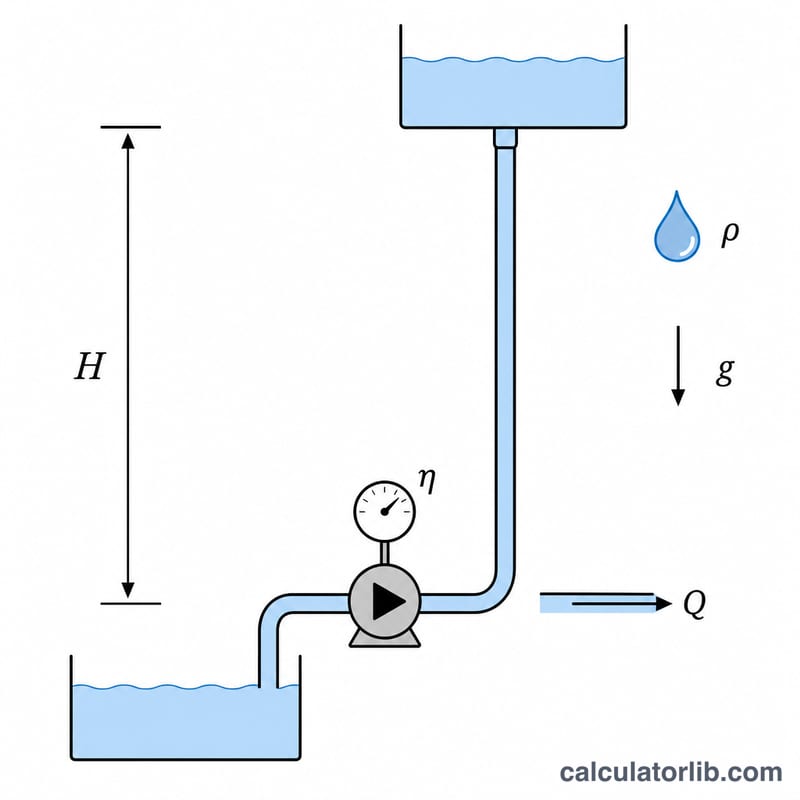
Enter the fluid density (1000 kg/m³ for water), the volumetric flow rate Q in cubic metres per second, the total head H in metres, and the pump efficiency as a percentage. Gravity defaults to 9.81 m/s². The calculator returns the brake power in kilowatts and horsepower, plus the underlying hydraulic power and the efficiency applied.
The formula explained
The hydraulic power is \(P_{\text{hyd}} = \rho g Q H\) (watts). Dividing by the fractional efficiency \(\eta\) gives the brake power:
$$P_{\text{brake}} = \frac{\rho g Q H}{\eta}$$Here \(\rho\) is density (kg/m³), \(g\) is gravitational acceleration (m/s²), \(Q\) is flow (m³/s) and \(H\) is head (m). Dividing watts by 1000 converts to kilowatts; dividing watts by 745.7 converts to horsepower.
Worked example
For water (\(\rho = 1000\)), \(Q = 0.05\) m³/s, \(H = 20\) m and \(\eta = 75\%\): hydraulic power =
$$1000 \times 9.81 \times 0.05 \times 20 = 9810\ \text{W} = 9.81\ \text{kW}$$Brake power =
$$\frac{9810}{0.75} = 13{,}080\ \text{W} \approx 13.08\ \text{kW}$$or about 17.5 hp. You would therefore select a motor rated above 13 kW.
FAQ
Why is brake power higher than hydraulic power? Because efficiency is less than 1; the motor must supply extra power to cover internal losses.
What efficiency should I use? Typical centrifugal pumps run 60–85%. Use the manufacturer curve at your operating point if available.
Can I use it for any liquid? Yes — just enter the correct density. For thick or non-Newtonian fluids actual losses may differ.