
What Is a Mole Ratio?
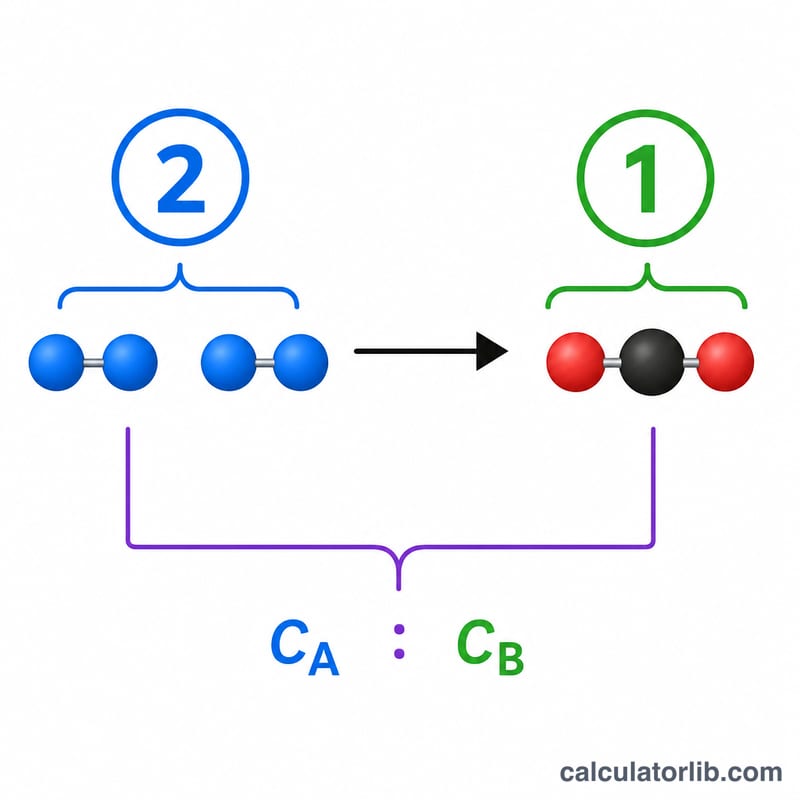
A mole ratio is the proportion between the amounts (in moles) of any two substances in a balanced chemical equation. It comes directly from the stoichiometric coefficients in front of each formula. Mole ratios are the bridge that lets chemists convert the amount of one reactant or product into the amount of another, making them central to nearly every stoichiometry problem.
How to Use This Calculator
First, make sure your chemical equation is balanced. Then enter the moles of the substance you already know (substance A), its coefficient from the equation, and the coefficient of the substance you want to find (substance B). The calculator multiplies the known moles by the ratio of coefficients to give the moles of B.
The Formula Explained
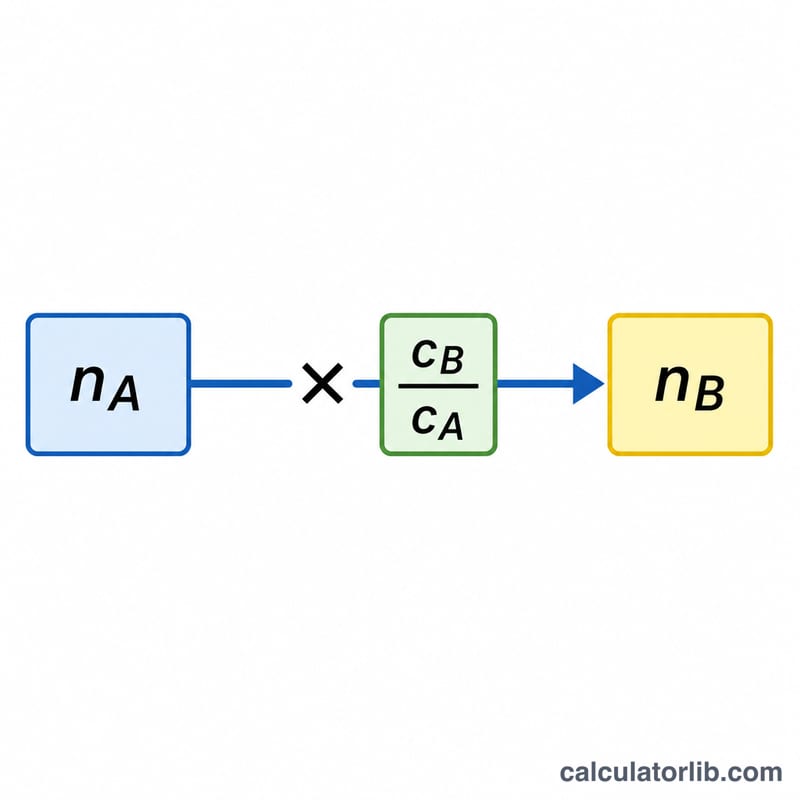
The conversion uses: $$n_B = \text{Moles of A} \times \frac{\text{Coefficient of B}}{\text{Coefficient of A}}$$ The fraction \(\frac{\text{coefficient B}}{\text{coefficient A}}\) is the mole ratio. Because coefficients describe the relative number of particles that react, this ratio scales the known quantity into the unknown quantity in the same proportion as the balanced equation.
Worked Example
Consider the reaction 2 H₂ + O₂ → 2 H₂O. Suppose you have 4 mol of H₂ (substance A, coefficient 2) and want to find moles of H₂O (substance B, coefficient 2). The mole ratio is \(\frac{2}{2} = 1\), so $$\text{moles H}_2\text{O} = 4 \times 1 = 4 \text{ mol}.$$ If instead you wanted O₂ (coefficient 1): $$\text{moles O}_2 = 4 \times \frac{1}{2} = 2 \text{ mol}.$$
FAQ
Do I need a balanced equation? Yes. Coefficients only give correct ratios when the equation is balanced.
Can A and B be a reactant and a product? Yes — the mole ratio works between any two species in the equation, reactant-to-reactant, reactant-to-product, or product-to-product.
What if a coefficient is 1? Many equations omit a written "1." Just enter 1 for that substance.