
What This Calculator Does
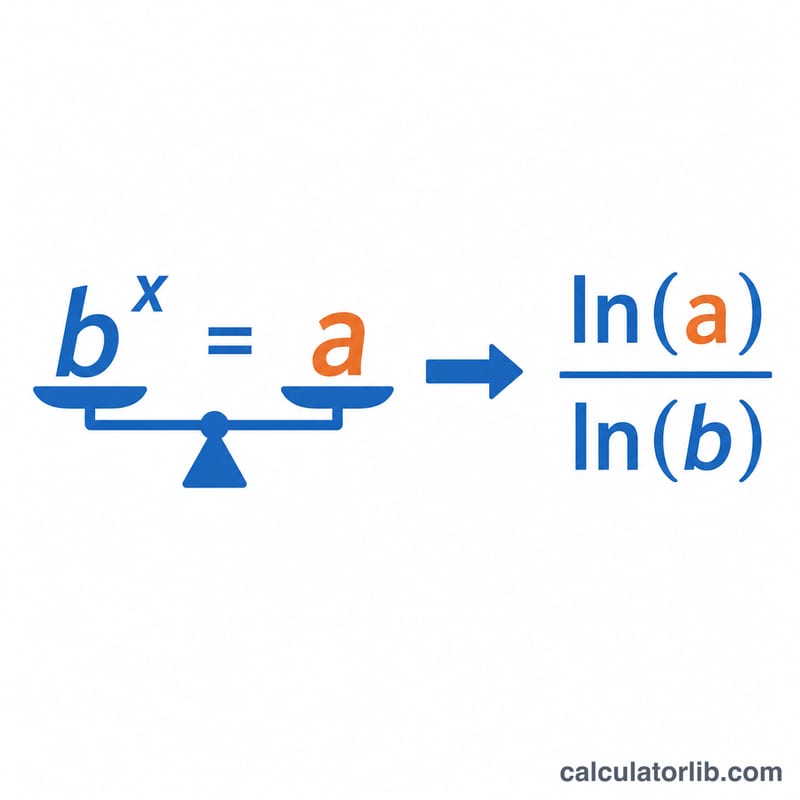
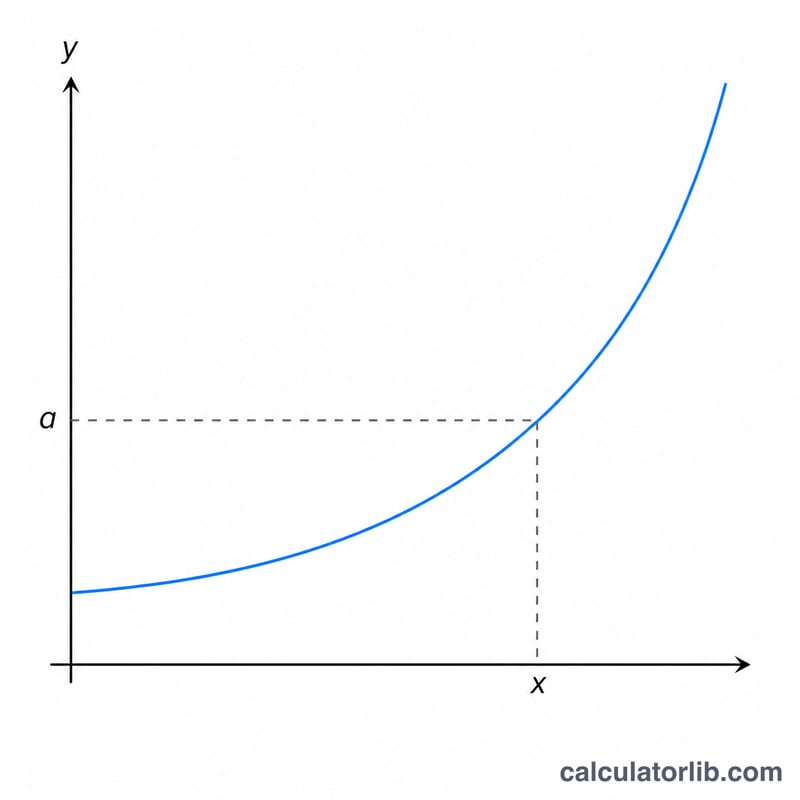
This tool solves the exponential equation \(b^x = a\) for the unknown exponent \(x\). Given a base \(b\) and a target value \(a\), it returns the power to which you must raise \(b\) to obtain \(a\). This is exactly the definition of a logarithm: \(x = \log_b(a)\).
How to Use It
Enter the base \(b\) (any positive number other than 1) and the result value \(a\) (any positive number). The calculator computes \(x\) instantly and shows a verification by raising the base back to the solved power.
The Formula Explained
Start with \(b^x = a\). Take the natural logarithm of both sides: \(\ln(b^x) = \ln(a)\). Using the power rule, \(x \cdot \ln(b) = \ln(a)\), so dividing by \(\ln(b)\) gives the change-of-base formula:
$$x = \frac{\ln(a)}{\ln(b)}$$and it equals \(\log_b(a)\). You could use any logarithm base (natural log, log base 10) and get the same answer, since the bases cancel in the ratio.
Worked Example
Solve \(2^x = 8\). Compute
$$x = \frac{\ln(8)}{\ln(2)} = \frac{2.0794}{0.6931} = 3$$Check: \(2^3 = 8\). Correct. Another: solve \(10^x = 1000\), giving \(x = \frac{\ln(1000)}{\ln(10)} = 3\).
FAQ
Why must the base be positive and not 1? The logarithm is undefined for non-positive bases, and a base of 1 gives \(\ln(1) = 0\), causing division by zero (\(1^x\) is always 1).
Can a be less than the base? Yes. If \(a\) is between 0 and 1, or smaller than \(b\), the exponent \(x\) will simply be a fraction or negative number.
Does the choice of logarithm matter? No. Natural log, common log, or any base produce the same \(x\) because they appear as a ratio.