
What Is Greek Gematria (Isopsephy)?
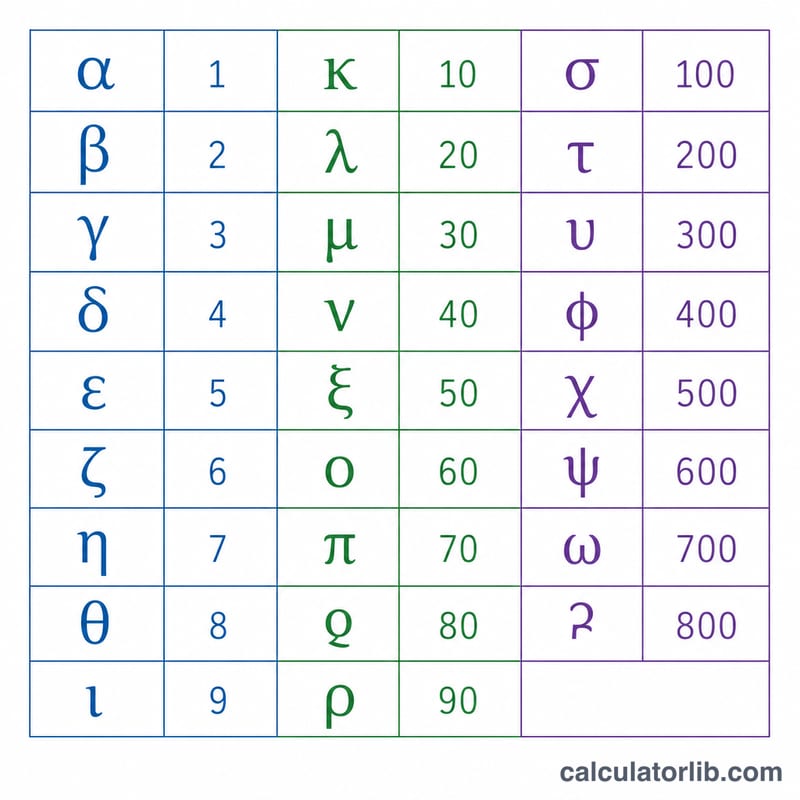
Greek gematria, more properly called isopsephy (from isos, "equal", and psephos, "pebble/count"), is the ancient practice of assigning numeric values to the letters of the Greek alphabet and summing them for a word or phrase. The system uses the Milesian numerals, where the alphabet is divided into units (1–9), tens (10–90), and hundreds (100–900). This calculator adds up those values for any Greek text you enter.
How to Use the Calculator
Type or paste a Greek word, name, or phrase into the box — for example Ιησους (Jesus) or αγαπη (love). The tool lowercases the text, looks up each Greek letter's isopsephy value, and reports the running total along with how many Greek letters were counted. Non-Greek characters, spaces, and accents are ignored.
The Formula Explained
The value is simply the sum of each letter's numeral:
$$\text{Isopsephy} = \sum_{i=1}^{n} v\!\left(\text{Greek Text}_i\right)$$alpha=1, beta=2, gamma=3 … iota=10, kappa=20 … rho=100, sigma=200 … omega=800. Final sigma (ς) equals the same as sigma (σ)=200. Archaic letters digamma/stigma (6), koppa (90), and sampi (900) are also supported.
Worked Example
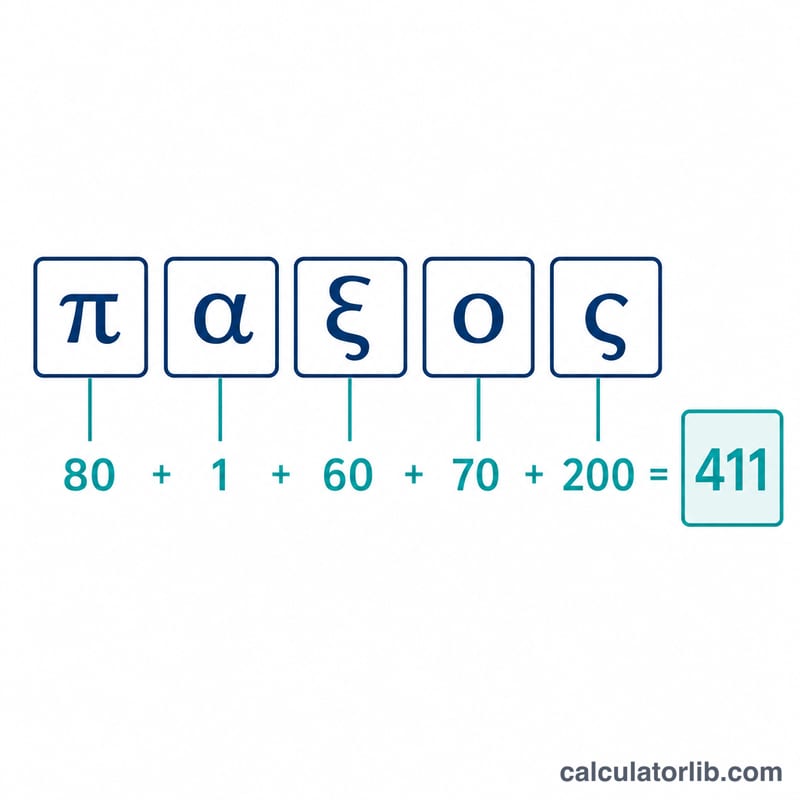
Take αγαπη ("love"): α=1, γ=3, α=1, π=80, η=8. The sum is
$$1 + 3 + 1 + 80 + 8 = 93$$computed from 5 letters.
FAQ
Does case matter? No — the calculator converts everything to lowercase before computing.
What about final sigma ς? It carries the same value as regular sigma (200).
Why is the famous "666" linked to isopsephy? The number of the beast in Revelation is an isopsephy puzzle; many Greek names sum to 666, which is why this counting method is historically significant.