
What Is Theoretical Yield?
The theoretical yield is the maximum amount of product a chemical reaction can produce, assuming the reaction goes to completion with no losses. It is determined entirely by the limiting reactant — the reactant that runs out first — and the balanced chemical equation. This calculator converts the mass of your limiting reactant into moles, applies the stoichiometric mole ratio from the balanced equation, then converts back to grams of product.
How to Use This Calculator
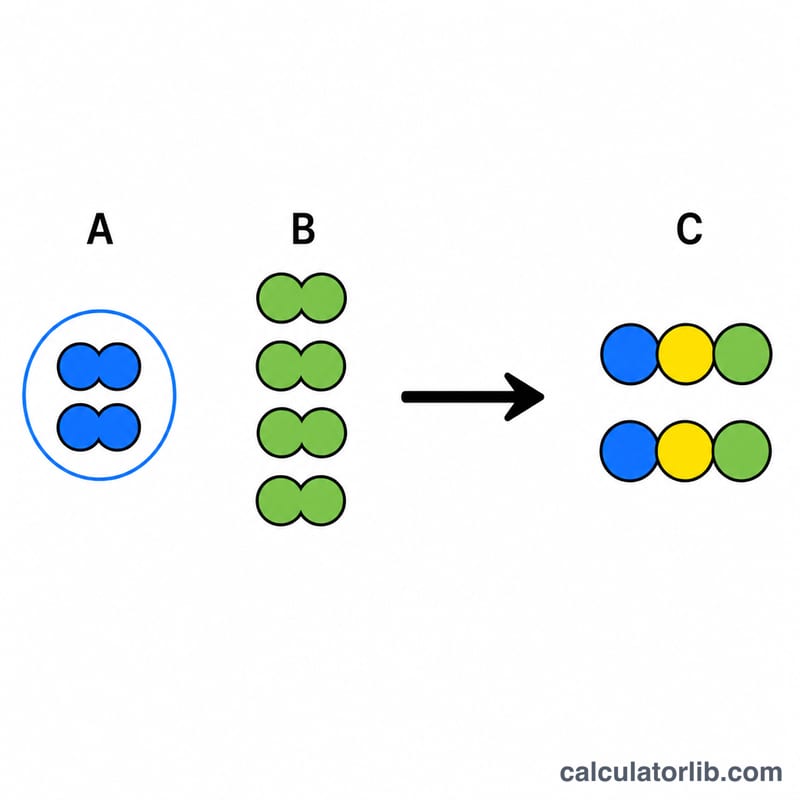
Enter the mass of the limiting reactant in grams and its molar mass in g/mol. Then enter the coefficients of the product and the limiting reactant exactly as they appear in your balanced equation, and the molar mass of the product. The tool reports the theoretical yield in grams along with the intermediate moles so you can check your work.
The Formula Explained
First, moles of limiting reactant = mass ÷ molar mass. Next, the stoichiometric ratio = product coefficient ÷ limiting reactant coefficient. Multiplying moles by this ratio gives moles of product, and multiplying by the product's molar mass gives the theoretical yield in grams:
$$\text{Yield} = \dfrac{m_{lim}}{M_{lim}} \times \dfrac{c_{prod}}{c_{lim}} \times M_{prod}$$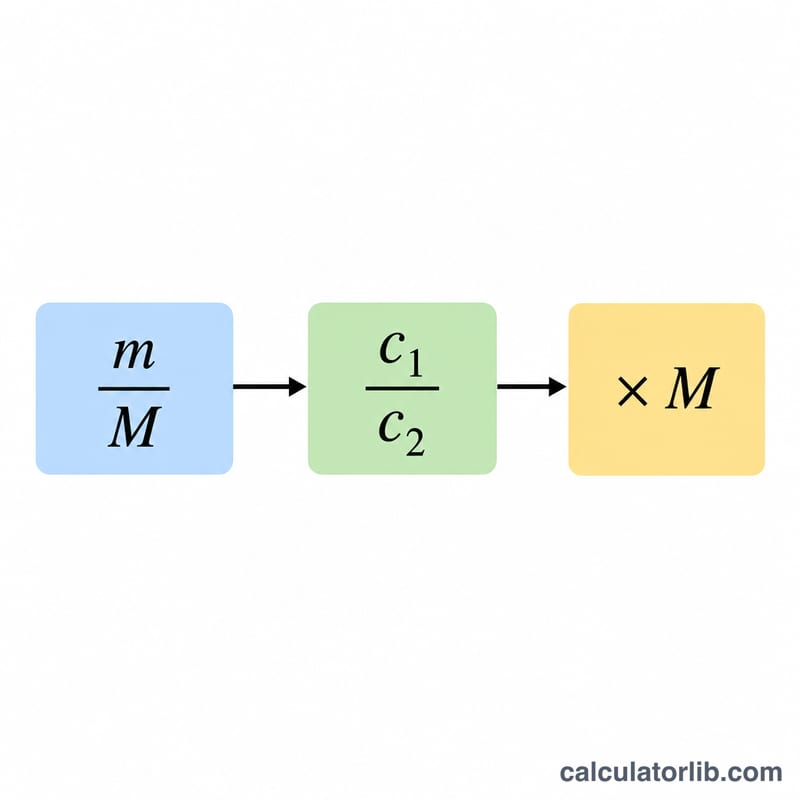
Worked Example
Burning 16 g of methane (CH₄, molar mass 16.04 g/mol) in the reaction CH₄ + 2O₂ → CO₂ + 2H₂O produces CO₂ (molar mass 44.01 g/mol). Moles of CH₄ = \(16 \div 16.04 \approx 0.9975\). The ratio CO₂:CH₄ is 1:1, so moles of CO₂ \(\approx 0.9975\), and yield:
$$0.9975 \times 44.01 \approx 43.9 \text{ g of CO}_2$$FAQ
What is the limiting reactant? It is the reactant fully consumed first, capping how much product can form. Always base theoretical yield on the limiting reactant.
How does theoretical yield differ from actual yield? Actual yield is what you measure in the lab and is usually lower due to side reactions and losses. Percent yield = \((\text{actual} \div \text{theoretical}) \times 100\).
What if my product coefficient is larger? A ratio above 1 means more moles of product form per mole of limiting reactant, increasing the yield proportionally.