
What is the Q10 temperature coefficient?
The Q10 temperature coefficient measures how much the rate of a biological or chemical process changes for every 10 °C rise in temperature. A Q10 of 2 means the rate doubles when the temperature increases by 10 degrees. It is widely used in physiology, enzymology, ecology, and chemistry to summarize the temperature sensitivity of metabolic rates, enzyme kinetics, and reaction speeds.
How to use this calculator
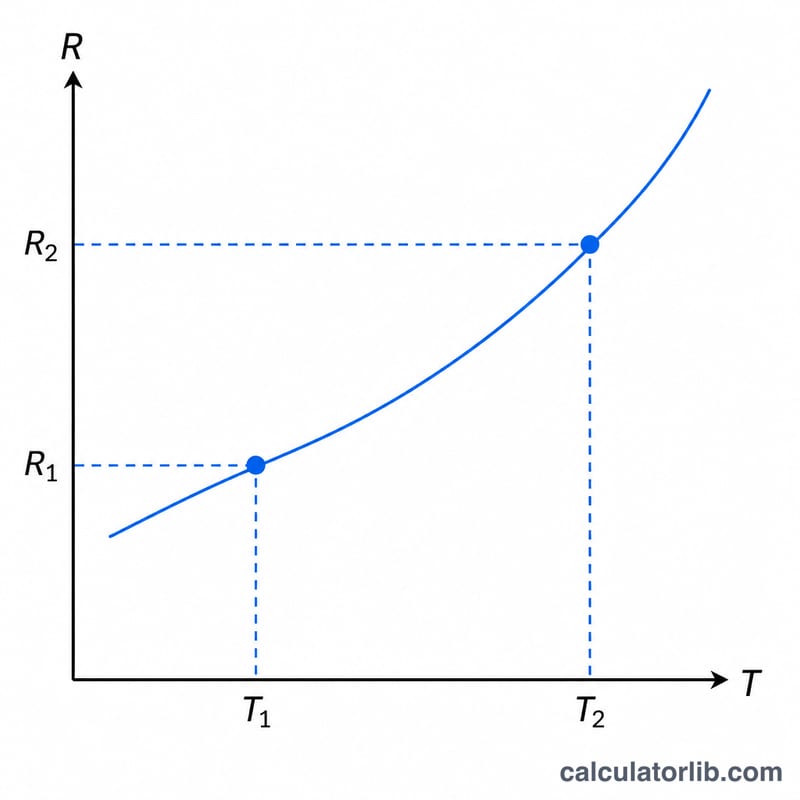
Enter the reaction rate R1 measured at temperature T1, then the rate R2 measured at temperature T2. Temperatures are entered in degrees Celsius. The calculator returns the Q10 value along with the rate ratio and the temperature difference so you can sanity-check your inputs.
The formula explained
The Q10 is defined as:
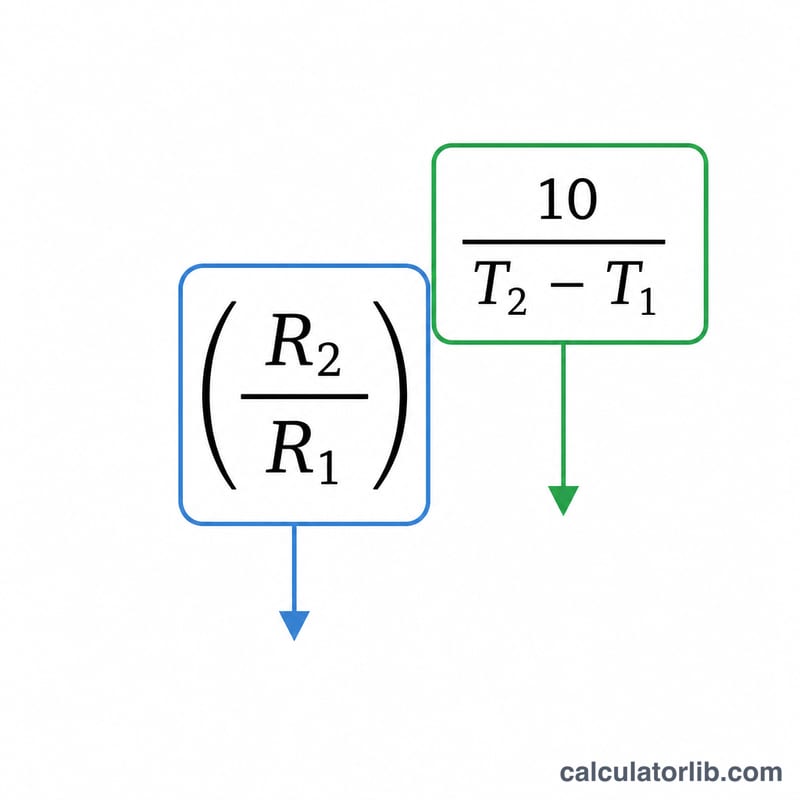
$$Q_{10} = \left(\dfrac{R_2}{R_1}\right)^{\frac{10}{T_2 - T_1}}$$
The ratio \(R_2/R_1\) captures how much faster (or slower) the process runs at the higher temperature, and the exponent \(10/(T_2-T_1)\) normalizes that change to a standard 10 °C interval. A Q10 of 1 means temperature has no effect; most biological processes fall between 2 and 3.
Worked example
Suppose an enzyme reaction proceeds at a rate of 1 unit at 20 °C and 2 units at 30 °C. The ratio is \(2/1 = 2\) and the temperature difference is \(30 - 20 = 10\). So $$Q_{10} = 2^{10/10} = 2^{1} = 2.$$ The reaction rate doubles per 10 °C.
FAQ
What does a Q10 of 2.5 mean? It means the process rate increases 2.5-fold for each 10 °C temperature rise.
Can Q10 be less than 1? Yes. If \(R_2\) is smaller than \(R_1\) (rate decreases with warming), Q10 will be below 1.
Does it matter if T2 is lower than T1? No — the formula still works, but the rates and temperatures must be paired correctly (\(R_1\) with \(T_1\), \(R_2\) with \(T_2\)). \(T_1\) and \(T_2\) must not be equal, or the exponent is undefined.