
What is the Langmuir Isotherm?
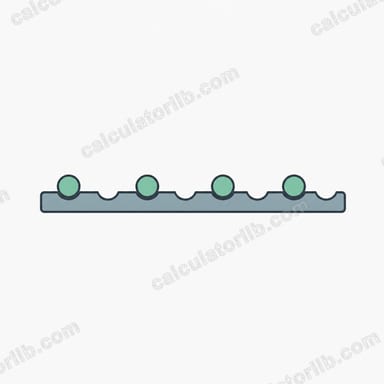
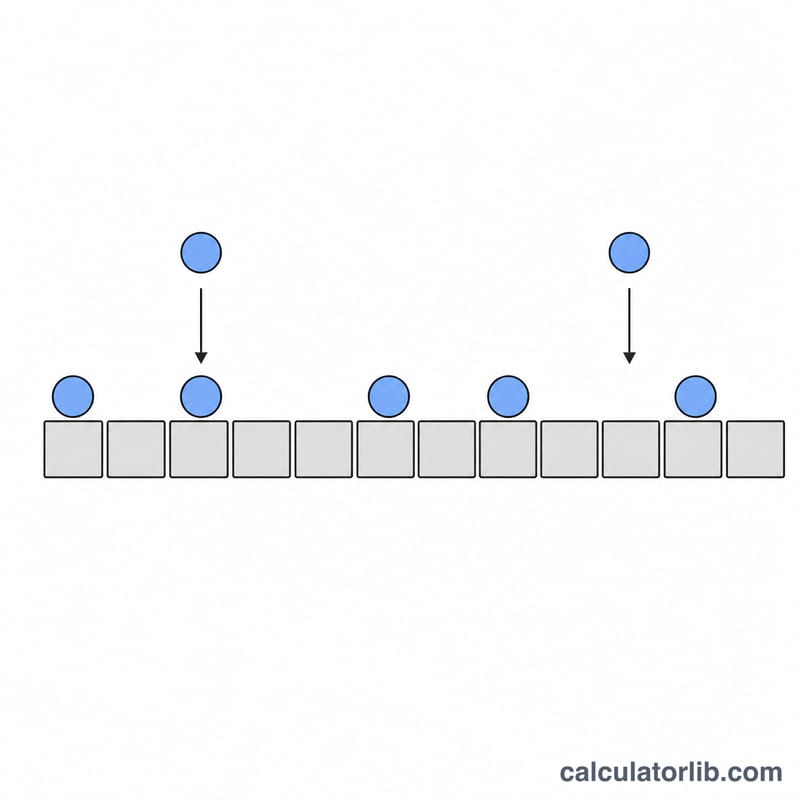
The Langmuir adsorption isotherm describes how gas molecules (or solutes) adsorb onto a solid surface that has a fixed number of identical adsorption sites. Proposed by Irving Langmuir in 1918, it assumes monolayer coverage, no interaction between adsorbed molecules, and equal energy for every site. The model gives the fractional surface coverage \(\theta\) — the fraction of available sites that are occupied at equilibrium.
How to Use This Calculator
Enter the adsorption equilibrium constant K (the ratio of adsorption to desorption rate constants, with units of inverse pressure or inverse concentration) and the partial pressure or concentration P. The calculator returns \(\theta\) as a value between 0 and 1, plus the same coverage expressed as a percentage of occupied sites.
The Formula Explained
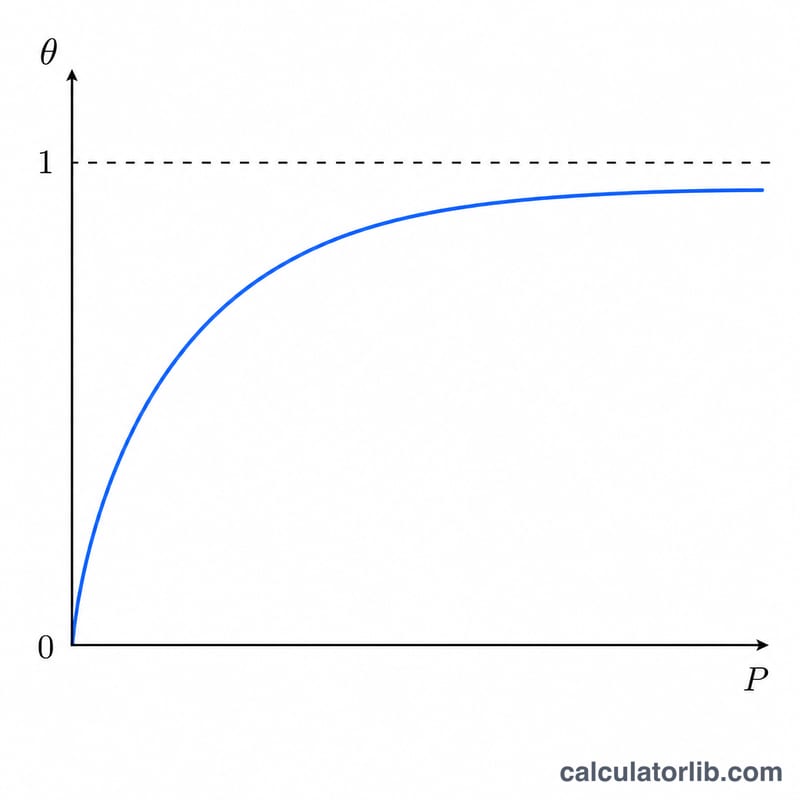
The Langmuir equation is $$\theta = \frac{K \cdot P}{1 + K \cdot P}$$ When \(K \cdot P\) is very small, \(\theta \approx K \cdot P\) and coverage rises almost linearly with pressure. When \(K \cdot P\) is very large, \(\theta\) approaches 1, meaning the surface saturates into a complete monolayer. The product \(K \cdot P\) is dimensionless, so the units of \(K\) must be the reciprocal of the units of \(P\).
Worked Example
Suppose \(K = 0.5 \text{ atm}^{-1}\) and \(P = 2 \text{ atm}\). Then \(K \cdot P = 1.0\), and $$\theta = \frac{1.0}{1 + 1.0} = 0.5$$ Exactly half of the surface sites are occupied — a 50% coverage.
FAQ
What does \(\theta = 1\) mean? It means the surface is fully saturated with a complete monolayer; no more sites are available.
What are the units of K? \(K\) has units that are the inverse of \(P\). If \(P\) is in atm, \(K\) is in atm⁻¹; if \(P\) is a molar concentration, \(K\) is in L/mol.
Can I use concentration instead of pressure? Yes. The Langmuir model applies equally to adsorption from solution; simply use concentration for \(P\) and an equilibrium constant with matching reciprocal units.