
What Is the Degree of Unsaturation?
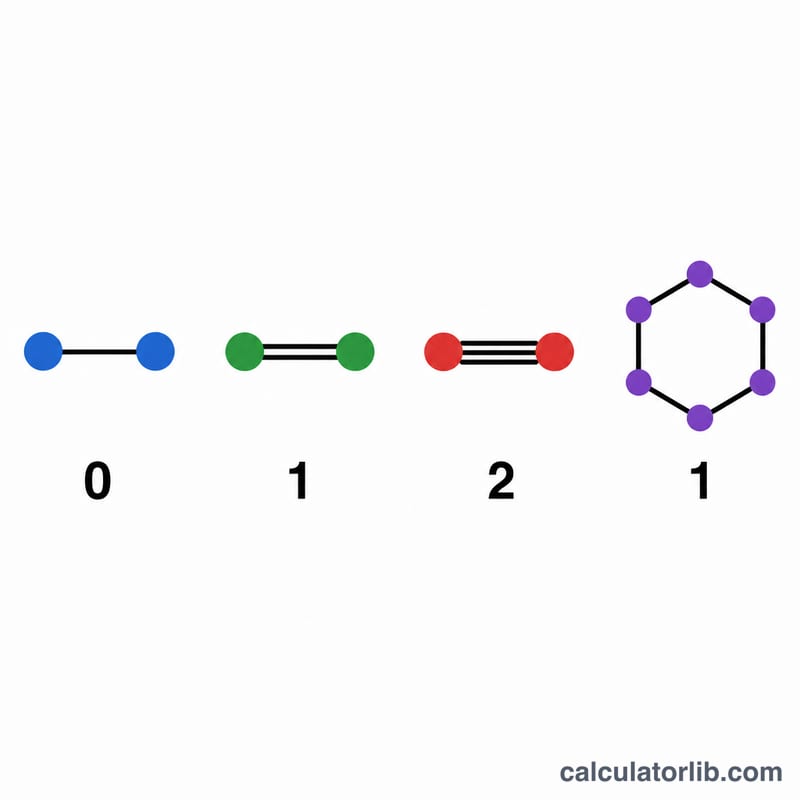
The degree of unsaturation (DoU), also called the index of hydrogen deficiency (IHD), tells you how many rings and pi (double or triple) bonds are present in a molecule based only on its molecular formula. Each unit of unsaturation corresponds to one ring or one pi bond — a double bond counts as 1, a triple bond as 2, and a ring as 1. It is one of the fastest sanity checks in organic structure elucidation.
How to Use This Calculator
Enter the number of carbon (C), hydrogen (H), nitrogen (N) and halogen (X = F, Cl, Br, I) atoms in the molecule. Oxygen, sulfur and other divalent atoms do not change the count, so you can simply ignore them. Press calculate to get the total number of rings plus pi bonds.
The Formula Explained
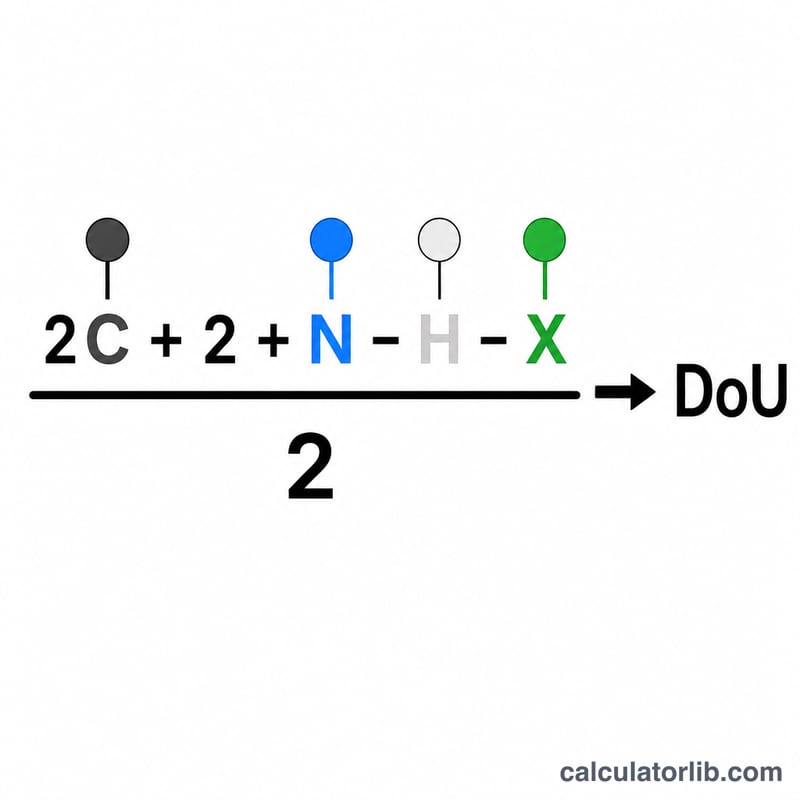
The general formula is:
$$\text{DoU} = \dfrac{2C + 2 + N - H - X}{2}$$
Monovalent halogens behave like extra hydrogens, so they are subtracted. Trivalent nitrogen adds one extra hydrogen-equivalent capacity, so it is added. Divalent oxygen and sulfur do not affect the saturation, so they are excluded entirely.
Worked Example
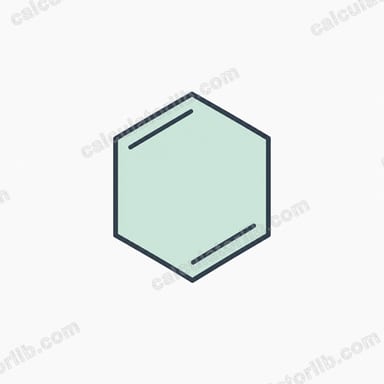
Benzene, C6H6: $$\text{DoU} = \frac{2\times 6 + 2 + 0 - 6 - 0}{2} = \frac{12 + 2 - 6}{2} = \frac{8}{2} = 4$$ This matches benzene's three double bonds plus one ring = 4 degrees of unsaturation.
FAQ
What does a result of 0 mean? A DoU of 0 means the molecule is fully saturated — no rings and no multiple bonds (e.g. an alkane like hexane).
Why doesn't oxygen appear? Oxygen is divalent and inserts into a chain without changing the hydrogen count, so it has no effect on the degree of unsaturation.
Can I get a fractional result? A non-integer answer usually signals a typo in the formula or an odd-electron species; for normal neutral molecules the DoU should be a whole number.