
What is the Stokes–Einstein diffusion coefficient?
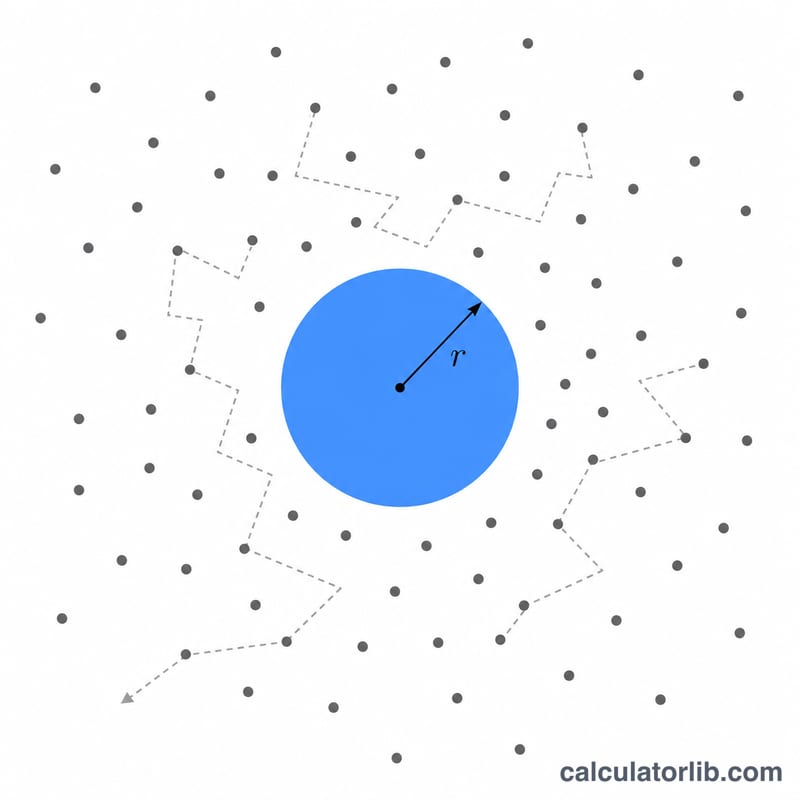
The diffusion coefficient (\(D\)) quantifies how quickly particles spread out through a fluid due to random Brownian motion. For a small spherical particle suspended in a liquid, the Stokes–Einstein equation links \(D\) to the temperature, the fluid's viscosity, and the particle's radius. It is widely used in physical chemistry, colloid science, biophysics, and pharmaceutics — for example to estimate how fast proteins, nanoparticles, or drug molecules migrate.
How to use this calculator
Enter three values: the absolute temperature in kelvin (K), the dynamic viscosity of the surrounding fluid in pascal-seconds (Pa·s), and the hydrodynamic radius of the particle in meters (m). The calculator returns \(D\) in square meters per second (m²/s). Water at 25 °C has a viscosity of about 0.00089 Pa·s; room temperature is 298.15 K.
The formula explained
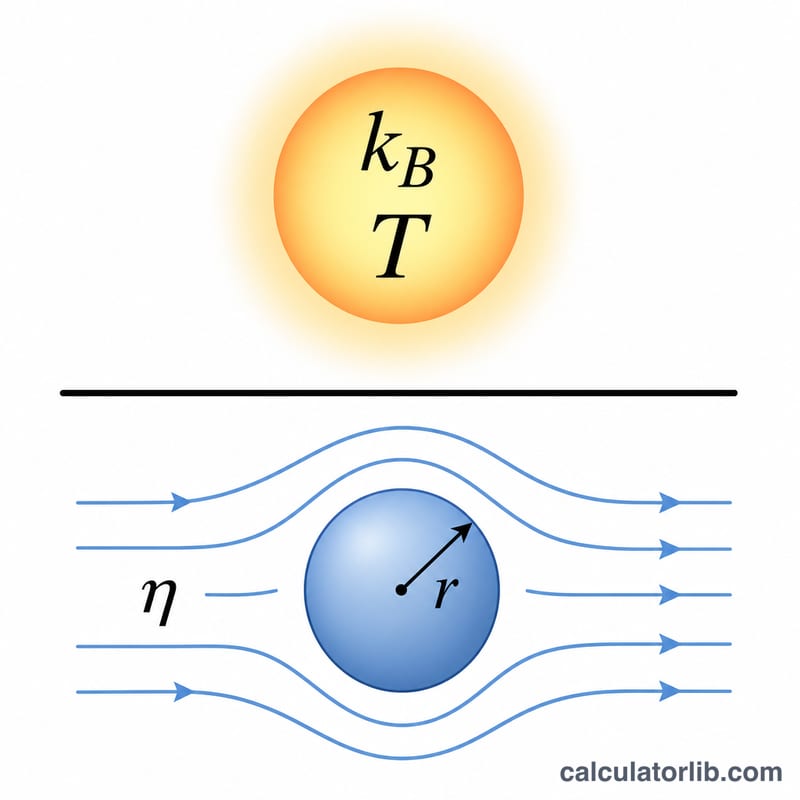
The equation is $$D = \dfrac{k_B \, T}{6 \pi \eta r}$$ where \(k_B = 1.380649 \times 10^{-23}\ \text{J/K}\) is the Boltzmann constant, \(T\) is absolute temperature, \(\eta\) is dynamic viscosity, and \(r\) is the particle radius. The denominator \(6 \pi \eta r\) is the Stokes drag coefficient for a sphere. Higher temperature increases diffusion, while higher viscosity or larger radius reduces it.
Worked example
For a 1 nm radius particle (\(r = 1 \times 10^{-9}\ \text{m}\)) in water at 25 °C (\(T = 298.15\ \text{K}\), \(\eta = 0.00089\ \text{Pa}\cdot\text{s}\)): the denominator is $$6 \times \pi \times 0.00089 \times 10^{-9} \approx 1.6776 \times 10^{-11}.$$ The numerator is $$1.380649 \times 10^{-23} \times 298.15 \approx 4.1164 \times 10^{-21}.$$ Therefore $$D \approx 2.45 \times 10^{-10}\ \text{m}^2/\text{s}.$$
FAQ
What units should I use? SI units: kelvin, pascal-seconds, and meters. The result is then in m²/s.
Does this assume a sphere? Yes — the \(6 \pi \eta r\) term is the Stokes drag for a smooth rigid sphere; for non-spherical particles use the effective hydrodynamic radius.
Is this valid for gases? The Stokes–Einstein relation is best suited to particles much larger than solvent molecules in a continuous liquid; for dilute gases other models apply.