
What Is the Boiling Point at Altitude Calculator?
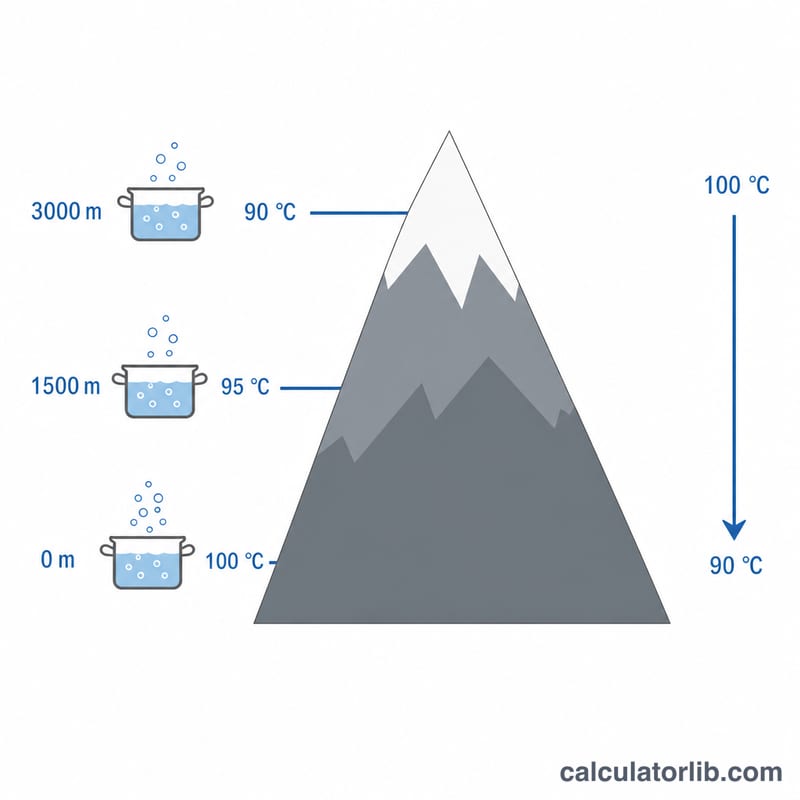
Water boils at 100 °C (212 °F) only at sea level. As you climb higher, atmospheric pressure drops, and so does the temperature at which water boils. This calculator gives you a quick, approximate boiling point for any elevation using a simple linear rule of thumb. It works anywhere in the world — the physics of pressure and boiling is universal.
How to Use It
Enter your altitude in meters above sea level and read off the estimated boiling point in both Celsius and Fahrenheit. For reference, 1,000 m is roughly 3,280 ft, and many mountain towns sit between 1,500 m and 3,000 m.
The Formula Explained
The approximation used is:
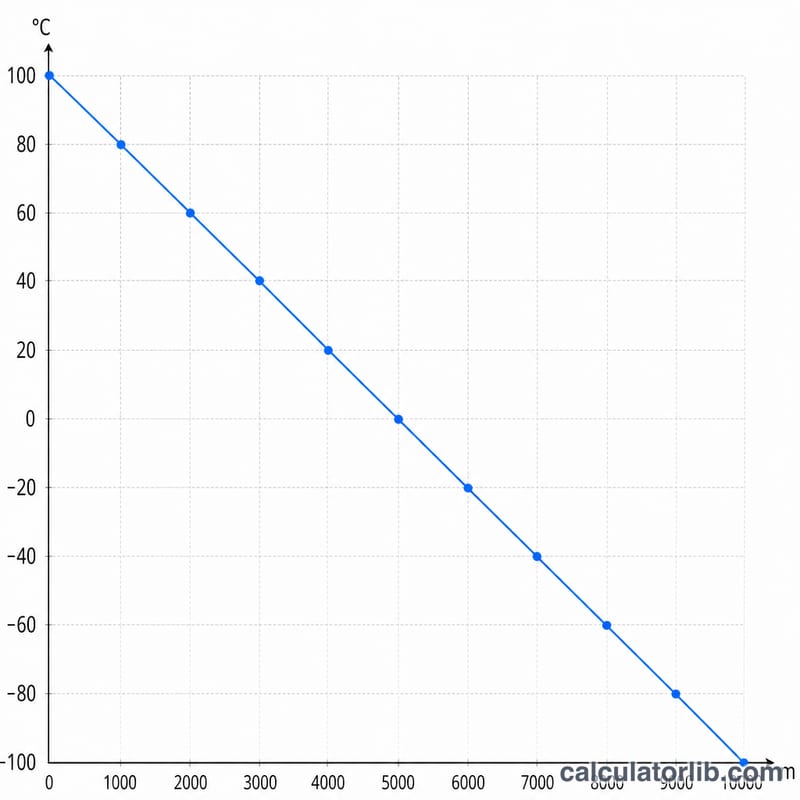
$$T_b \approx 100 - \frac{\text{altitude}_m}{285}\ \degree C$$This says that for roughly every 285 meters of elevation gain, the boiling point of water drops by about 1 °C. It is a linear simplification of the more complex Clausius–Clapeyron relationship, accurate enough for cooking and everyday estimates up to a few thousand meters.
Worked Example
Suppose you are in Denver, Colorado at about 1,600 meters. Plugging in:
$$100 - \frac{1600}{285} = 100 - 5.61 = 94.39\ \degree C$$(about 201.9 °F). That is why high-altitude cooking takes longer — the water simply isn't as hot.
FAQ
Why does water boil at a lower temperature higher up? Boiling happens when vapor pressure equals the surrounding air pressure. Higher altitude means lower air pressure, so water reaches that point at a cooler temperature.
How accurate is this estimate? It is an approximation good for most practical purposes below ~4,000 m. Exact values depend on weather and humidity.
Does this affect cooking? Yes. Lower boiling temperatures mean foods like pasta, eggs, and beans need longer cooking times at altitude.