
What is the Electrolysis Calculator?
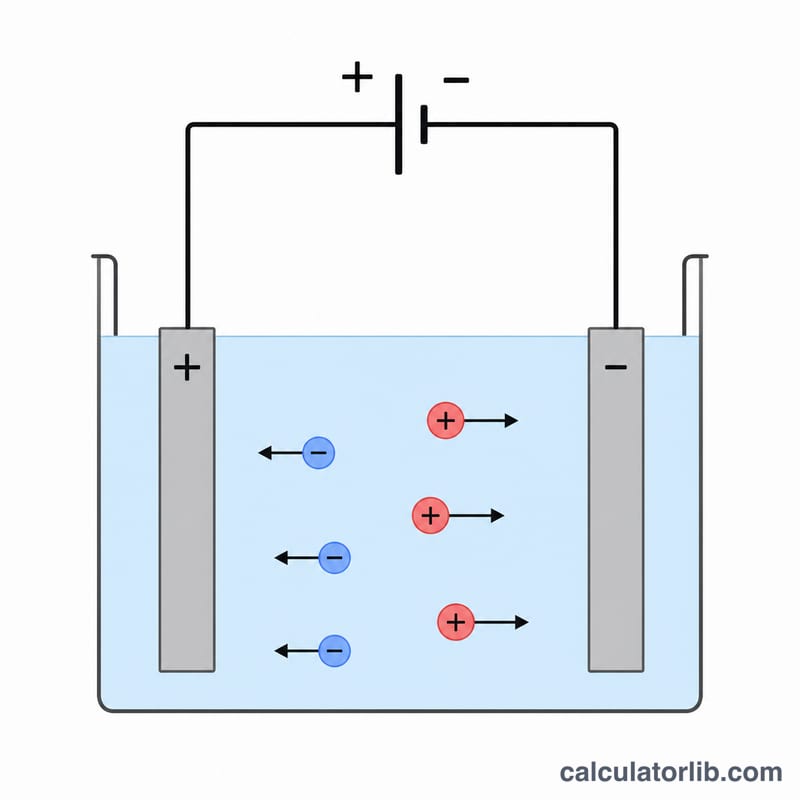
This calculator applies Faraday's first law of electrolysis to find how much of a substance is deposited at an electrode (or liberated as gas) when an electric current is passed through an electrolyte. It is a universal physics/chemistry tool based on fundamental constants, so it applies anywhere.
How to use it
Enter the current in amperes, the time in seconds, the molar mass of the substance in grams per mole, and the number of electrons (n) transferred per ion (for example, \(n = 2\) for Cu²⁺, \(n = 1\) for Ag⁺, \(n = 3\) for Al³⁺). The calculator returns the deposited mass in grams, the total charge passed, and the moles of substance produced.
The formula explained
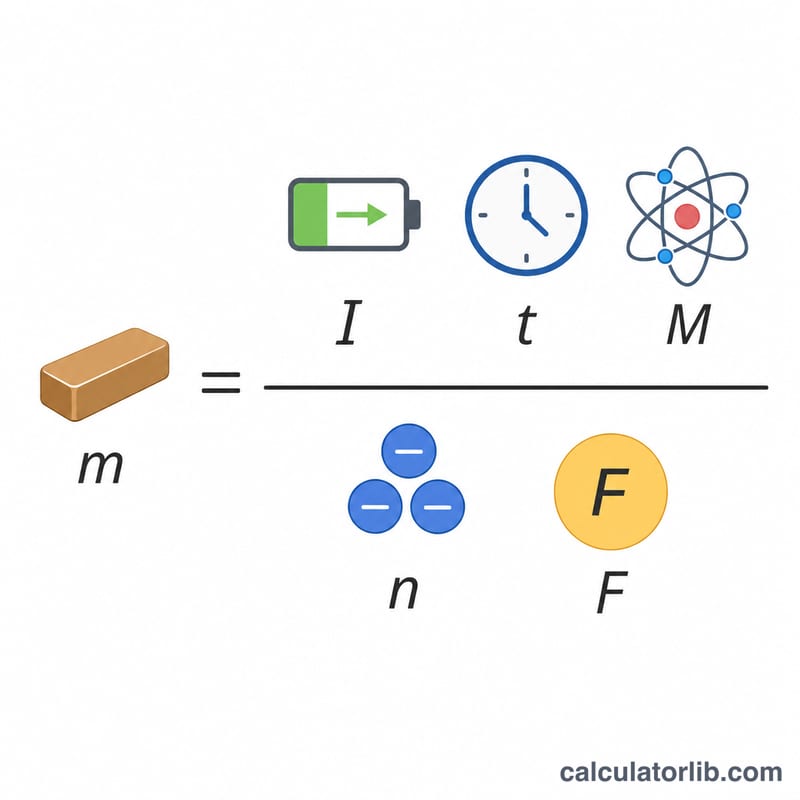
The deposited mass is given by:
$$m = \frac{I \cdot t \cdot M}{n \cdot F}$$
Here \(Q = I \cdot t\) is the total charge in coulombs. Dividing by \(n \cdot F\) (where \(F = 96485 \ \text{C/mol}\) is the Faraday constant) gives the moles of substance, and multiplying by molar mass \(M\) converts moles to grams. The product \(n \cdot F\) represents the charge needed to deposit one mole of substance.
Worked example
Suppose a current of 2 A flows for 1 hour (3600 s) through a copper sulfate solution. Copper has \(M = 63.55 \ \text{g/mol}\) and \(n = 2\). Charge \(Q = 2 \times 3600 = 7200 \ \text{C}\). Mass $$m = \frac{7200 \times 63.55}{2 \times 96485} = \frac{457560}{192970} \approx 2.371 \ \text{g}$$ of copper deposited.
FAQ
What is n? It is the number of electrons exchanged per ion in the electrode reaction — equal to the magnitude of the ion's charge.
Why is F = 96485? The Faraday constant is the charge of one mole of electrons (≈ 96485 coulombs per mole).
Can I use minutes instead of seconds? No — convert time to seconds first (multiply minutes by 60, hours by 3600).