
What Is Boiling Point Elevation?
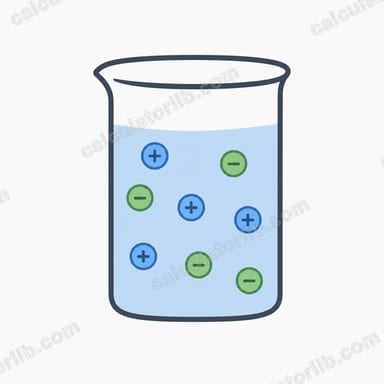
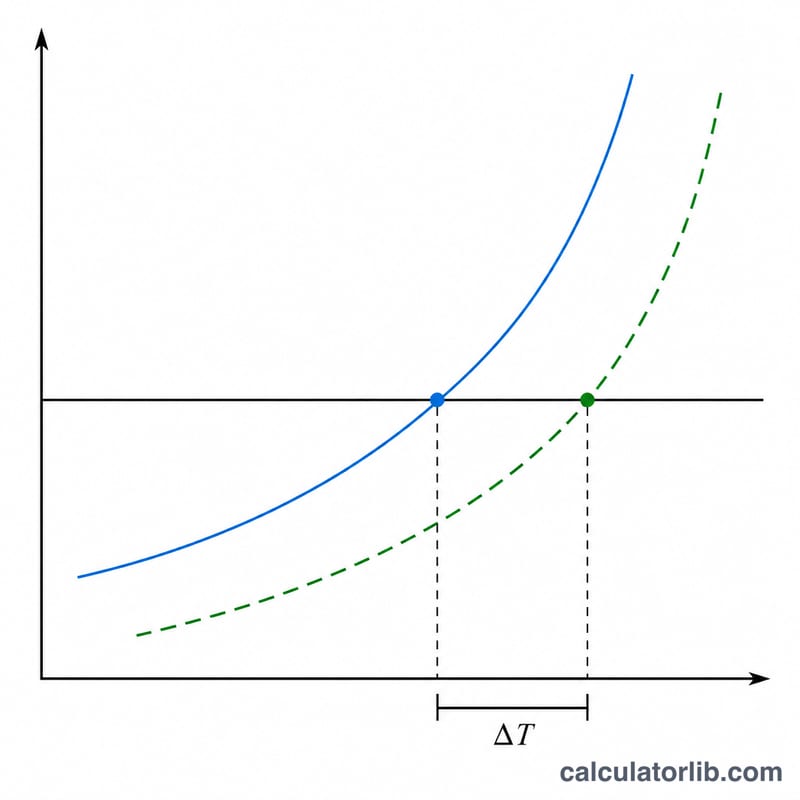
Boiling point elevation is a colligative property: when a non-volatile solute is dissolved in a solvent, the boiling point of the resulting solution rises above that of the pure solvent. The size of the increase depends only on how many solute particles are present, not on their chemical identity. This calculator computes the elevation, \(\Delta T_b\), and optionally the new boiling point of the solution.
How to Use This Calculator
Enter three values: the van't Hoff factor (\(i\)), the ebullioscopic constant of the solvent (\(K_b\), in °C·kg/mol), and the molality of the solution (\(m\), in mol/kg). Optionally enter the solvent's normal boiling point to get the elevated boiling point. For water, \(K_b \approx 0.512\) °C·kg/mol and the normal boiling point is 100 °C.
The Formula Explained
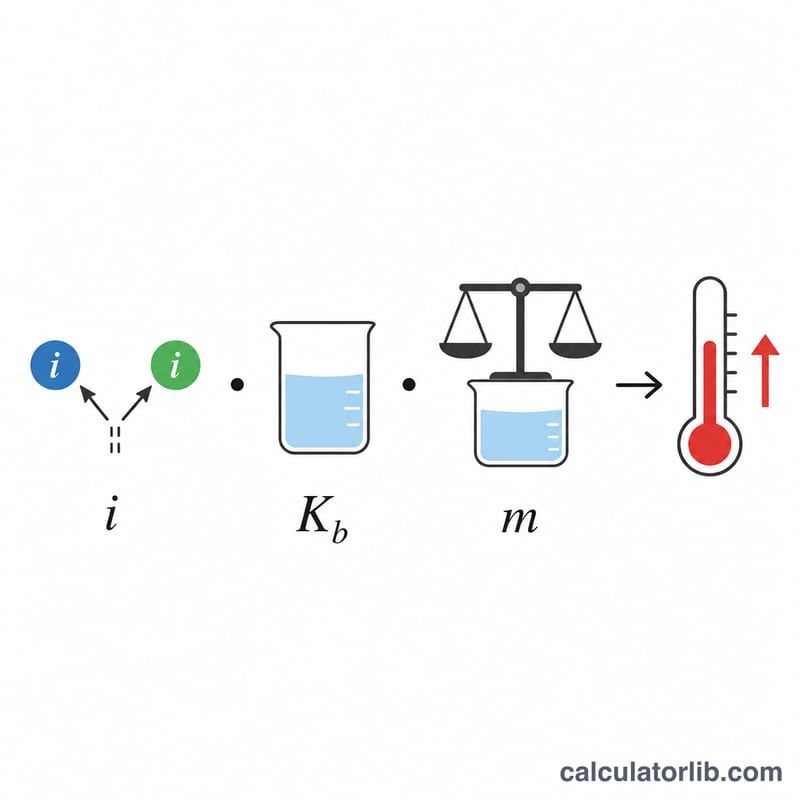
The relationship is $$\Delta T_b = i \cdot K_b \cdot m$$ Here \(i\) is the van't Hoff factor — the number of dissolved particles each formula unit produces (1 for sugar, ~2 for NaCl, ~3 for CaCl₂). \(K_b\) is a property of the solvent. \(m\) is molality, moles of solute per kilogram of solvent. The new boiling point is simply $$T_b = T_b^{0} + \Delta T_b$$
Worked Example
Dissolve 1 mol of NaCl in 1 kg of water (\(m = 1\) mol/kg). NaCl dissociates into Na⁺ and Cl⁻, so \(i \approx 2\). With \(K_b = 0.512\): $$\Delta T_b = 2 \times 0.512 \times 1 = 1.024 \text{ °C}$$ The solution boils at about \(100 + 1.024 = 101.024\) °C.
Ebullioscopic Constants (Kb) and Boiling Points of Common Solvents
The ebullioscopic constant \(K_b\) is a property of the solvent that relates the molality of a solution to its boiling point elevation through \(\Delta T_b = i \cdot K_b \cdot m\). Larger \(K_b\) values mean a solvent's boiling point rises more steeply per mole of dissolved particles. The table below lists \(K_b\) (in °C·kg/mol) and the normal boiling point (at 1 atm) for common laboratory solvents.
| Solvent | Kb (°C·kg/mol) | Normal boiling point (°C) |
|---|---|---|
| Water | 0.512 | 100 |
| Benzene | 2.53 | 80.1 |
| Chloroform | 3.63 | 61.2 |
| Ethanol | 1.22 | 78.4 |
| Acetic acid | 3.07 | 118.1 |
| Carbon tetrachloride | 4.95 | 76.7 |
| Diethyl ether | 2.02 | 34.5 |
| Camphor | 5.95 | 207.4 |
| Cyclohexane | 2.79 | 80.7 |
Note that \(K_b\) values vary slightly between literature sources depending on the reference temperature and measurement method; use the value supplied with your specific data set when high precision is required.
Typical van't Hoff Factors for Common Solutes
The van't Hoff factor \(i\) accounts for the number of dissolved particles each formula unit produces in solution. Non-electrolytes such as sugars do not dissociate, so \(i \approx 1\). Ionic compounds dissociate into ions, giving an ideal \(i\) equal to the number of ions. In real solutions ion pairing reduces the effective value below the ideal, so the observed \(i\) is often lower, especially for multiply charged ions.
| Solute | Formula | Ions produced | Ideal i | Approx. observed i (dilute) |
|---|---|---|---|---|
| Sucrose | C₁₂H₂₂O₁₁ | none (non-electrolyte) | 1 | 1 |
| Glucose | C₆H₁₂O₆ | none (non-electrolyte) | 1 | 1 |
| Sodium chloride | NaCl | Na⁺ + Cl⁻ | 2 | ~1.9 |
| Potassium chloride | KCl | K⁺ + Cl⁻ | 2 | ~1.9 |
| Calcium chloride | CaCl₂ | Ca²⁺ + 2 Cl⁻ | 3 | ~2.7 |
| Magnesium sulfate | MgSO₄ | Mg²⁺ + SO₄²⁻ | 2 | ~1.3 |
| Sodium sulfate | Na₂SO₄ | 2 Na⁺ + SO₄²⁻ | 3 | ~2.5 |
| Aluminum chloride | AlCl₃ | Al³⁺ + 3 Cl⁻ | 4 | ~3 (varies) |
| Acetic acid | CH₃COOH | weak electrolyte (partial) | 1–2 | slightly >1 |
Use the ideal \(i\) for quick estimates and the observed value when matching experimental data. The strong divergence of MgSO₄ from its ideal value of 2 reflects extensive ion pairing between the doubly charged ions.
FAQ
What is the van't Hoff factor? It is the effective number of particles a solute releases per formula unit when dissolved. Non-electrolytes like sugar use \(i = 1\); ionic compounds use the number of ions (with corrections for ion pairing at high concentration).
What units does molality use? Molality is moles of solute per kilogram of solvent (mol/kg), not per liter — it does not change with temperature.
What is \(K_b\) for common solvents? Water 0.512, benzene 2.53, chloroform 3.63, and ethanol 1.22 °C·kg/mol.