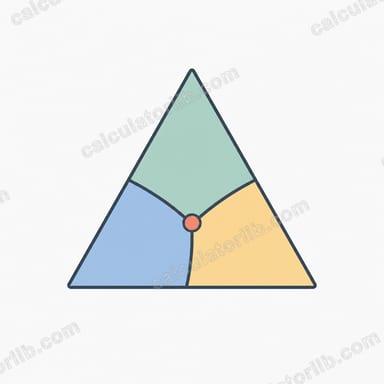

What Is Gibbs' Phase Rule?
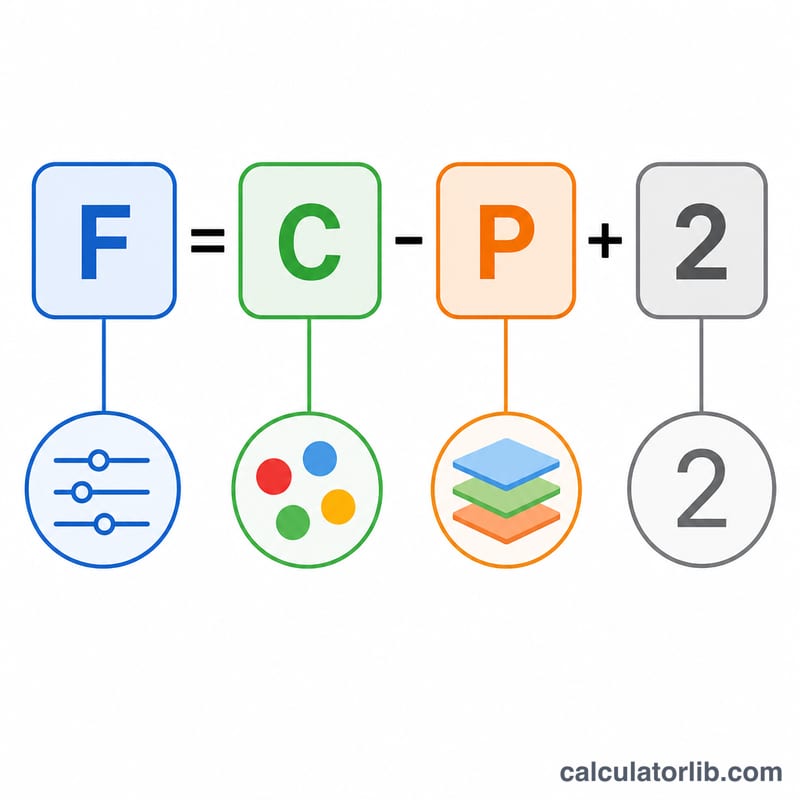
Gibbs' phase rule is a fundamental relationship in physical chemistry and thermodynamics that determines the number of independent intensive variables (degrees of freedom) you can change without altering the number of phases in a system at equilibrium. It is expressed as $$F = C - P + 2$$, where F is the degrees of freedom, C is the number of chemical components, and P is the number of phases present. The "+2" accounts for the two intensive variables temperature and pressure.
How to Use This Calculator
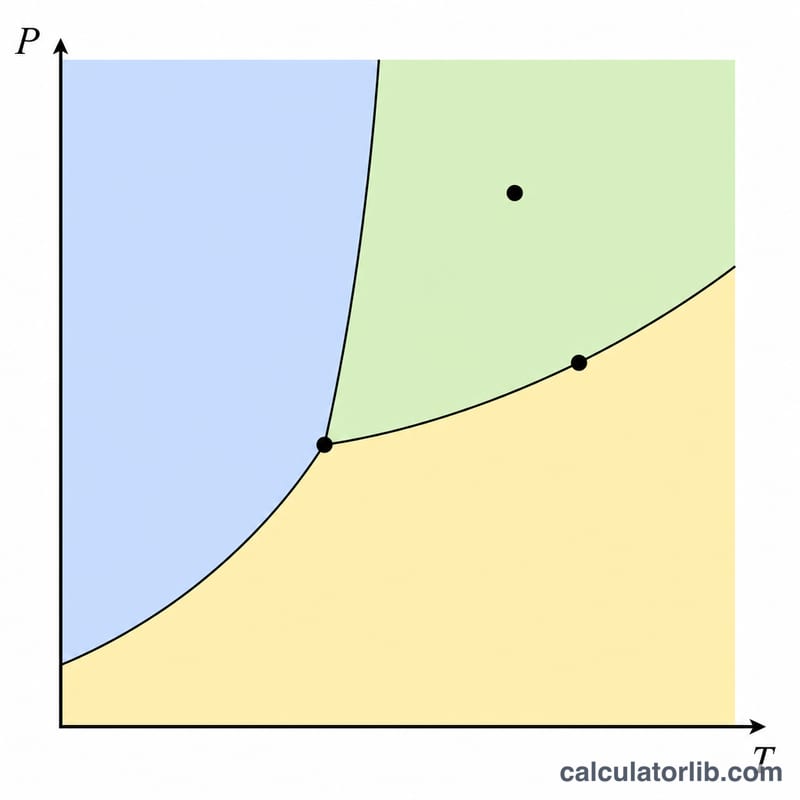
Enter the number of components (C) — the minimum number of independent chemical species needed to define every phase — and the number of phases (P) such as solid, liquid, gas, or distinct solid structures. The calculator instantly returns F, the degrees of freedom. A value of \(F = 0\) means the system is invariant (fixed at a single point, like a triple point), \(F = 1\) is univariant, and \(F = 2\) is bivariant.
The Formula Explained
Each phase contributes constraints through equilibrium between phases, while each component and the two state variables (T and P) add freedom. Subtracting phases from components and adding 2 gives the net count of variables you may independently vary. If pressure is held constant (the condensed/reduced phase rule), the formula becomes $$F = C - P + 1.$$
Worked Example
Consider pure water at its triple point. Here C = 1 (water only) and P = 3 (ice, liquid water, and vapor coexisting). Then $$F = 1 - 3 + 2 = 0,$$ meaning the triple point is invariant — it exists only at one exact temperature and pressure. For liquid water alone (C = 1, P = 1), $$F = 1 - 1 + 2 = 2,$$ so both temperature and pressure can vary freely.
FAQ
Why the "+2"? It represents the two intensive state variables, temperature and pressure, that influence phase equilibrium.
Can F be negative? No. A negative result indicates an impossible (over-constrained) combination of components and phases that cannot coexist at equilibrium.
What if pressure is fixed? Use the reduced phase rule \(F = C - P + 1\), common in metallurgy and condensed-phase systems.