
What is the Rate of Effusion Calculator?
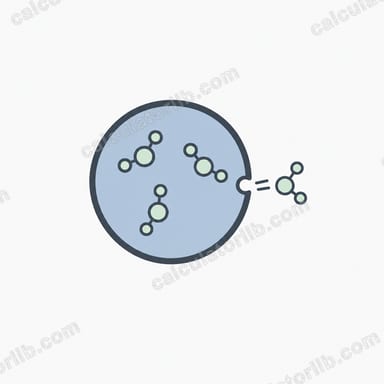
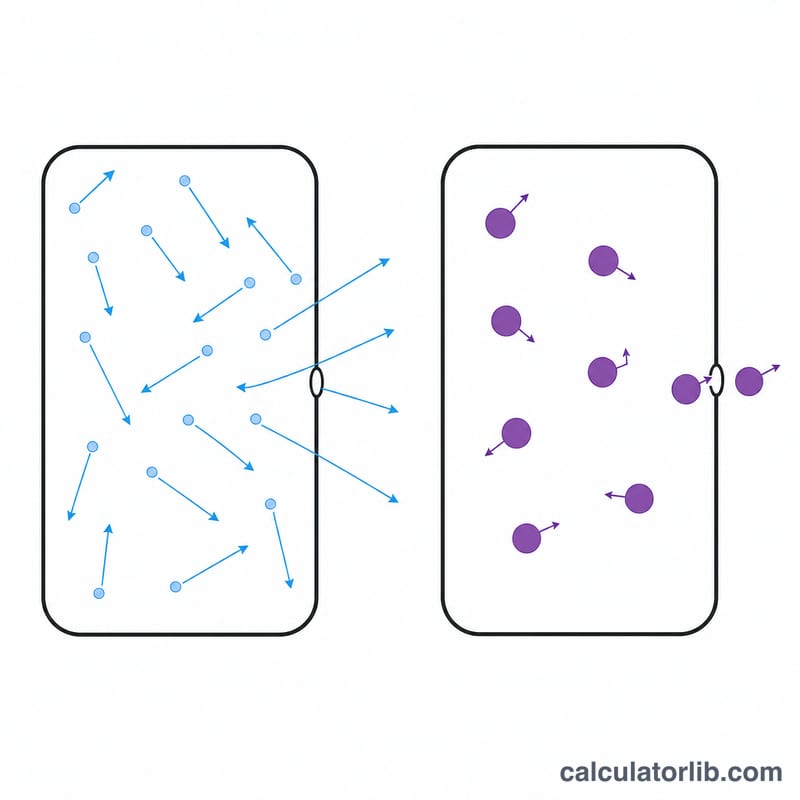
Effusion is the process by which gas molecules escape through a tiny opening into a vacuum. Graham's Law states that lighter gases effuse faster than heavier ones — the rate of effusion is inversely proportional to the square root of a gas's molar mass. This calculator applies Graham's Law to find the effusion rate of one gas (gas 1) when you know the rate of a reference gas (gas 2) and the molar masses of both.
How to use it
Enter the known effusion rate of gas 2 (rate₂), the molar mass of gas 1 (M₁), and the molar mass of gas 2 (M₂), both in g/mol. The calculator returns rate₁ in the same units as rate₂, plus the dimensionless rate ratio rate₁/rate₂.
The formula explained
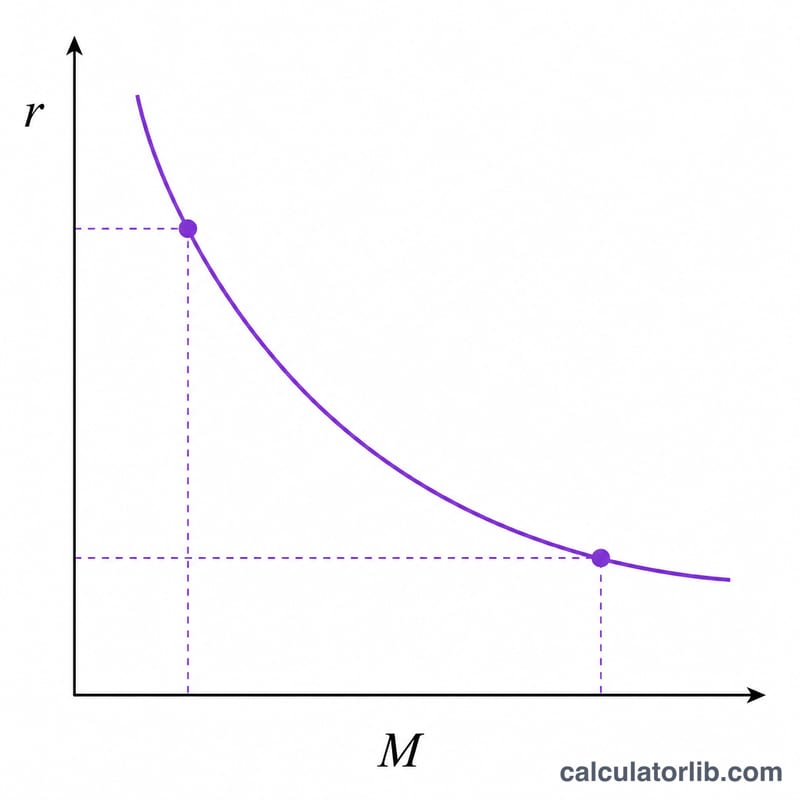
Graham's Law is written as $$\frac{r_1}{r_2} = \sqrt{\frac{M_2}{M_1}}$$ Notice the molar masses are swapped relative to the rates — the lighter gas (smaller M) has the higher rate. Rearranged to solve for the unknown: $$r_1 = r_2 \times \sqrt{\frac{M_2}{M_1}}$$ If \(M_1 < M_2\) then the square root exceeds 1 and gas 1 effuses faster than gas 2.
Worked example
Compare helium (\(M_1 = 4.0026\) g/mol) to oxygen (\(M_2 = 31.998\) g/mol) where oxygen effuses at \(r_2 = 1\). Then $$r_1 = 1 \times \sqrt{\frac{31.998}{4.0026}} = \sqrt{7.994} \approx 2.827$$ Helium effuses about 2.83 times faster than oxygen — consistent with its much smaller molar mass.
FAQ
Is effusion the same as diffusion? They are related; Graham's Law applies to both as an approximation, but strictly it describes effusion through a small orifice.
What units should rate₂ be in? Any consistent rate units (mol/s, volume/time, or even a relative value of 1). rate₁ is returned in the same units.
Why are molar masses inverted? Lighter molecules move faster at the same temperature (equal average kinetic energy), so a smaller M₁ produces a larger rate.