
What is the Young-Laplace equation?
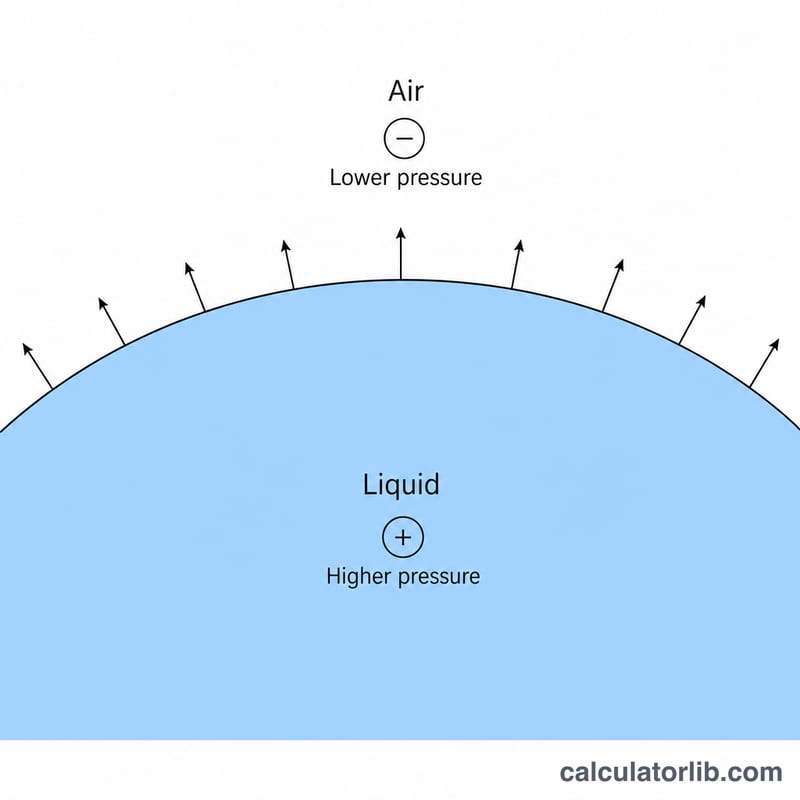
The Young-Laplace equation describes the pressure difference (\(\Delta P\)) sustained across the interface between two static fluids — for example air and water — that is caused by surface tension. A curved interface, like the surface of a droplet or a bubble, pushes back on the fluid inside it, raising the internal pressure above the surrounding pressure. This calculator computes that pressure jump from the surface tension \(\gamma\) and the curvature of the surface.
How to use this calculator
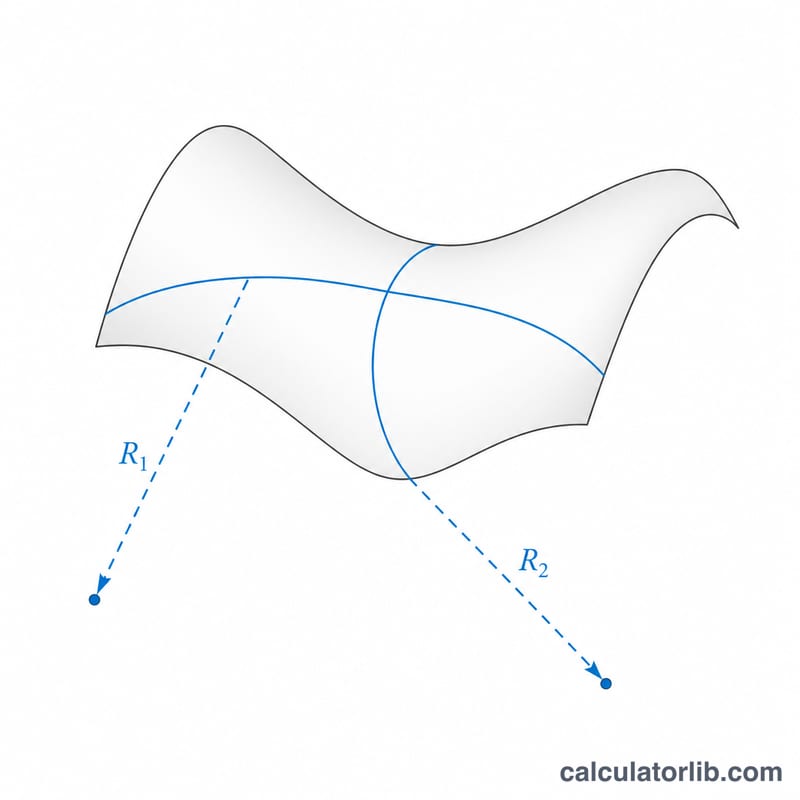
Choose the surface geometry. For a sphere or a spherical droplet, enter the surface tension \(\gamma\) (in newtons per metre) and the single radius \(R\). For a general surface, enter both principal radii of curvature \(R_1\) and \(R_2\). The calculator returns \(\Delta P\) in pascals, kilopascals and millimetres of mercury. Use SI units throughout: radii in metres and surface tension in N/m (equivalently J/m²).
The formula explained
For a general surface the pressure jump is $$\Delta P = \gamma \left( \frac{1}{R_1} + \frac{1}{R_2} \right)$$ The term \(\left( \frac{1}{R_1} + \frac{1}{R_2} \right)\) is twice the mean curvature of the surface. A small radius means high curvature and therefore a large pressure difference, which is why tiny droplets and bubbles have high internal pressures. For a sphere both radii are equal, so the equation simplifies to $$\Delta P = \frac{2\gamma}{R}$$
Worked example
Consider a water droplet of radius \(R = 0.001 \text{ m}\) (1 mm) with surface tension \(\gamma = 0.0728 \text{ N/m}\) at room temperature. Using the sphere formula, $$\Delta P = \frac{2 \times 0.0728}{0.001} = 145.6 \text{ Pa}$$ So the pressure inside the droplet is about 146 Pa higher than the surrounding air.
FAQ
Why is there a factor of 2 for a sphere? A sphere has the same radius in every direction, so \(\frac{1}{R_1} + \frac{1}{R_2} = \frac{2}{R}\).
Does this work for a soap bubble? A soap bubble has two interfaces (inside and outside), so its pressure jump is double: \(\Delta P = \frac{4\gamma}{R}\). Enter half the radius or multiply the sphere result by 2 to account for the extra surface.
What units should I use? Use metres for radii and N/m for surface tension to get the answer in pascals.