
What Is the Double Bond Equivalent?
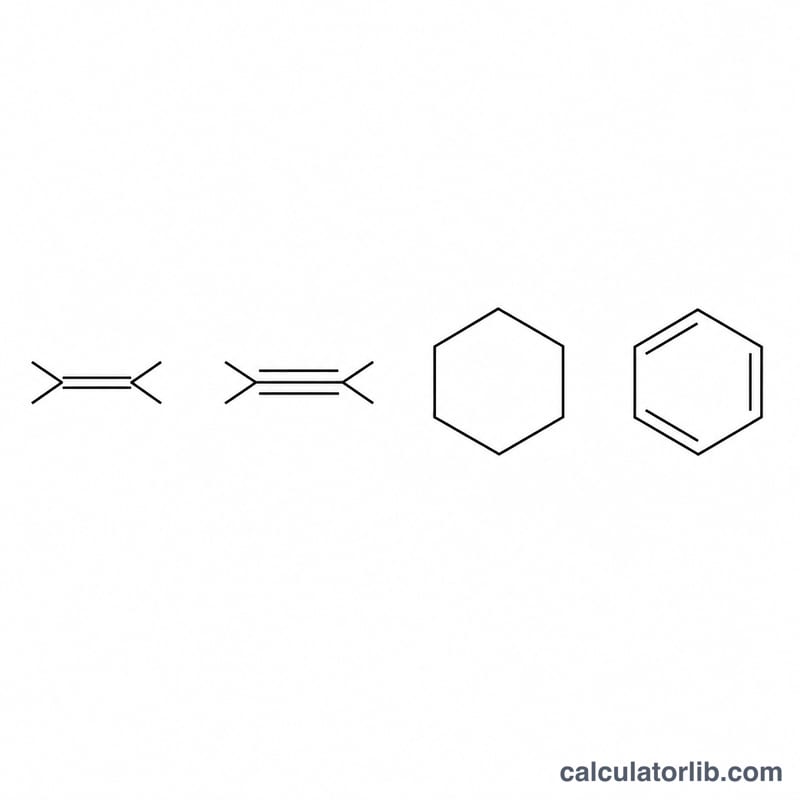
The Double Bond Equivalent (DBE), also called the degree of unsaturation or index of hydrogen deficiency (IHD), tells you how many rings and π bonds are present in a molecule. Each DBE unit represents one ring or one double bond; a triple bond counts as two. It is a quick sanity check used in organic chemistry and mass spectrometry to narrow down possible structures from a molecular formula.
How to Use This Calculator
Enter the number of carbon atoms (C), the total of hydrogen plus monovalent halogen atoms (H + F + Cl + Br + I), and the number of nitrogen atoms (N). Divalent atoms such as oxygen and sulfur do not affect the count, so you can ignore them. Click calculate to get the DBE value.
The Formula Explained
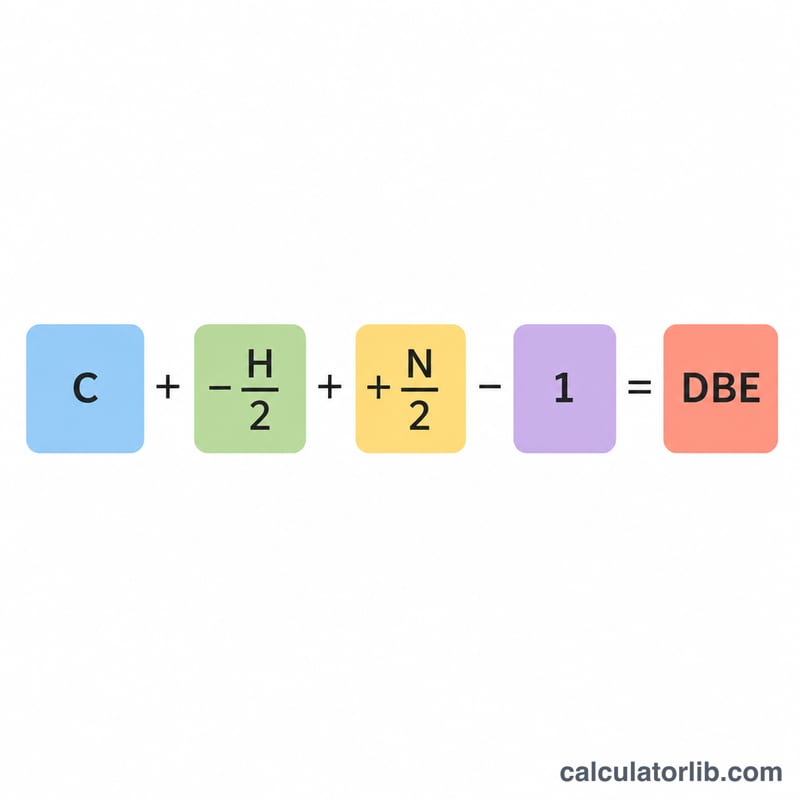
The calculator uses:
$$\text{DBE} = C - \frac{H}{2} + \frac{N}{2} + 1$$
Carbon (tetravalent) and nitrogen (trivalent) add unsaturation potential, while hydrogen and halogens (monovalent) reduce it. A result of 0 indicates a fully saturated, acyclic molecule. Non-integer or negative results usually mean the formula is wrong or contains atoms with unusual valences.
Worked Example
Take benzene, C₆H₆. With \(C = 6\), \(H = 6\), \(N = 0\): $$\text{DBE} = 6 - \frac{6}{2} + \frac{0}{2} + 1 = 6 - 3 + 1 = 4$$ That correctly reflects benzene's three double bonds plus one ring = 4 degrees of unsaturation.
FAQ
Do I include oxygen and sulfur? No. Divalent atoms (O, S) do not change the DBE, so leave them out.
How are halogens handled? Count halogens (F, Cl, Br, I) together with hydrogen, since they are monovalent.
What does a fractional DBE mean? A half-integer result indicates an odd electron count (a radical or ion) or an error in the formula. Neutral closed-shell molecules give whole numbers.