
What Is the Michaelis-Menten Equation?
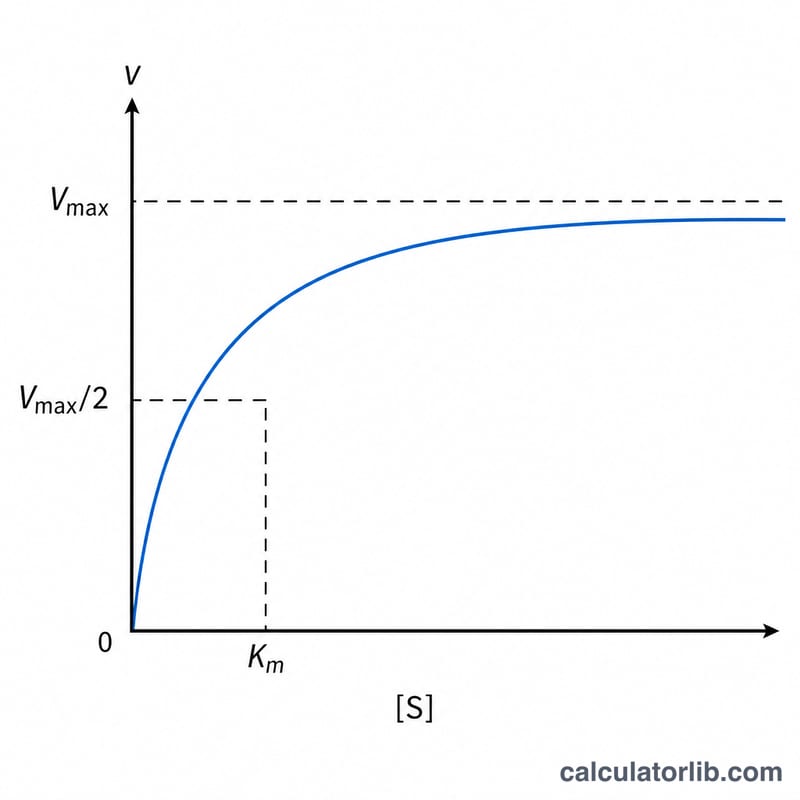
The Michaelis-Menten equation is the cornerstone of enzyme kinetics. It describes how the rate (velocity) of an enzyme-catalyzed reaction depends on the concentration of substrate. As substrate concentration rises, the reaction speeds up until the enzyme becomes saturated and the rate approaches a maximum, called Vmax. This calculator computes the reaction velocity v for any combination of Vmax, the Michaelis constant Km, and substrate concentration [S].
How to Use This Calculator
Enter three values: Vmax (the maximum reaction rate when the enzyme is fully saturated), Km (the substrate concentration at which the reaction runs at half of Vmax), and [S] (the current substrate concentration). The calculator returns the velocity v, the percent of Vmax achieved, and the denominator \(K_m + [S]\). Use consistent units — for example, Vmax in µmol/min and Km and [S] in mM.
The Formula Explained
The equation is $$v = \frac{V_{max} \cdot [S]}{K_m + [S]}$$ When [S] equals Km, the term simplifies to \(V_{max}/2\), which is exactly why Km is defined as the half-saturation constant. A small Km means the enzyme reaches high velocity at low substrate concentrations (high affinity), while a large Km indicates lower affinity. At very high [S], the [S] terms dominate and v approaches Vmax.
Worked Example
Suppose Vmax = 100 µmol/min, Km = 5 mM, and [S] = 10 mM. Then $$v = \frac{100 \times 10}{5 + 10} = \frac{1000}{15} \approx 66.67 \text{ µmol/min}$$ which is about 66.67% of Vmax. Notice the reaction has not yet reached its maximum because the enzyme is not fully saturated.
FAQ
What does Km represent? Km is the substrate concentration at which the reaction velocity is half of Vmax. It is a measure of the enzyme's affinity for its substrate.
Can v ever exceed Vmax? No. The equation asymptotically approaches Vmax as [S] increases, but never exceeds it.
What units should I use? Any units are fine as long as Km and [S] share the same units; v will then carry the same units as Vmax.